
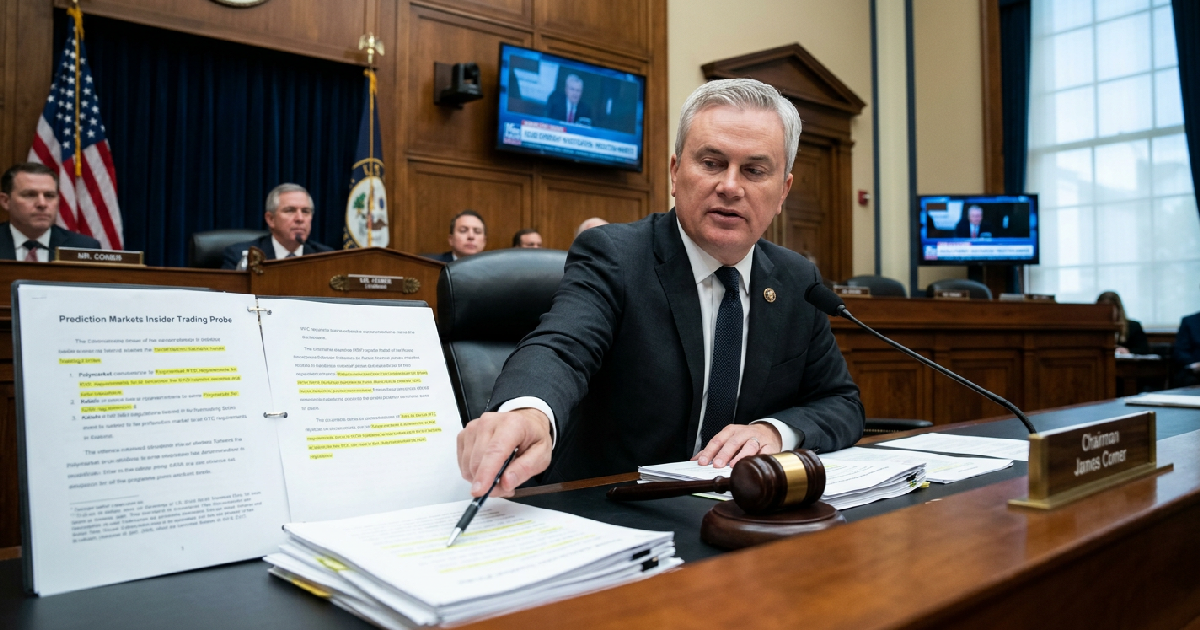

The U.S. House Oversight and Governance Reform Committee has launched a formal investigation into prediction markets Polymarket and Kalshi over allegations of widespread insider trading. Congressman James Comer (R-Kentucky), who serves as the Committee Chair, announced the move during a televised interview with CNBC, describing the sector as the “wild west.” The probe follows high-profile reports of traders profiting from sensitive military and diplomatic intelligence before it reached the public domain.
Investigators are focusing on several specific instances of suspicious activity involving government-related personas. In one case cited by Chairman James Comer, a U.S. soldier reportedly profited by more than $400,000 by betting on the capture of Venezuelan President Nicolás Maduro using insider intelligence. Additionally, some Polymarket wallets reportedly made over $2.4 million on bets related to the U.S.-Iran war, raising alarms about whether participants had access to non-public information.
The committee is also exploring allegations that politicians have attempted to manipulate markets tied to their own election races. This investigation aims to build a case for new legislation. Proposed laws would include a ban on members of Congress, government employees, and presidential administration staff from participating in prediction markets. This legislative push comes as our market sentiment shifts as the CLARITY Act advances through other congressional committees.
Congressman James Comer targets regulatory gaps and insider gains
Chairman James Comer argued that prediction markets have only become a significant issue in recent months because of the lack of written laws. He noted that the novelty of the sector has allowed it to operate without traditional safeguards. To address this, the House Oversight and Governance Reform Committee has reached out to the leadership of the industry’s biggest players to demand transparency.
Formal letters were sent to Kalshi CEO Tarek Mansour and Polymarket CEO Shayne Coplan. The Committee is pressing for details on their internal controls, specifically their “Know Your Customer” (KYC) systems. These inquiries look to determine if identity verification and insider trading prohibitions for international users match those of domestic users. While Kalshi is regulated by the Commodity Futures Trading Commission (CFTC), its expansion to 120 global markets has caught the eye of U.S. lawmakers.
Polymarket, which recently received approval to re-enter the U.S. market, maintains a significant global share partly due to its historical lack of KYC requirements. The Committee is now requesting the trading history of all U.S. government employees on these platforms, including military officers. This level of scrutiny mirrors broader market jitters often seen when crypto liquidations rise alongside treasury yields during periods of heightened macro uncertainty.
Global crackdown on event contracts and betting platforms
The pressure on platforms like Polymarket and Kalshi is not confined to the United States. International regulators are increasingly cracking down on prediction markets to prevent market gaming. In India, the government has banned these platforms under the Promotion and Regulation of Online Gaming Act (PROGA). The Ministry of Electronics and Information Technology (MeiTY) has even taken steps to flag VPN providers used to bypass these domestic restrictions.
This global shift toward stricter oversight is forcing many platforms to prioritize transparency over rapid, unregulated growth. As the “wild west” era fades, these companies must adapt to survive increasing legal pressure. We are seeing a similar trend in other sectors, as Stake.com and Fairspin lead top crypto casinos in shifting toward more transparent operations to meet regulatory demands.
The U.S. investigation will determine how widespread insider trading has become and what specific regulations are necessary to curb it. For industry leaders Shayne Coplan and Tarek Mansour, the coming months will be defined by their ability to provide the Committee with the requested data on their internal compliance and user demographics. The House Oversight and Governance Reform Committee remains focused on ensuring that market contracts are not used as a vehicle for illicit gains by those in power.