
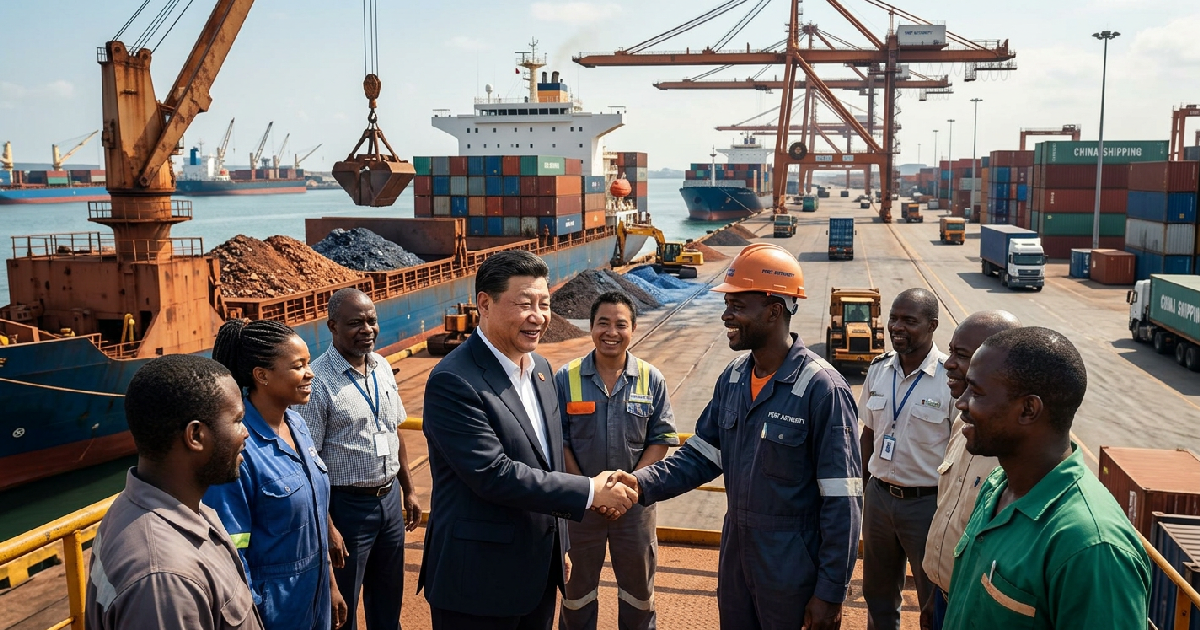

The People’s Republic of China is attempting to seize the narrative of global free trade by implementing a “zero-tariff” policy for 53 African countries, a move aimed at positioning Beijing as a stable alternative to the United States. Following the 70th anniversary of China-Africa diplomatic ties celebrated on May 23, 2026, the Editorial Board of The Washington Post argues that Beijing is exploiting global frustration with the Trump administration’s tariff regime to gain geopolitical dividends.
This strategy marks a pivot for China, which is already the largest trading partner for the African continent.
By removing trade barriers for nearly the entire continent, Beijing seeks to generate goodwill while securing a steady flow of essential raw materials. China remains heavily dependent on African exports of crude oil, copper, cobalt, and various unprocessed minerals to fuel its industrial sectors. As macro warning signs emerge across traditional financial sectors, Beijing is doubling down on these tangible resource alliances to bolster its economic standing.
Beijing leverages zero-tariff deals to secure African resources
The “zero-tariff” initiative serves as a centerpiece for China’s renewed diplomatic push in the Global South. During the recent Africa Day in Beijing on May 23, officials commemorated seven decades of relations with high-profile events, including cultural displays featuring participants from various partner nations. Behind the festivities, however, lies a pragmatic effort to consolidate China’s role as the primary destination for African agricultural and mineral exports.
China’s economic model is described by analysts as “state-capitalist,” characterized by an undervalued currency and policies that prioritize massive industrial investment over domestic consumption. This structure has allowed Beijing to maintain a record trade surplus globally. While the strategy facilitates cheap exports, it simultaneously creates a reliance on foreign markets to absorb China’s excess production capacity. This imbalance remains a point of friction with Western trading partners who argue the playing field is far from level.
The contradiction of state capitalism and free market rhetoric
The move to champion “free markets” is a stark departure from the internal logic of the Chinese Communist Party (CCP). Under the “Made in China 2025” policy, President Xi Jinping has sought to make the global economy more dependent on China while ensuring China remains independent of the world. This protectionist backbone contradicts the open-market image Beijing is currently projecting to African leaders who are seeking predictable trade environments.
This rhetorical shift comes as investor sentiment shifts toward more transparent and regulated frameworks globally. While China offers zero tariffs on paper, the underlying state control of its economy complicates the “free market” mantle it hopes to wear. For African nations, the deal provides immediate market access, but for Beijing, it is a tool to counter American influence and the 2024 U.S. legislative actions targeting Chinese firms like TikTok.
China navigates geopolitical setbacks in Panama and South America
China’s intensified focus on Africa follows a series of setbacks in other strategic regions. In Central America, courts in Panama recently ruled against Hong Kong-based firm CK Hutchison regarding its ownership of ports on both sides of the Panama Canal. This development represents a significant hurdle for Chinese logistics firms attempting to solidify their presence along one of the world’s most critical maritime trade routes.
The Chinese government has also faced challenges in South America and Europe. Investment in Venezuela has lost perceived value following the arrest of dictator Nicolás Maduro, and a $23 billion injection into Argentina has failed to secure special treatment from the administration of President Javier Milei. Furthermore, Italy scaled down its agreements with China in 2023, signaling a broader retreat from the Belt and Road Initiative (BRI) in European markets.
The focus on 53 African nations allows Beijing to reset its international image after these regional complications. By offering a simplified trade structure, China hopes to distract from the debt concerns that characterized the early years of the BRI. The “zero-tariff” policy is as much a PR exercise as it is an economic one, aimed at convinced the Global South that Beijing, not Washington, is the true guardian of the global trading system.