
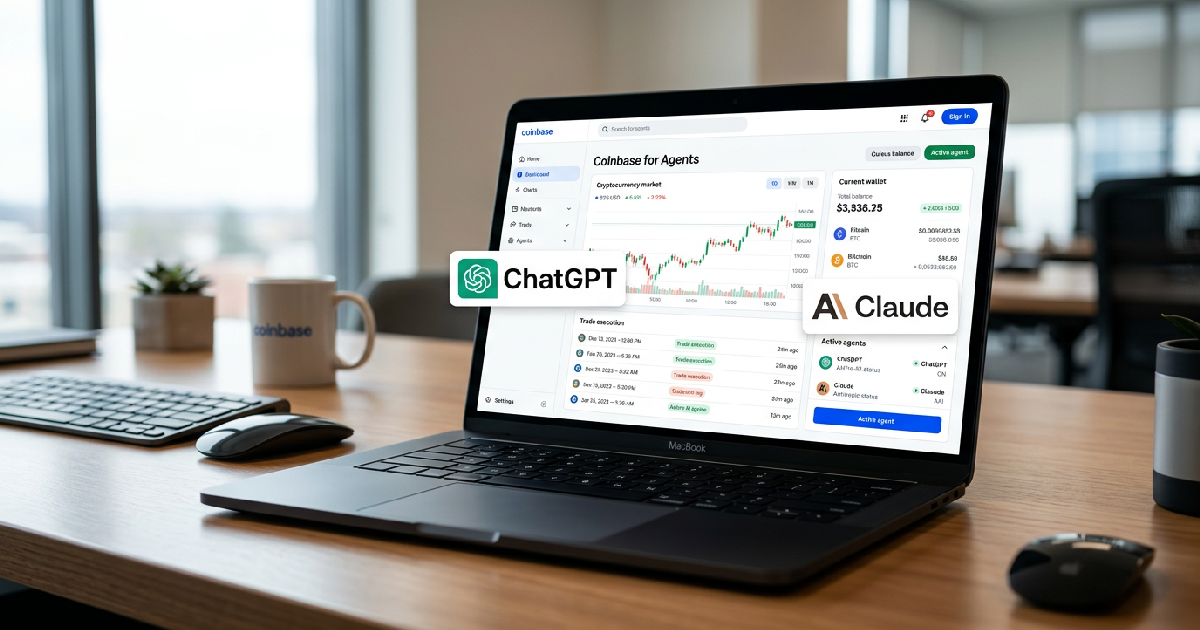

Coinbase Global Inc. officially launched Coinbase for Agents on Thursday, June 11, 2026, a new tool that allows artificial intelligence assistants to trade cryptocurrencies and settle payments autonomously.
The platform, announced by Lincoln Murr, Coinbase’s Head of AI Product, enables large language models (LLMs) such as OpenAI’s ChatGPT and Anthropic’s Claude to connect directly to user accounts. This development shifts AI from a passive information tool to an active economic participant capable of managing digital assets without human intervention.
The product release includes a Model Context Protocol (MCP) for web integrations and a separate Command-Line Interface (CLI) tailored for developers. These tools allow agents to interact with Coinbase Advanced, the company’s professional trading suite, to analyze market data and execute orders.
By setting specific financial boundaries, users can delegate complex tasks to AI, ranging from one-time trading advice to the management of entire portfolios based on specific investment theses.
This launch follows a period of heavy accumulation in the digital asset space, where bitcoin supply on exchanges recently hit a six-year low. As liquidity remains tight, the entry of high-frequency AI agents could provide a new layer of market activity.
Lincoln Murr noted that the company aims to move beyond niche developer tools to create a primary interface for how people interact with the internet in the late 2020s.
How Coinbase for Agents manages automated crypto trading
The “Coinbase for Agents” platform supports a wide array of financial actions, including spot trading and derivatives market execution. AI assistants can also monitor cash positions 24/7 to ensure idle funds are optimized, or execute dollar-cost averaging strategies with precision. Users maintain control by defining specific investment parameters that the AI must follow, allowing for automated rebalancing of holdings as market conditions change.
Security is handled through a “gift card” account model, which effectively sandboxes the AI agent. This structure ensures that an agent only has visibility into the specific assets it is assigned, with no access to a user’s broader Coinbase holdings.
Private keys are kept within Coinbase’s secure enclave infrastructure and are never exposed to the AI’s prompt or the underlying LLM, mitigating the risk of key theft during a session.
To prevent runaway trades, Coinbase implemented “smart guardrails” that enforce strict spending caps on a per-session and per-transaction basis. These limits are supported by built-in Know Your Transaction (KYT) screening, which automatically flags and blocks high-risk interactions. This level of oversight is intended to give retail and institutional users the confidence to let software agents handle real money.
The x402 protocol and the rise of agentic payments
At the center of this new ecosystem is x402, an open payment protocol that Coinbase launched in May 2025 alongside partners like Amazon Web Services (AWS) and Circle. The protocol revives the long-dormant HTTP 402 “Payment Required” status code, allowing AI agents to negotiate and complete payments for digital services directly.
This means an agent can pay for premium research data or on-demand compute power without needing a manual login or a subscription.
Data released during the launch indicates that the x402 protocol has already seen massive adoption. As of June 11, 2026, the protocol has processed more than 160 million transactions since its debut. In the last 30 days alone, it handled $24 million in volume across 75 million individual transactions.
Most of this activity is settled in USDC, with over 90% of the volume running on the Base layer-2 network, per Coinbase’s Q1 2026 earnings disclosures.
While some platforms focus solely on trading, Lincoln Murr emphasized that Coinbase is the only firm combining exchange access with a native payments protocol. This integration is vital for bitcoin price stabilization and broader market health, as it creates a utility-driven demand for stablecoins.
The establishment of the x402 Foundation, a joint effort between Coinbase and Cloudflare, further aims to promote these open standards across the tech industry.
Future implications for AI-driven financial independence
The long-term goal for Coinbase for Agents is to provide AI entities with full financial independence. By giving software access to money, developers can build agents that not only provide information but can also procure the resources they need to function. This could lead to a future where AI “workers” manage their own operating costs through autonomous trading or service provision.
Coinbase is positioning this shift as being as significant as the transition from desktop to mobile in the 2010s. If AI agents become the primary way the public accesses the internet, having a built-in financial layer for those agents becomes a critical piece of infrastructure.
The company expects the developer community to drive the next wave of innovation, using the CLI to integrate AI into terminal-based environments like OpenAI Codex and Hermes Agent.