
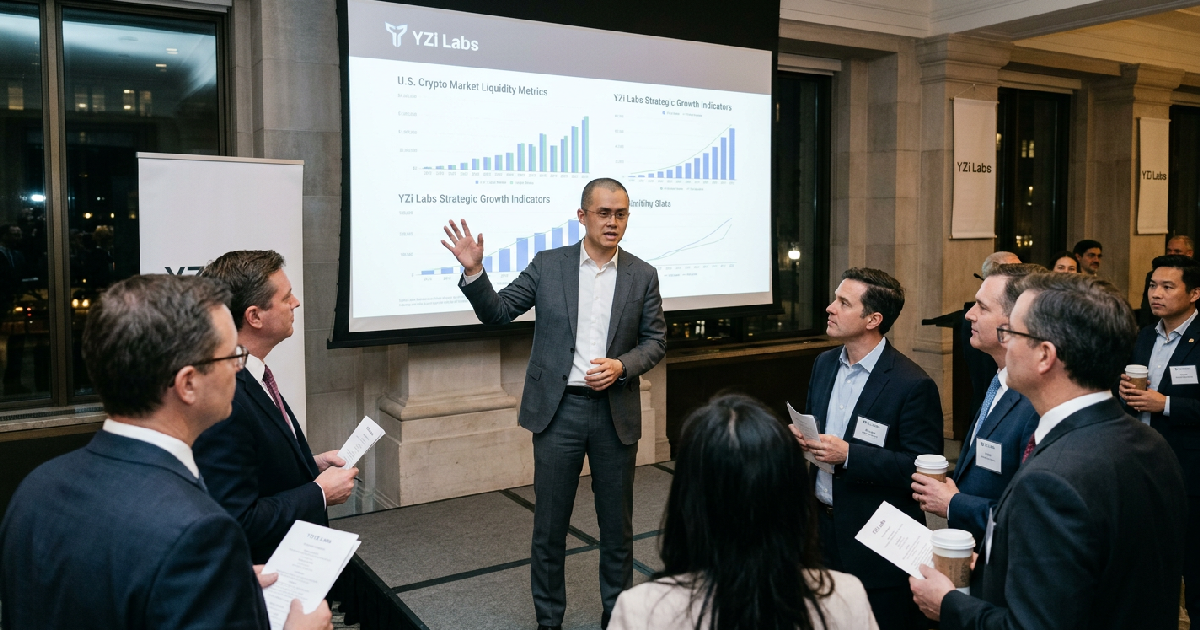

Changpeng Zhao, the billionaire founder and former chief executive of Binance, has publicly launched a personal campaign to transform the United States into the “capital of crypto,” signaling a definitive return to the digital asset spotlight following his 2024 prison term and subsequent presidential pardon.
During a series of high-level interviews this month, Zhao—widely known as “CZ”—confirmed he is actively lobbying Washington policymakers and investors through his new vehicle, YZi Labs, to bridge the liquidity gap currently disadvantaging American traders.
Challenging the American liquidity disadvantage
Despite his status as a majority shareholder, Zhao clarified he will not resume an executive role at Binance or Binance.US, choosing instead to act as a strategic advisor to the broader Web3 ecosystem.
The timing of Zhao’s reemergence in June 2026 is clinically calculated, following a turbulent period for both his personal legal standing and the global markets.
After serving a four-month sentence for Bank Secrecy Act violations and receiving a pardon from Donald Trump in October 2025, the executive is leveraging his net worth—estimated by Forbes at $111.1 billion—to influence U.S. financial policy.
He argues that the domestic market is currently “structurally broken” because American consumers lack access to the deep global pools of liquidity found on international exchanges, leading to higher fees and significant slippage during trades.
Key details
Zhao’s primary critique centers on the disparity between U.S. capital markets and the global crypto industry. He pointed out that while the U.S. typically offers the most competitive pricing in traditional finance, the digital asset sector remains siloed.
This isolation forces domestic users to trade on thinner order books, which results in higher costs compared to the global Binance platform.
To rectify this, Zhao is advocating for a framework that would allow Binance.US to tap into the global liquidity of its parent company, or for new services to be established that provide Americans with “the best prices in the world.”
This push for deeper market integration comes at a time when traditional financial institutions are deepening their own ties to the sector. For instance, Italy’s largest bank exceeds $200M in Bitcoin exposure, illustrating a global trend of mainstream adoption that Zhao believes the U.S. must lead.
He argues that with 80% of global GDP residing outside North America, the U.S. cannot afford to rely solely on internal exchange growth to close the pricing gap. His sessions at Consensus Miami 2026 reportedly focused on convincing regulators that liquidity is a consumer protection issue as much as an economic one.
Navigating the 2026 bear market and AI rotation
The broader crypto landscape Zhao is returning to is far from the euphoric peaks of late 2025. Bitcoin, which reached an all-time high of $126,000 in October, has seen its price decline by roughly 50% to trade near the $60,000 mark.
Zhao remains unbothered by these fluctuations, dismissing them as part of a natural four-year market cycle. He also addressed the recent trend of capital rotating away from digital assets and toward artificial intelligence, suggesting that this shift is not a threat but an evolution of the technology sector.
Zhao believes that the influx of capital into AI will eventually benefit Web3 by driving demand for decentralized financial technologies as transactions become more automated. While some analysts worry about a prolonged downturn, Zhao maintains a long-term perspective. As crypto market liquidations rise alongside Treasury yields, Zhao’s strategy involves steady reinvestment.
Through YZi Labs, he is specifically targeting infrastructure projects that he believes will underpin the next decade of digital commerce, regardless of short-term price volatility in tokens like BNB or BTC.
Key details
Zhao’s optimism about the U.S. becoming a crypto hub is partly rooted in recent legislative progress. He specifically cited the passage of the GENIUS Act as a pivotal moment for the industry, as it established the country’s first robust federal framework for stablecoins.
By providing clear rules for dollar-backed assets, the act has removed one of the largest clouds of uncertainty hanging over the domestic market. However, Zhao warned that the job is far from finished.
He described current bills under consideration, such as the Digital Asset Market Clarity Act, as “tactical” steps that remain essential but incomplete. There is a palpable concern that if the U.S.
fails to pass comprehensive clarity legislation within the next year, it will cede its competitive edge to European or Asian jurisdictions that have moved faster.
Unlike his previous contentious relationship with the Securities and Exchange Commission (SEC), Zhao’s current tone is one of cooperation, emphasizing that clear rules are the only way to facilitate the massive institutional inflows required to stabilize the market.
Zhao’s new role as advisor and shareholder
One of the most delicate aspects of Zhao’s return is his relationship with the companies he founded. Under the terms of his U.S. settlement, Richard Teng now leads Binance as CEO, and Zhao has repeatedly stated he has no intention of returning to the helm.
Instead, he is positioning himself as a “lead advisor” and passive majority shareholder. This distinction is critical for maintaining the fragile peace with the Department of Justice (DOJ), which previously accused him of failing to maintain effective anti-money laundering programs.
In his current capacity, Zhao sits as a board member for Binance.US but emphasizes that the U.S.-based exchange is a separate entity with its own leadership and investor base. His focus has shifted toward high-level diplomacy and mentoring.
He spent a significant portion of early 2026 meeting with foreign heads of state—including the president of Kyrgyzstan and members of the Pakistan Crypto Council—to discuss national blockchain strategies. This global influence is what he now hopes to bring to Washington, D.C.
Key details
For Zhao, the path to making the U.S. the capital of crypto is paved with the need to rebuild trust. While the presidential pardon cleared his legal record, the “4.3 billion dollar elephant” in the room—a reference to the fine Binance paid to U.S. authorities—remains a fresh memory for many.
Zhao’s strategy to overcome this legacy is one of radical transparency and investment in “safety-first” technologies. He is reportedly backing new protocols that prioritize regulatory compliance at the code level, rather than as an afterthought.
Despite the challenges, his influence remains unmatched. As a major holder of BNB, his personal wealth is intrinsically tied to the success of the ecosystem.
Investors continue to watch his moves closely, particularly as VanEck and Grayscale move toward potential spot BNB ETFs, which would provide further institutional legitimacy to the tokens that built Zhao’s empire.
Whether his presence in Washington will be welcomed or merely tolerated is yet to be determined, but Zhao appears committed to staying the course for the long haul.
Future outlook for the U.S. digital asset hub
As 2026 progresses, the impact of Zhao’s advocacy will likely be measured by whether Binance.US is eventually allowed to merge its liquidity pools with the global exchange. If successful, this could spark a new era of price discovery and competition in the American market. Zhao’s vision goes beyond just trading; he envisions a U.S.
where Web3 developers can build without the constant fear of enforcement actions, supported by a legislative environment that understands the nuances of decentralized protocols.
The coming months will be critical for Zhao as he continues his tour of U.S. financial centers. With the industry still reeling from the 50% Bitcoin correction and investors seeking a clear direction, the return of its most recognizable founder provides a sense of renewed momentum.
Zhao’s message remains simple: the United States has the talent and the capital to lead the world in financial technology, provided it stops standing in its own way. While he may no longer hold a CEO title, his influence on the American crypto landscape has perhaps never been stronger.