
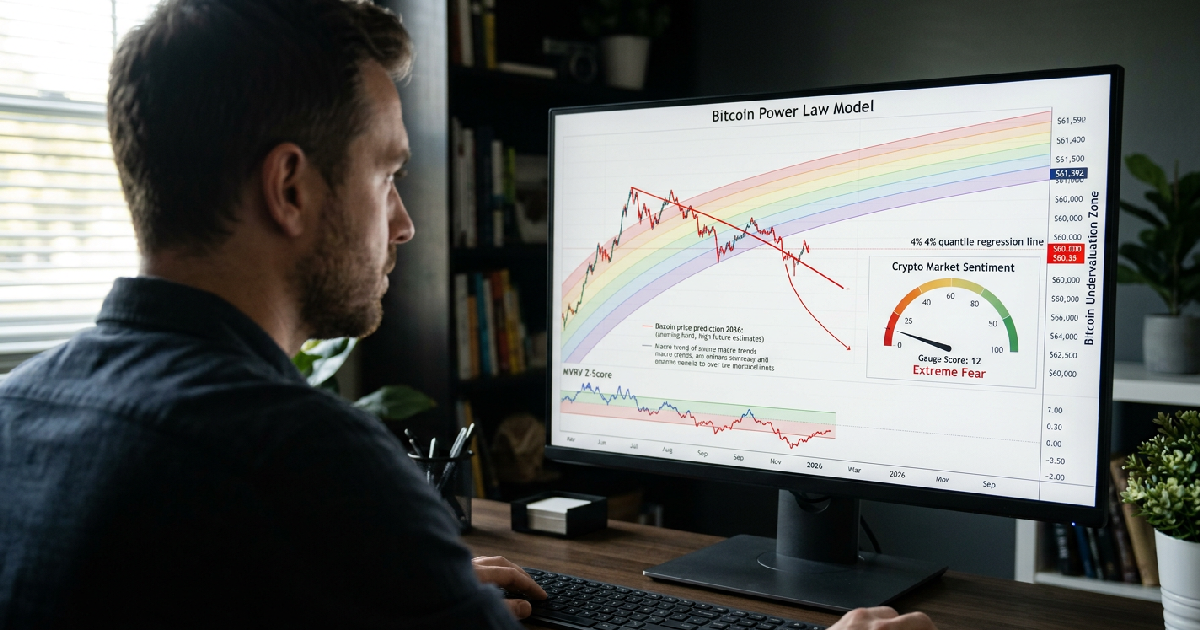

Bitcoin has entered an “extreme undervaluation zone” as of June 7, 2026, according to recent market data and analysis by prominent industry experts. Lead analyst Darkfost reported that the digital asset dropped below the 4% quantile of the Bitcoin Power Law Model, a technical threshold that has historically signaled major market bottoms.
This development comes as Bitcoin trades between $60,000 and $61,592, reflecting deep investor pessimism and a significant 26.8% decline in value since mid-May.
The current price action represents a rare technical alignment across multiple analytical frameworks. On June 5, 2026, observations by Darkfost on X (formerly Twitter) indicated that Bitcoin had fallen to an extreme regression level.
Historically, periods where the price lingers below the 4% quantile have preceded substantial rebounds, as seen in 2016, 2020, and the bear market of 2022. Analysts typically view these phases as opportunistic windows for long-term accumulation rather than short-term trading signals.
Market sentiment has soured alongside the price drop, with the Fear & Greed Index crashing to a score of 12. This “extreme fear” ranking coincides with a 56.14% collapse in daily trading volume, which has thinned out to roughly $31.21 billion. While the price shows signs of com/bitcoin-price-77000-market-confidence-geopolitics-2026-analysis/”>market confidence stabilizing near the $61,000 mark after a relief bounce, the broader trend remains heavily bearish for the first week of June.
Bitcoin Power Law Model and MVRV Z-Score analysis
The Bitcoin Power Law Model serves as a long-term valuation tool that tracks the asset’s growth on a logarithmic scale. By dropping below the 4% quantile, Bitcoin is currently trading at a valuation lower than approximately 96% of its historical price observations.
This metric suggests the asset is “over-sold” relative to its projected adoption curve, creating a wedge between its current market price and its long-term fair value.
Supporting this view is the Market Value to Realized Value (MVRV) Z-Score, which stood at 0.49 as of April 7, 2026. While this figure shows Bitcoin is approaching undervalued territory, it remains slightly above the “deep green zone” found at levels below 0.10.
Those extreme levels previously identified the definitive cycle bottoms in 2015, 2018, and late 2022. Some traders are waiting for a final flush to reach that 0.10 mark before committing heavy capital.
Interpreting these shifting market structure signals requires patience. Analyst Semilore Faleti notes that Power Law signals should be viewed through a broader investment horizon. Because these models assess long-term conditions, they rarely predict the exact day a price reversal will begin, but rather identify areas where the risk-to-reward ratio is highly favorable for buyers.
Glassnode identifies historical floor territory
Data from Glassnode’s on-chain pricing framework further reinforces the undervaluation thesis. As of June 5, 2026, when Bitcoin dipped toward $62,000 and $60,000, it crossed into what Glassnode defines as “historical floor territory.” This framework utilizes realized price metrics—the average price at which all coins last moved—to determine when the market is under intense financial stress.
The current $1.24 trillion market cap reflects a significant departure from the highs seen earlier in the cycle. Despite the recent 2% gain in the last 24 hours, Bitcoin has underperformed the global cryptocurrency market over the last seven days, dropping 16.4% compared to the broader market’s 14.5% decline.
This relative weakness often occurs just before a market leader regains its dominance during a recovery phase.
Future price projections and macro influences
Despite the prevailing gloom, some analysts expect a swift recovery as liquidity conditions evolve. Analysts at Coincodex have issued a projection of $69,489 for the coming month, suggesting the current “deep undervaluation” will be short-lived. This forecast aligns with the historical tendency for Bitcoin to bounce aggressively once it exits the extreme fear zone of the sentiment index.
Broader economic factors remain a headwind for the immediate future. Tightening global liquidity and regulatory pressure have weighed on risk assets throughout 2026. However, many institutional observers are eyeing a potential Federal Reserve pivot toward interest rate cuts. This shift, projected for the second half of 2026, could provide the necessary catalyst for the next major liquidity expansion and price rally.
Investors often look for technical confirmations like the 200-day moving average to validate a trend change. Until then, the focus remains on on-chain indicators. With 20,039,087 BTC already in circulation and the next halving not due until April 2028, the supply side remains constrained, leaving the door open for price appreciation if demand returns to historical norms.