
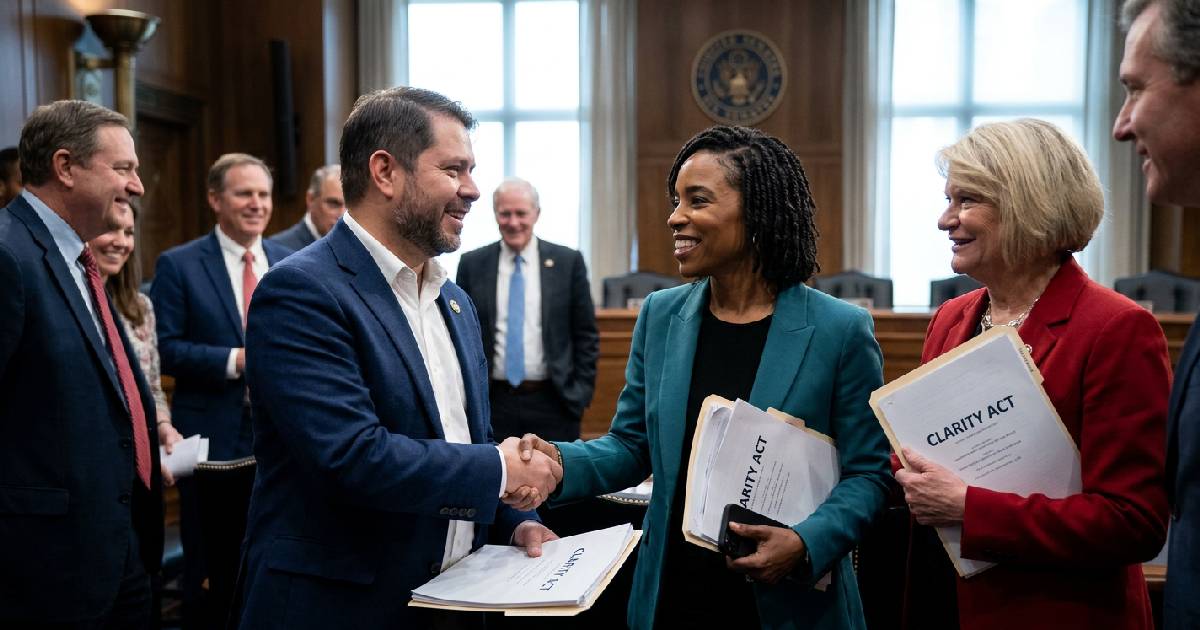

Capitol Hill is bracing for a “landmark day” in cryptocurrency regulation as the Senate Banking Committee voted 15-9 to advance the Clarity Act on May 15, 2026. This legislative movement marks a sharp pivot toward treating digital assets as matters of national security. The bill, which previously passed the House of Representatives by a 294 to 134 margin in July 2025, now moves to the Senate floor for further consideration.
The legislative progress is being driven by a bipartisan coalition, with Democratic Senators Ruben Gallego and Angela Alsobrooks joining Republican members to clear the committee hurdle. Senator Tim Scott (R-SC) has signaled a target date of September 30, 2025, to advance market structure legislation, noting that the House’s version offers a strong template. The push comes as lawmakers increasingly view investor sentiment and asset dominance through a geopolitical lens.
Representative Lance Gooden of the House Armed Services Committee recently characterized Bitcoin as a “tool of power projection.” In an op-ed, Gooden warned that the U.S. cannot lose the “bitcoin race” to China, noting that the Chinese Communist Party is stockpiling the asset while deploying a digital yuan. This framing has gained traction among Republicans who now explicitly label the flagship cryptocurrency a national security asset.
Clarity Act defines digital commodities and agency jurisdiction
The Digital Asset Market Clarity Act (CLARITY Act) seeks to end jurisdictional confusion by drawing clear lines between the SEC and the CFTC. It defines a “digital commodity” as an asset intrinsically linked to a blockchain, where value is derived from the use of that system. Crucially, it excludes these commodities from the definition of a security, even while preserving SEC oversight for specific investment contracts involving them.
Entities operating as digital commodity exchanges, brokers, or dealers must register with the CFTC within 180 days of the bill becoming law. This requirement includes filing provisional registration statements and meeting strict recordkeeping and risk-management standards. The goal is to provide a legislative progress anchor for firms that have long struggled with regulatory ambiguity in the United States.
The legislation also resolves a long-standing impasse regarding stablecoin yields. A survival provision by Senators Alsobrooks and Thom Tillis (R-NC) bars firms from issuing rewards for stablecoin balances that function like interest-bearing bank deposits. However, companies may still offer activity-based incentives, such as cashback on payments or transaction-based rewards, to encourage commercial use without mimicking traditional banking products.
Military testing and the U.S. Strategic Bitcoin Reserve
The intersection of digital finance and defense has become concrete with reports of military operational testing. U.S. Indo-Pacific Commander Admiral Samuel Paparo revealed that the military has already deployed a live node on the Bitcoin network. This operational testing suggests the Pentagon is investigating decentralized infrastructure for resilient communication or logistical applications in contested environments.
In a major development for the sector, researchers have confirmed a “breakthrough” regarding the U.S. Strategic Bitcoin Reserve. While details on the implementation remain limited, the development aligns with the growing sentiment on Capitol Hill that Bitcoin is a strategic asset. Proponents argue that such a reserve could bolster U.S. economic dominance against rival powers exploring digital currencies.
Internal shifts in traditional finance further underscore this trend. Some European institutions have already begun building inventory, with reports showing Italy’s largest bank exceeding $200 million in Bitcoin exposure through ETFs. This institutional adoption provides a backdrop of market legitimacy as Washington debates the official sovereign role of the asset.
Establishing safeguards and the micro-innovation sandbox
To address concerns surrounding illicit finance, the act establishes an Independent Financial Technology Working Group. This body draws representatives from the Treasury, DOJ, FBI, and the private sector to research the use of digital assets by bad actors. Additionally, it mandates that digital commodity brokers be treated as financial institutions under the Bank Secrecy Act, requiring robust anti-money laundering programs.
The bill also looks to support small-scale development through a “Micro-Innovation Sandbox.” This program allows eligible firms to test innovative digital products for up to two years with limited exemptions from certain regulations. House Financial Services Committee Chair French Hill stated that this framework will “unleash innovation” and ensure the U.S. maintains its dominance in the digital asset space while protecting consumers.
Despite the breakthrough on the Bitcoin reserve and the committee victory, the Clarity Act faces more hurdles. It must be merged with a product from the Senate Agriculture Committee and reconciled with the House version before reaching the president. An ethics provision regarding government officials’ engagement with digital assets remains a primary “thorny” issue yet to be resolved by lawmakers.