
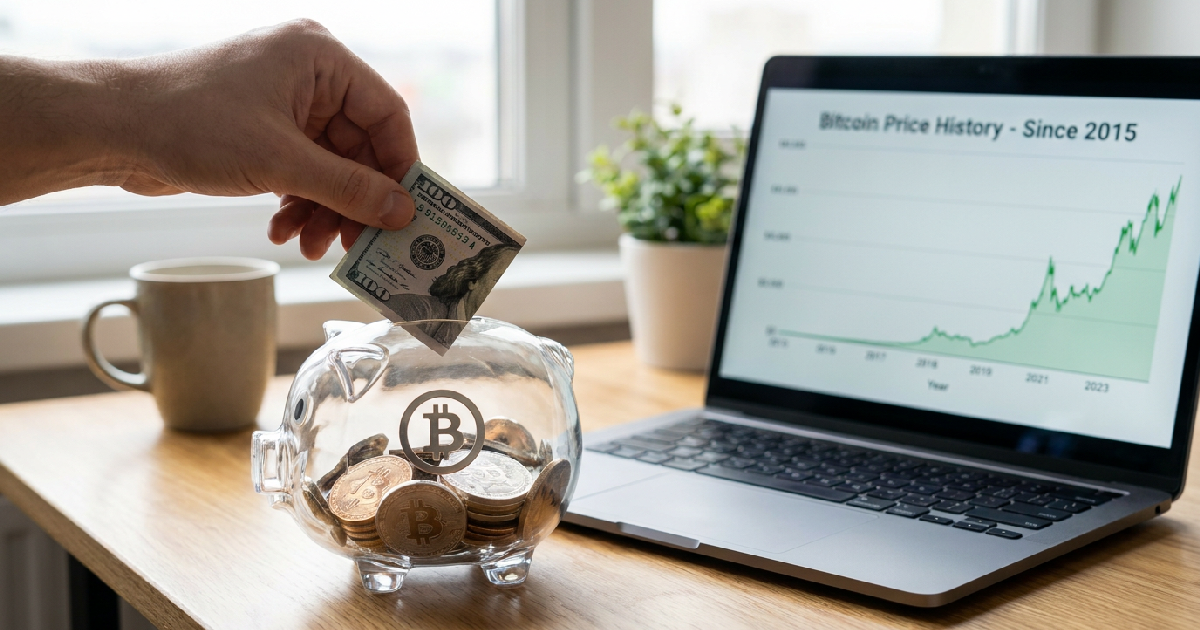

Investors who consistently allocated just $100 each month to Bitcoin starting in January 2015 would have poured a total of $13,800 into the cryptocurrency by June 2026. This disciplined approach, known as dollar-cost averaging (DCA), highlights a profoundly lucrative outcome for this Bitcoin investment as it currently trades around $62,015.9 as of July 14, 2026.
This long-term strategy effectively cushioned against Bitcoin’s inherent volatility, allowing investors to acquire more coins during price dips and fewer during rallies. The journey from its early stages to its current multi-thousand-dollar valuation has minted significant wealth for those who stuck with a consistent Bitcoin investment approach.
Understanding dollar-cost averaging in crypto
Dollar-cost averaging (DCA) stands out as a favoured strategy for navigating volatile markets like cryptocurrency. It involves investing a fixed sum of money at regular intervals, regardless of the asset’s price. This systematic approach removes the emotional guesswork often associated with trying to “time the market.”
For an asset like Bitcoin, known for its dramatic price swings, DCA proved particularly effective over the past decade. By consistently buying $100 worth of Bitcoin every month since January 2015, an investor would have spread their purchases across numerous market cycles, from periods when Bitcoin traded for hundreds of dollars to its peaks.
This method allows an investor to automatically buy more Bitcoin when prices are low and less when prices are high. Over the long run, this tends to lower the average cost per Bitcoin, maximizing potential returns. It’s a testament to patience and adherence to a strategy rather than speculative trading.
Bitcoin’s appreciation from 2015 to today
In January 2015, Bitcoin was trading at approximately $314.07. For someone investing $100 at that time, it meant acquiring a substantial 0.318397 BTC. Fast forward to today, July 14, 2026, and Bitcoin is hovering around $62,015.9, showcasing an astounding appreciation over the years.
The journey hasn’t been linear, marked by several bull runs and significant corrections. However, the overarching trend has been one of robust growth, fueled by increasing institutional adoption, broader public awareness, and its evolving role as a digital store of value. This sustained growth underpins the hypothetical investment’s considerable gains.
Over these 11 years and six months, Bitcoin has transitioned from a niche digital asset to a mainstream investment vehicle. This attracts interest from both retail investors and major financial institutions alike. Developments like Bitcoin ETFs have further legitimized its standing, bringing more traditional capital into the ecosystem.
Total capital invested and present-day value insights
The total capital deployed into this hypothetical Bitcoin investment since January 2015 amounts to $13,800. This figure represents 138 monthly payments of $100 each, concluding in June 2026. This modest sum has, over time, positioned investors to benefit significantly from Bitcoin’s price trajectory.
Consider an investor who stopped buying in December 2015. Their accumulated 4.628804 BTC, purchased for approximately $1,200, would be worth over $287,000 today at Bitcoin’s current price of $62,015.9. This illustrates the exponential growth potential that continued contributions would have amplified over the full investment period.
The market for Bitcoin remains dynamic, with prices trading near the low-$60,000 region. Recent intraday trading for Bitcoin has been roughly between $58,000 and $61,000. Yesterday, July 13, 2026, Bitcoin’s closing price was $64,127.14.
Strategic implications for future crypto investors
The compelling returns from a consistent $100 monthly Bitcoin investment serve as a powerful case study for anyone considering crypto. It underscores the potential for significant wealth creation through disciplined, long-term participation in the digital asset space, even with relatively small contributions.
This historical performance suggests that patient investors, those willing to weather market fluctuations, can reap substantial rewards. It’s a lesson in conviction, demonstrating that early entry combined with regular contributions can outperform attempts at market timing, particularly for an asset with Bitcoin’s growth trajectory.
As the crypto market matures, the principles of dollar-cost averaging remain highly relevant. Investors now have more regulated avenues, such as Bitcoin exchange-traded funds (ETFs), which have seen inflows. These developments contribute to market stability and could further drive value.
Prospective investors often face paralysis when confronted with Bitcoin’s current price. However, this historical context illustrates that even modest, regular contributions over time can lead to substantial gains. The key lies in consistency and a long-term outlook, rather than chasing short-term rallies or focusing on daily price movements.