
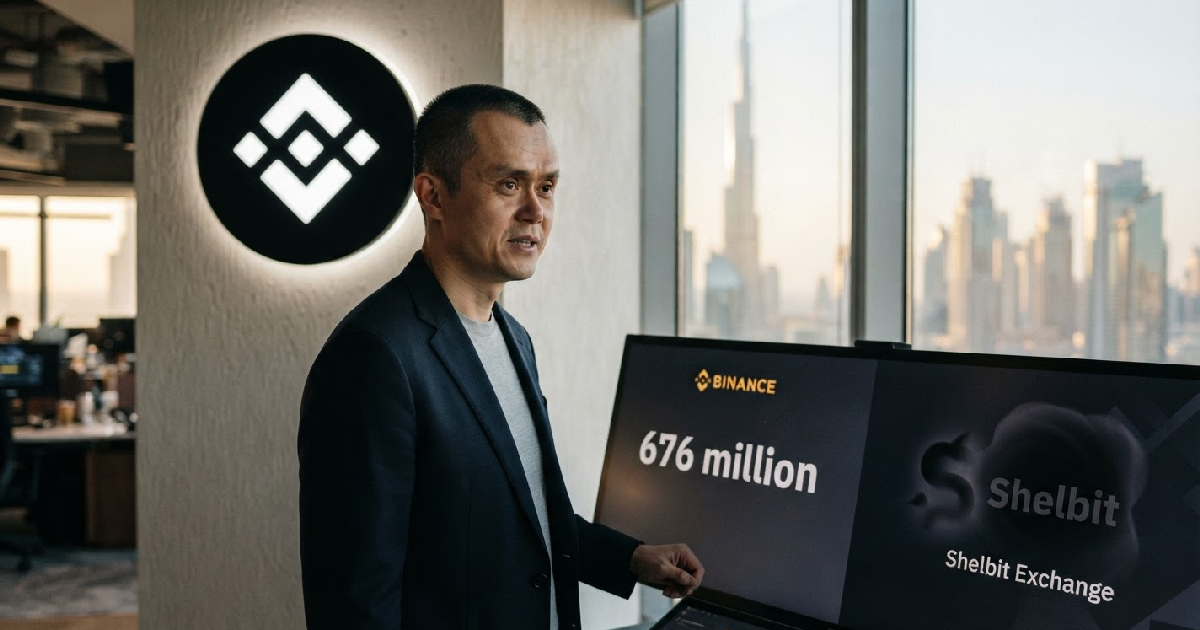

Binance, the world’s largest cryptocurrency exchange, received at least $676 million in cryptocurrency from Shelbit, an unlicensed Dubai-based exchange allegedly central to an Iranian sanctions-evasion operation, a Reuters investigation published last Friday revealed.
The findings indicate a significant flow of funds from an entity linked to Iran’s central bank and a vast illegal gambling network, raising renewed questions about Binance’s compliance protocols despite its 2023 settlement with US authorities.
Shelbit’s alleged role in sanctions evasion
The alleged transfers, some occurring after Dubai regulators had fined Shelbit and after Binance was reportedly warned, highlight the persistent challenges in enforcing global financial sanctions within the often-opaque digital asset landscape. Shelbit, run by Iranian expatriate Siavash Kayvanpour, reportedly facilitated over $4 billion in transactions since May 2024, enabling sanctioned entities to access global crypto markets.
Operating from a discrete three-room office above a budget hotel in Dubai, Shelbit has no public website but served as a crucial conduit for Iranian entities looking to bypass international sanctions. The Reuters investigation, citing data from crypto investigative firms and researcher Rich Sanders, detailed Shelbit’s expansive network.
Investigators traced at least $125 million directly from Iran’s Central Bank to Shelbit. Additionally, approximately $20 million from a suspected Iranian mining operation flowed through intermediary wallets before reaching the exchange. This suggests a concerted effort to leverage cryptocurrency for state-level financial maneuvers.
Shelbit’s client base extended beyond state actors, encompassing an illegal Farsi-language gambling network of more than 2,000 websites. One of these sites alone accounted for $130 million in transactions, with over $250 million total tied to gambling operations moving through Shelbit. Researcher Rich Sanders described Shelbit as “an IRGC operation,” though Reuters could not independently confirm direct control by Iran’s Islamic Revolutionary Guard Corps.
The exchange also maintained connections with Nobitex, Iran’s largest crypto exchange, which the U.S. Treasury sanctioned in June 2026 for its role in facilitating payments for terrorist activities and sanctions evasion. This connection underscores the interconnected nature of the alleged illicit financial ecosystem.
Binance’s prior compliance issues and current defense
Of the $676 million allegedly channeled to Binance, about $540 million moved after Dubai’s Virtual Assets Regulatory Authority (VARA) issued a fine against Shelbit in January 2025 for operating without a license. More critically, these flows reportedly continued even after Rich Sanders notified Binance of Shelbit’s Iranian links in October 2025.
Binance has responded by stating that Shelbit itself never held an account on its platform. The exchange asserted that its compliance program “operated as it should have,” investigating and freezing relevant accounts belonging to users associated with Shelbit, and reporting them to law enforcement. Binance also claimed an independent third-party blockchain analytics firm did not classify these transactions as high risk.
The exchange has gone further, telling The Block it has “no evidence” for Sanders’ account and disputing the $540 million figure transferred post-fine. However, Binance did not dispute processing hundreds of millions of dollars from users linked to Shelbit, only that Shelbit itself was not a direct account holder.
This situation echoes Binance’s past regulatory troubles. In November 2023, the exchange pleaded guilty to anti-money laundering (AML) and sanctions violations, agreeing to a $4.3 billion settlement with US authorities. This settlement included a three-year monitoring program. Former CEO Changpeng Zhao also pleaded guilty to AML violations.
US officials had previously noted that Binance facilitated approximately $900 million in transactions between American and Iranian users. The Treasury has reportedly pressed Binance over its compliance with the 2023 settlement’s monitoring program, particularly after a report highlighted a separate $1 billion flow to Iran.
Binance secured licenses for its main trading platform in the United Arab Emirates in December 2025, adding another layer to the compliance oversight it faces.
Intensifying regulatory scrutiny in Dubai and beyond
Dubai’s Virtual Assets Regulatory Authority (VARA) had previously taken action against Shelbit, issuing a cease-and-desist notice in January 2025. Following the Reuters investigation, VARA issued a new order on July 24, 2026, directing Shelbit to immediately halt all unlicensed virtual asset activities, citing violations related to anti-money laundering and counter-terrorism financing.
The Office of Foreign Assets Control (OFAC) within the U.S. Treasury has acknowledged the allegations, stating it is “taking them very seriously.” This suggests potential federal action could follow, especially given the US government’s ongoing focus on Iran’s use of cryptocurrency for sanctions evasion.
Iran has increasingly relied on crypto to circumvent international sanctions. Chainalysis estimated Iranian crypto outflows reached $4.18 billion in 2025, a 70% increase year-over-year. The Islamic Revolutionary Guard Corps (IRGC) has been identified as a major player in Iran’s crypto activities, reportedly accounting for over $3 billion in value received in Q4 2025.
This escalating pattern of crypto-enabled sanctions evasion adds complexity to already strained US-Iran relations, potentially impacting ongoing nuclear negotiations. The incident with Shelbit and Binance underscores the global financial system’s vulnerability to sophisticated evasion tactics, even as regulators strive to bring the nascent crypto industry under tighter control.
The allegations against Binance, particularly concerning the flows after warnings and regulatory fines, highlight the challenges faced by large, international crypto exchanges in preventing illicit finance. Despite sophisticated compliance systems and significant penalties for past infractions, the sheer volume and distributed nature of cryptocurrency transactions mean bad actors continue to seek loopholes.
This ongoing cat-and-mouse game between sanctioned entities and global financial watchdogs ensures that regulatory bodies like VARA and OFAC will intensify their oversight. It also places greater pressure on exchanges like Binance to demonstrate robust, effective, and proactive compliance that extends beyond mere technical detection to preemptively identify and block illicit financial flows, especially from known high-risk jurisdictions.