
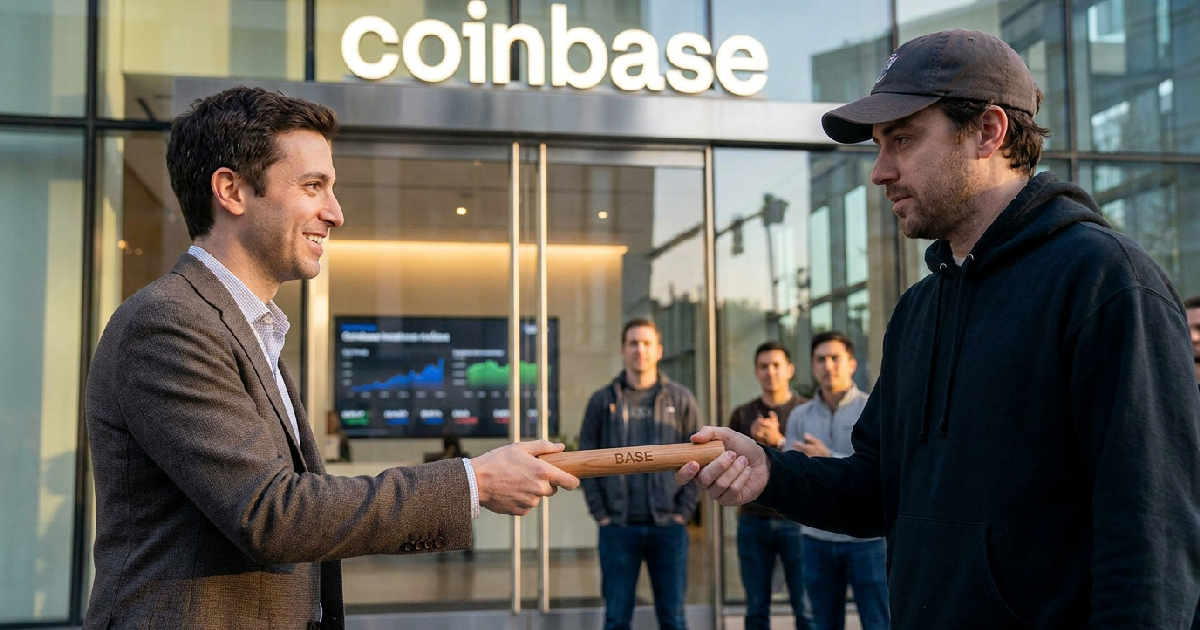

Coinbase executive Jesse Pollak has relinquished his leadership role for the Base app team, officially handing the reins to Jordan Fish, better known as crypto influencer Cobie. The move, announced by Pollak on X this Wednesday, July 15, 2026, signals a significant strategic pivot for Base.
Pollak candidly admitted that many of the network’s earlier ventures into social and creator-focused features ultimately failed to gain meaningful traction.
Admitting socialfi’s shortcomings
This leadership change shifts Pollak’s focus to the underlying infrastructure of the Base blockchain. He plans to concentrate on developing capabilities for trading, stablecoin payments, and AI agents. It’s a clear re-prioritization away from the speculative “socialfi” experiments that marked Base’s initial growth phase, and towards a more institutional, utility-driven future for the Ethereum Layer 2 network.
Pollak’s announcement was notably self-critical, highlighting a challenging period for Base. He described the first quarter of 2026 as “a punch in the face” in his X message. Several high-profile projects and features, including integrations with Farcaster, Zora, and various creator coins, “disintegrated completely.”
These initiatives, once touted as foundational to Base’s social Web3 vision, simply didn’t resonate with users or prove sustainable. Coinbase CEO Brian Armstrong had also previously conceded that Base’s socialfi features “didn’t work.” This collective acknowledgment of failure marks a rare moment of public introspection from a major crypto entity.
The failure of creator coins, in particular, left many early investors “underwater,” as Pollak described. While the creator-coin frenzy briefly made Base the busiest chain for new token launches in August 2025, generating substantial trading volume, the speculative bubble eventually burst. It demonstrated a stark reality: hype alone doesn’t build enduring utility.
Cobie takes the app helm
Taking over the Base app team is Jordan Fish, a prominent and respected voice within the crypto community. Known for his incisive market analysis and influential social media presence as Cobie, Fish joined Coinbase in 2025 following the exchange’s acquisition of his on-chain investment platform, Echo, in a deal valued at approximately $375 million.
Cobie’s appointment suggests a fresh perspective for Base’s application layer. His background, combining deep crypto insight with practical investment platform experience, could steer Base app development towards more robust and user-centric solutions. It also aligns with Pollak’s new infrastructure-focused vision, ensuring the app layer supports rather than detracts from core utility.
A strategic reorientation for Base
The shift in leadership accompanies a significant strategic reorientation for the Base blockchain. Pollak will now dedicate his efforts to the core chain infrastructure. His stated priorities are trading, stablecoin payments, and AI agents.
This refined focus is ambitious. Pollak articulated a vision for Base to become “the blockchain for global finance,” aiming to establish it as the primary settlement layer for the world’s money in the coming century. Such a goal requires robust, reliable infrastructure, a stark contrast to the experimental social applications that previously dominated the app team’s efforts.
The emphasis on “trading” encompasses a wide range of assets, from tokenized stocks and meme coins to app-specific tokens. “Payments” centers on global stablecoin transactions for both individuals and enterprises. And “agents” refers to leveraging crypto’s native digital money properties to accelerate an economy increasingly driven by artificial intelligence.
Navigating a competitive layer 2 landscape
This strategic pivot comes at a critical juncture for the Ethereum Layer 2 ecosystem. Competition is intensifying, with new entrants continually emerging. Just last week, Robinhood launched its own native Ethereum Layer 2, which has, notably, prioritized stock and meme trading—areas that Pollak now explicitly targets for Base.
Base has demonstrated significant growth since its 2024 launch, becoming one of the most active Ethereum Layer 2s. By July 2025, it reported over 3.5 million daily active addresses and 28.4 million monthly active addresses. It also became the largest chain in the OP Superchain by total value locked (TVL) and generated 62% of all Ethereum L2 revenue in 2025, totaling $75.4 million.
However, recent challenges have highlighted the importance of foundational stability. Base experienced two mainnet chain stalls in late June, occurring around the time of a scheduled update. These incidents underscore the necessity of a resilient infrastructure, especially as the network aims to support global financial applications.
The institutionalization of crypto, marked by increased interest in tokenization and perpetuals trading, further validates Base’s new direction. By focusing on core financial primitives rather than niche social applications, Base positions itself to cater to this evolving market demand. It’s a pragmatic shift reflecting broader industry trends.
Refocusing on utility and adoption
Pollak’s candid admission regarding socialfi’s failures, while perhaps uncomfortable, offers a valuable lesson for the wider crypto ecosystem. It demonstrates a willingness to learn from missteps and to adapt strategy in response to real-world outcomes. This contrasts sharply with the often-unwavering optimism that can characterize nascent technological fields.
The decision to install Cobie at the helm of the Base app team, combined with Pollak’s renewed focus on infrastructure, suggests a more grounded and mature approach. It prioritizes scalable utility and financial integration over speculative social experiments. This could lead to a more stable and ultimately more impactful Base ecosystem, better equipped to onboard the “next billion users” by offering tangible, reliable financial services.
The industry is watching closely to see if this strategic re-calibration, born from an honest assessment of past performance, can propel Base towards its ambitious goals in global finance. It’s a move that indicates a maturation within the Layer 2 space, where foundational strength and practical application are beginning to outweigh experimental, and often short-lived, social narratives.