
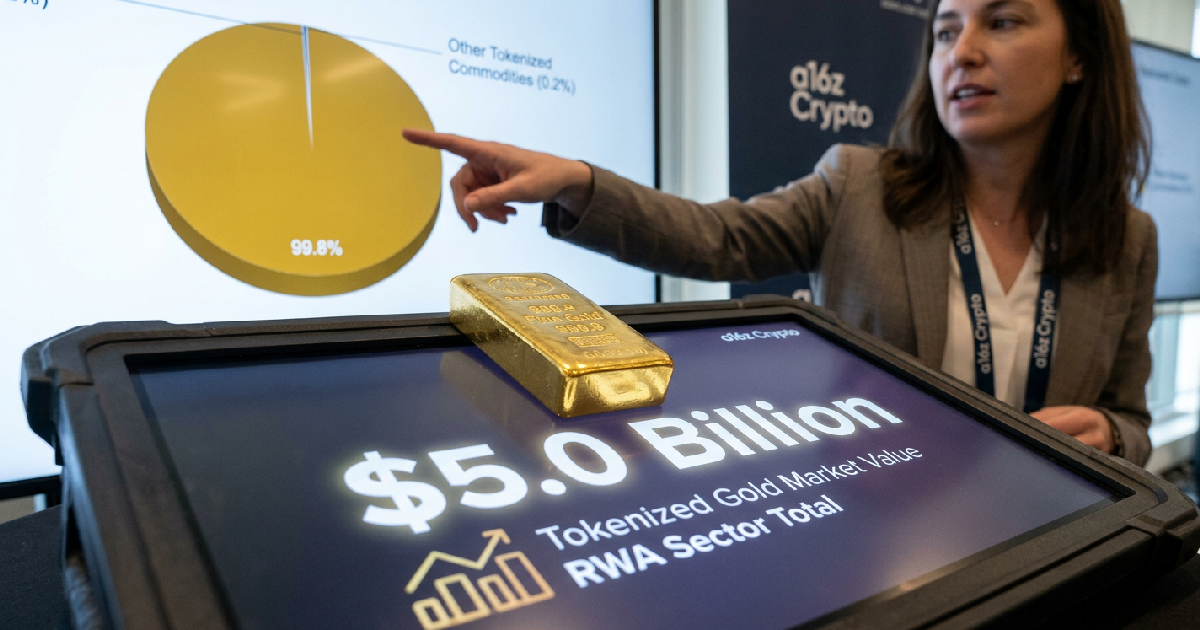

Gold has established near-total dominance over the tokenized commodity market, accounting for approximately 99.8% of the sector according to data from a16z Crypto. As of May 7, 2026, tokenized gold products command nearly $5 billion of the $5.1 billion total market value for on-chain commodities. This overwhelming concentration leaves silver and all other digital commodity products with a combined valuation of just $57.6 million, highlighting a narrow investor focus within the real-world asset (RWA) space.
The rise of tokenized gold is led by two primary issuers, Tether and Paxos. Their respective tokens, Tether Gold (XAUT) and PAX Gold (PAXG), represent the vast majority of the supply. As of early March 2026, these two tokens accounted for roughly 97% of the entire tokenized gold supply. These assets function as digital claims on physical gold held in secure vaults, allowing traders to hold and transfer bullion with the ease of a cryptocurrency.
The broader market for tokenized assets has expanded rapidly, growing from less than $3 billion in mid-2024 to approximately $34 billion recently. This growth has been driven largely by U.S. Treasury debt, which allows investors to access money-market yields in a digital format. While bitcoin price analysis often highlights market volatility, tokenized gold has emerged as a stable counterweight for digital asset portfolios.
Treasury bonds and gold lead RWA sectors
While gold dominates the commodity sub-sector, U.S. Treasury debt remains the largest overall category in the tokenized asset market. Tokenized bonds currently sit at $15.2 billion. Major financial institutions, including BlackRock and Franklin Templeton, have accelerated their efforts to provide these products. They cater to a demand for liquid yield that can be held in digital wallets alongside stablecoins.
This institutional interest comes at a time when traditional market volatility is prompting a flight to quality. Investors are increasingly looking for ways to hedge their portfolios, though macro warning signs emerge as broader market liquidations often coincide with fluctuating treasury yields. For many, holding tokenized gold or Treasurys provides a perceived safe haven within the digital environment.
Data from a16z Crypto indicates that government debt and commodities reached the $1 billion milestone in roughly two to three years. Other categories are moving significantly faster. Asset-backed credit, which includes tokenized Home Equity Lines of Credit (HELOCs), reached $1 billion just 185 days after its first recorded on-chain activity. Specialty finance, covering niches like reinsurance contracts and Bitcoin mining notes, surpassed the $1 billion mark in under two years.
Ethereum remains the preferred network for tokenization
Ethereum continues to serve as the primary infrastructure for these high-value assets, hosting roughly $15.7 billion of the total tokenized market. Other networks are carving out specific niches; the BNB Chain holds $4 billion, while Solana and Stellar account for $2.2 billion and $1.7 billion respectively. The liquidity and established security of Ethereum remain a primary draw for major issuers of gold-backed tokens.
However, the actual utility of these tokens within decentralized finance (DeFi) remains relatively low. Only about 5% of tokenized bond supply, or roughly $800 million, is currently used inside DeFi protocols. Precious metals show similar patterns. Most holders choose to keep their tokenized gold in wallets rather than using it as programmable collateral. This suggests that for many, tokenization is currently serving more as a digitized storage solution than a fully integrated financial tool.
The market faces ongoing pressure from sell-side activity in specific sub-sectors. For instance, Ondo Finance approaches critical support as participants weigh the viability of non-gold commodity tokens. Ondo currently manages some of the largest non-gold products, including tokenized silver (SLVon) and oil (USOon), but these still represent a microscopic fraction of the liquidity seen in the gold-backed market.
Future projections for the multi-trillion dollar market
Despite the current concentration in gold and Treasurys, global financial institutions predict a massive expansion of the tokenized market. McKinsey & Company estimates the sector could reach $2 trillion to $4 trillion by 2030. Standard Chartered offers an even more bullish outlook, projecting the market will exceed $30 trillion by 2034. These forecasts assume a wider array of assets will eventually follow the path blazed by gold.
Standard Chartered analyst Geoffrey Kendrick has projected that tokenized real-world assets could grow to as much as $2 trillion by 2028. The rapid growth of trading volume supports this trajectory. Total trading volume for tokenized gold surged to $178 billion in 2025, a 227% year-on-year increase from 2024. This made it the world’s second-largest gold investment vehicle, trailing only the SPDR Gold Shares ETF.
By the first quarter of 2026, spot trading for gold-based tokens reached $90.7 billion, already surpassing the total volume recorded for the entire year of 2025. This momentum suggests the infrastructure for a blockchain-based global trade system is being solidified. While other commodities like copper remain in early stages, the “digital gold” narrative has provided a proven framework for institutional-grade asset migration to public blockchains.