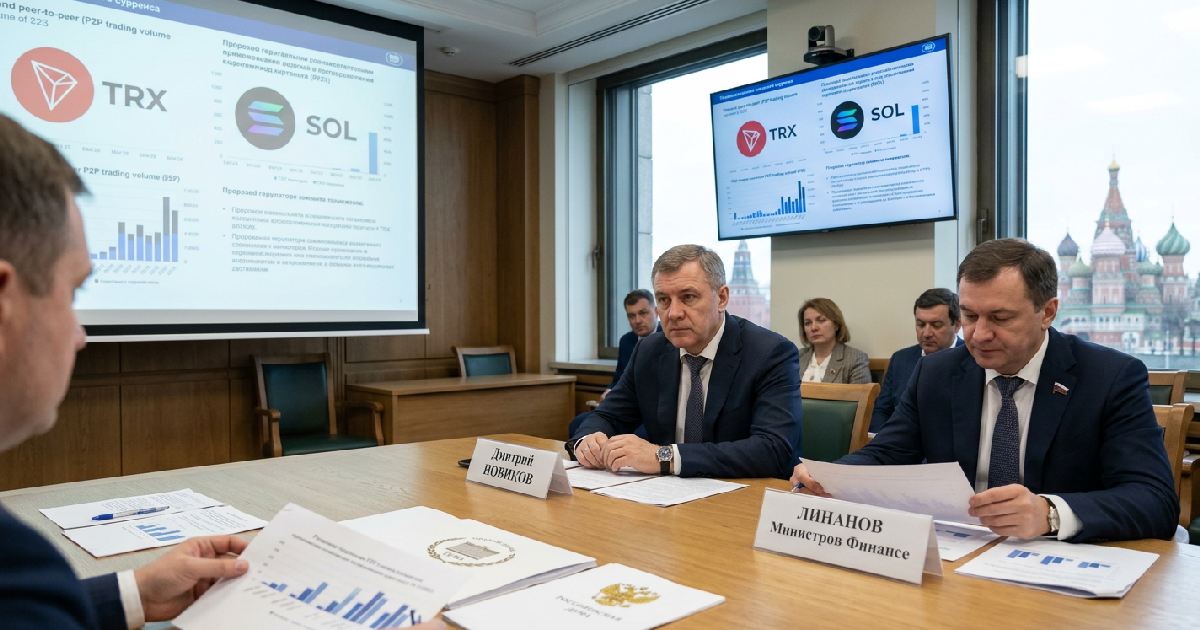
Dmitry Novikov, a member of the State Duma and the Liberal Democratic Party of Russia (LDPR), has reportedly submitted a series of amendments to the Ministry of Finance aimed at loosening proposed restrictions on digital currency. The amendments, which surfaced through reports by the Interfax news agency, seek to legalize peer-to-peer (P2P) trading for individual citizens and expand the list of approved digital assets to include networks like Tron (TRX) and Solana (SOL). These proposals arrive as Russian lawmakers work toward finalizing a comprehensive regulatory framework for the country’s maturing digital asset sector.
The current legislative draft, titled “On Digital Currency and Digital Rights,” has faced pushback from various political and market figures who argue the existing language is too restrictive. Initial versions of the bill reportedly sought to limit digital asset purchases to licensed entities registered with the Central Bank of Russia (CBR). By advocating for the legalization of direct P2P swaps for cash, Novikov argues that the law must reflect the reality of the domestic market, where a substantial portion of transactions occurs through direct peer exchanges rather than centralized platforms.
Government officials have previously acknowledged the massive scale of the grey market they are attempting to bring under formal oversight. Proponents of the new amendments suggest that a total ban on P2P trading would be difficult to enforce and could hinder efforts to create a transparent, regulated environment. The goal of the LDPR’s proposal is to bridge the gap between strict state control and the decentralized nature of the crypto economy.
Expanding the Whitelist Beyond Major Tokens
A central component of the proposed changes involves the “whitelist” of assets permitted for domestic trading within Russia. Current criteria for asset inclusion are reportedly quite high, often limiting the scope to established assets like Bitcoin and Ethereum. This has led to concerns that the framework may be too rigid for a rapidly evolving market.
Lawmakers are now pushing to include tokens like TRX and SOL, citing practical reasons for their necessity. Since many users interact with stablecoins on these specific networks, they require the native tokens to cover transaction fees. Including these assets would ensure that the regulated environment remains functional for participants. This shift comes as the global Ethereum network activity grows and users increasingly look for faster, lower-cost alternatives for decentralized finance (DeFi).
The inclusion of a wider variety of tokens represents a move toward a more permissive atmosphere than what was initially envisioned by the central bank. By allowing for a broader range of assets, proponents hope to prevent Russian capital from flowing toward unregulated offshore platforms that offer more flexibility.
Adjusting Investment Limits and Self-Custody Rights
The amendments also address the financial thresholds placed on individual investors. While the initial framework proposed relatively low annual limits for non-qualified investors, the new suggestions advocate for a significant increase in these caps. Lawmakers are reportedly arguing for monthly limits that would allow for a much higher total annual investment, providing more freedom for citizens to manage their portfolios.
Another major point of contention in the legislative debate is the right to self-custody. The legislation has previously been interpreted as potentially prohibiting the withdrawal of digital assets to private, non-custodial wallets. Novikov has argued that such restrictions interfere with a citizen’s right to manage their own property. By legalizing transfers to private wallets, the updated bill would align more closely with the technical nature of blockchain technology.
Such discussions on investor rights and transparency mirror global trends, such as how Stake.com and Fairspin have had to adapt to increasing demands for transparency in their respective sectors. Russian officials appear to be gauging how to balance these demands for autonomy with the state’s need for oversight.
Balancing State Oversight with Economic Growth
The Ministry of Finance must now evaluate these liberalizing suggestions against the Central Bank of Russia’s preference for a closed and tightly monitored system. Historically, the central bank has remained skeptical of digital currencies, citing risks to the ruble and the potential for financial crimes. However, the need to maintain economic liquidity and facilitate international trade in the face of sanctions has created a sense of urgency in Moscow to find a middle ground.
Recent policy moves in other major economies have also influenced the Russian approach. For example, the advancement of the CLARITY Act in the United States has provided a template for how other nations view digital asset classification. Russian lawmakers are or reportedly monitoring these international developments to ensure their domestic rules remain competitive and clear.
Beyond trade mechanics, the proposed changes call for more precise legal definitions within Russian law. The amendments suggest creating distinct legal categories for various types of digital assets, specifically separating standard cryptocurrencies from stablecoins. Currently, the term “digital currency” is used as a broad catch-all, which many argue fails to account for the technical differences between volatile coins and assets pegged to external values.
As the bill proceeds through the legislative process, the final version will determine if Russia adopts a strictly siloed approach or allows for a more open, P2P-friendly ecosystem. Even in times of market volatility, such as when Bitcoin drops amid macro headwinds, Russian officials seem to be moving away from the idea of a total ban in favor of a pragmatic, regulated market.

 By Michael Fawn