
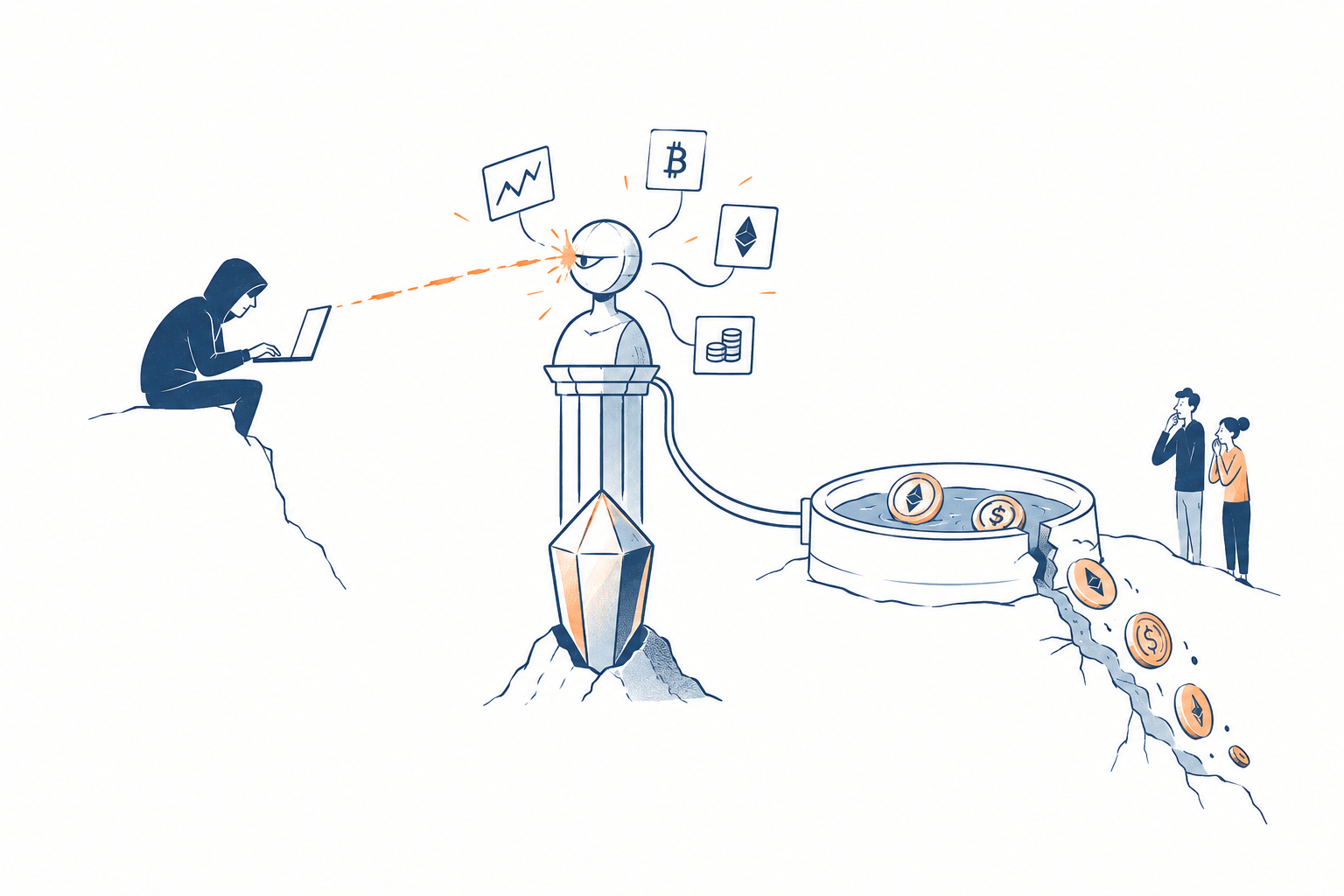

In a DeFi lending market, a price can decide how much someone may borrow or whether their collateral is sold to repay a loan. Even when a smart contract follows its rules, the outcome can be unsafe if the price it receives is misleading.
That dependency creates an opening for DeFi oracle attacks. An oracle supplies information a blockchain cannot determine for itself, such as an asset’s market price. An attacker does not always need to compromise the oracle network; they may exploit the market it observes, an update delay or the way a protocol uses the reported value.
The consequences can include excess borrowing, avoidable liquidations or assets redeemed at an unfair price.
How do DeFi oracle attacks put lending protocols at risk?
Many lending protocols require borrowers to deposit collateral worth more than the amount borrowed. A price feed translates that collateral into a value the contract uses to set borrowing limits and decide when a position is unsafe.
Imagine the feed values a token far above what it could fetch in liquid markets. A borrower may take out more than the collateral could repay; if the price normalises, the protocol can be left with a shortfall. A price distorted in the opposite direction can trigger unnecessary liquidations. Other applications use price feeds to set swap rates, price derivatives or value assets held in a vault.
The contract does not need to malfunction. It may perform every calculation as programmed; the failure is the assumption that its input is trustworthy.
A liquidation is not automatically an attack: in many lending markets, it is a routine safety mechanism. The danger is when manipulated, unsuitable or outdated data triggers a decision the protocol would not otherwise have made.
A manipulated market price is not always a faulty oracle
It is important to distinguish compromising an oracle from manipulating the market it observes.
Some decentralised exchanges calculate prices from the assets held in a liquidity pool. A deep pool can absorb trades more easily; in a thinly traded pool, a large order may shift the exchange rate sharply.
If a lending protocol uses that pool’s spot price — the rate implied by trades at that moment, as its main reference, an attacker may be able to move the reported value by trading against the pool.
The oracle can report the pool’s price accurately while the protocol relies on a reference that is too easy to influence.
Flash loans can help finance some attacks. They allow assets to be borrowed without traditional collateral, provided the loan is repaid within the same blockchain transaction. This can give an attacker substantial temporary buying or selling power.
But a flash loan is a tool, not the underlying vulnerability: the exploit depends on whether the price source can be manipulated profitably and whether the protocol’s safeguards contain the impact.
Decentralisation alone does not settle the question. A network that aggregates reports from several operators reduces reliance on a single participant, but that protection weakens if the operators share data sources or if the underlying price comes from a market with little liquidity.
When a price is accurate but no longer safe to use
Not every dangerous price is manipulated. Data may be reasonable when published but stale by the time a contract reads it.
Feeds do not all update continuously. Depending on configuration, a new report may be triggered when a price moves beyond a set threshold or when a maximum interval has elapsed. These are often called a deviation threshold and a heartbeat, and settings vary by feed, asset and network.
During a sharp market move, a feed can lag behind exchange prices. Network congestion or disruption can add delays. If a lending protocol ignores the update timestamp, collateral may look safer than it is, allowing excessive borrowing.
An old price that is too low can also lead to unnecessary liquidations.
A more robust integration checks more than the number itself. It can verify that the price is positive, that the update is recent enough and that the response is complete. Large differences from other credible references may warrant further checks, while missing or invalid data should trigger a defined response.
Simply stopping every operation is not a perfect solution. Pausing new borrowing may reduce exposure, while pausing liquidations during a market fall can leave lenders carrying more risk. The fallback needs to reflect the protocol’s design, rather than being left to chance.
What should users look for in a protocol’s oracle setup?
Most users cannot audit a smart contract themselves, and a polished dashboard does not prove that its price infrastructure is safe. Documentation, risk disclosures and audit reports can nevertheless help answer three questions.
Where does the price come from? Look for the feed and the markets behind it. A token traded in one small pool carries different risks from a widely traded asset with healthy liquidity across several markets.
Multiple inputs may help, provided they are sufficiently independent and appropriately weighted.
How does the protocol handle stale or abnormal data? The documentation should explain whether the contract checks update times, rejects incomplete responses and has a plan for an unavailable feed. If the project does not explain what happens when a price cannot be trusted, an important part of the risk remains unclear.
What happens if the price is wrong? Borrowing limits, collateral requirements and liquidation rules should account for volatility and pricing errors. An oracle integration cannot compensate for a lending model that permits excessive borrowing against volatile collateral or fails to handle an outlier.
Audits are useful evidence, not a guarantee. Their scope, date and assumptions matter, and a protocol may change after an audit. Nor does using a recognised oracle provider prove that the application has integrated its feed correctly.
These checks cannot certify a protocol as safe; they can show whether its assumptions and failure modes are addressed openly.
Decentralised data cannot fix a flawed lending model
DeFi oracle attacks expose a weakness in automated finance: code can execute correctly while the resulting decision is still wrong. A contract cannot independently judge whether a price reflects a deep market, an unusual trade or conditions that changed after the last update. The data design and the protocol must account for those possibilities.
Combining sources, checking freshness, accounting for liquidity and defining a safe response to missing data can make manipulation harder, but no single control works in every situation. A longer averaging window, for example, may blunt a brief price spike while reacting more slowly to a genuine market move.
For users, the practical lesson is to look beyond the oracle brand. The relevant questions are whether the feed fits the asset, whether the contract knows when to distrust it and whether the lending rules remain resilient when the data is imperfect.
Decentralised price reporting can distribute trust. It cannot remove the need to decide what a protocol should do when the market refuses to behave like a clean number on a screen.