
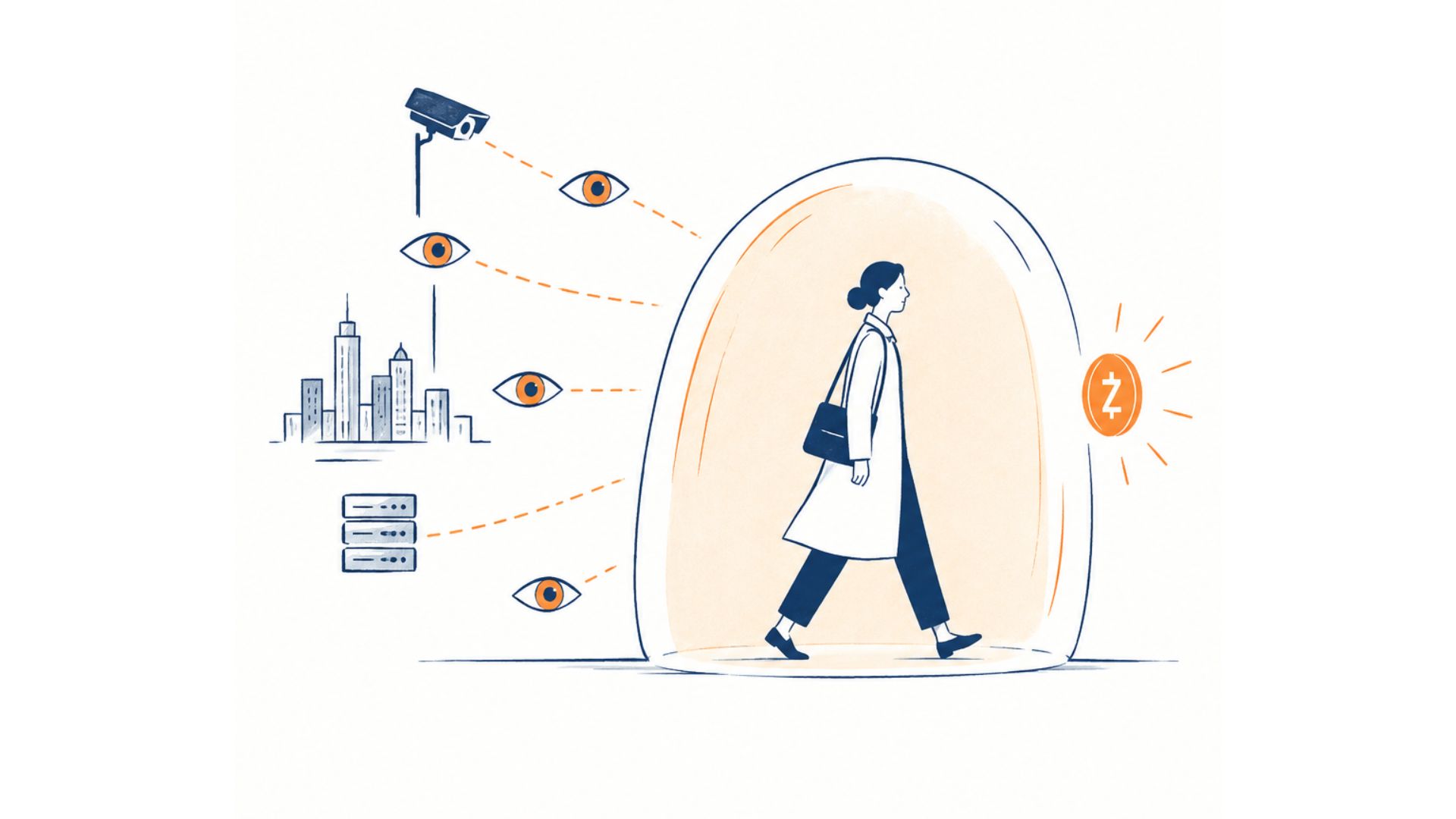

A Bitcoin transaction can reveal more about someone’s finances than a wallet address might suggest. Although addresses do not display their owners’ names, the public blockchain records transfers, amounts and the connections between addresses. If one address becomes linked to an individual or business, other parts of its transaction history may become easier to investigate.
Zcash was designed to offer an alternative. The cryptocurrency allows users to make transactions that protect financial information from public view without abandoning the blockchain’s ability to verify payments.
But does that make Zcash anonymous?
Not necessarily. The cryptocurrency supports both transparent and shielded transactions, and the difference between them is fundamental. Zcash can protect transaction details through cryptography, but using ZEC does not automatically make every payment or a user’s wider financial activity untraceable.
Why Zcash does not make every transaction private
The first distinction to understand is between owning Zcash and using its privacy features.
Zcash, whose native cryptocurrency is ZEC, supports two broad types of addresses: transparent addresses and shielded addresses. Each offers a different level of visibility on the blockchain.
Transparent addresses work in a similar way to Bitcoin addresses. Transactions between them publicly reveal the sending address, receiving address and amount transferred. Anyone examining the blockchain can inspect this information, even if they cannot immediately identify the people behind the addresses.
Shielded addresses are designed to conceal these details. When a transaction takes place entirely between shielded addresses, the sender, recipient and transferred amount are not publicly visible in the conventional way.
The network still records the transaction, but the financial information is protected.
A transaction involving both address types does not provide the same level of privacy as one conducted entirely within the shielded system. If funds move from a transparent address into a shielded address, information associated with the transparent side remains visible.
The reverse can also expose details when funds leave the shielded environment.
The result is a more flexible model than a simple choice between a public and a private blockchain. Users can make transparent transactions when visibility is required and shielded transactions when they want to limit what outsiders can learn.
However, the privacy available in practice also depends on the wallet or exchange being used. Not every service supports every type of Zcash transaction, so owning ZEC alone says little about how much information a particular transfer will reveal.
How shielded transactions hide details without hiding the transaction itself
The mechanism behind Zcash’s privacy features is cryptography, specifically zero-knowledge proofs.
A zero-knowledge proof allows someone to demonstrate that a statement is true without revealing all the information used to establish it. In Zcash, this technology helps the network verify that a shielded transaction follows the protocol’s rules without publishing its underlying financial details.
Consider what a cryptocurrency network needs to establish when someone sends funds. The transaction must be valid, the sender must be authorised to spend the funds, and the same coins cannot be spent twice. A network based on public transaction data can check these conditions using information visible to anyone examining the blockchain.
Zcash takes a different approach for shielded transactions. Cryptographic proofs allow the network to verify the relevant conditions while keeping sensitive information concealed. Zcash uses a form of zero-knowledge proof known as a zk-SNARK, which is designed to make such verification possible without exposing the protected data itself.
A network can establish that a payment is valid without making every detail of that payment public.
This does not mean the transaction vanishes from the blockchain. Its existence and other transaction information, including the network fee, can still be visible. What changes is the information an outside observer can obtain from the transaction record.
That distinction separates Zcash’s approach from the transparent transaction model used by Bitcoin. On Bitcoin, transaction amounts and address-level movements are public by design. On Zcash, shielded transactions can protect those financial details while preserving the network’s ability to validate the transfer.
The technology therefore addresses a specific problem: how to maintain verifiable digital payments without requiring the public disclosure of every financial detail.
It does not, however, answer every question about whether the people involved in a transaction can be identified.
Can a shielded Zcash transaction still be traced?
A fully shielded transaction is designed to prevent an observer from reading its sender, recipient and amount directly from the public blockchain. That is a meaningful form of protection. But the blockchain is only one possible source of information about a person’s financial activity.
A connection to an identity can emerge elsewhere. A customer may send funds through an exchange that records their identity, publicly disclose a payment, or share transaction details with another person.
If these records can be connected to other available information, an observer may learn something about the activity even when the corresponding shielded transaction does not reveal the details on-chain.
The same distinction applies to artificial intelligence. Analytical tools can help investigators compare large datasets, find patterns and organise information that would otherwise take considerable effort to examine.
But they cannot simply reconstruct data that remains cryptographically protected when no sufficient clues are available elsewhere.
The way funds move between transparent and shielded addresses also matters. A transfer crossing that boundary can leave publicly observable information on one side of the transaction. Depending on the circumstances, that information may provide clues about activity associated with the shielded side.
Privacy can therefore be reduced by the path funds take, even without breaking the underlying cryptography.
There are also limits beyond the transaction record itself. Network-level information, such as an IP address, can potentially help an observer correlate activity with other internet traffic. Zcash’s transaction privacy features do not automatically eliminate every form of network-level information leakage.
The ability to share information selectively introduces another nuance. Zcash supports viewing keys, which can allow someone to grant a third party read access to certain information associated with a shielded address without giving that party the ability to spend the funds.
This can be useful for accounting or auditing, but the information accessible depends on the type of key and the wallet’s implementation.
Sharing a viewing key is not the same as making an individual payment public to everyone. Nevertheless, the user must understand what information the recipient will be able to inspect before granting access.
Taken together, these limitations point to a more precise interpretation of privacy. A shielded transaction can protect data at the blockchain level, while an individual’s wider financial activity may still generate information through exchanges, network connections or voluntary disclosures.
A transaction being difficult to trace on-chain is not the same as proving that its participants are impossible to identify.
So, is Zcash anonymous?
The answer depends on what kind of transaction takes place and what information an observer can access.
A transparent Zcash transaction does not provide the same financial privacy as a fully shielded one. When both addresses are transparent, the sender, recipient and amount can be examined on the public blockchain.
When a transaction takes place between shielded addresses, those details are protected by cryptography, although the transaction itself remains part of the network’s public record.
Even then, shielded transactions should not be treated as a guarantee of absolute anonymity. Records held outside the blockchain, information revealed by the user and clues exposed when funds cross between transparent and shielded addresses can all affect how much of an activity can be connected to an identity.
The distinction from Bitcoin is therefore not simply that one cryptocurrency is public and the other is private. It is that Zcash gives users the option to protect transaction details at the protocol level, rather than requiring those details to be publicly visible for every payment.
For anyone evaluating Zcash’s privacy, the most useful question is not whether the cryptocurrency is anonymous in the abstract.
It is whether a particular transaction keeps its sensitive details shielded throughout the payment process, and what information remains available outside that protection.
That is where the difference between pseudonymity and financial privacy becomes practical. An address without a name can still leave a revealing trail. Cryptographic privacy can limit that trail considerably, but it cannot automatically control every source of information connected to the person using it.