
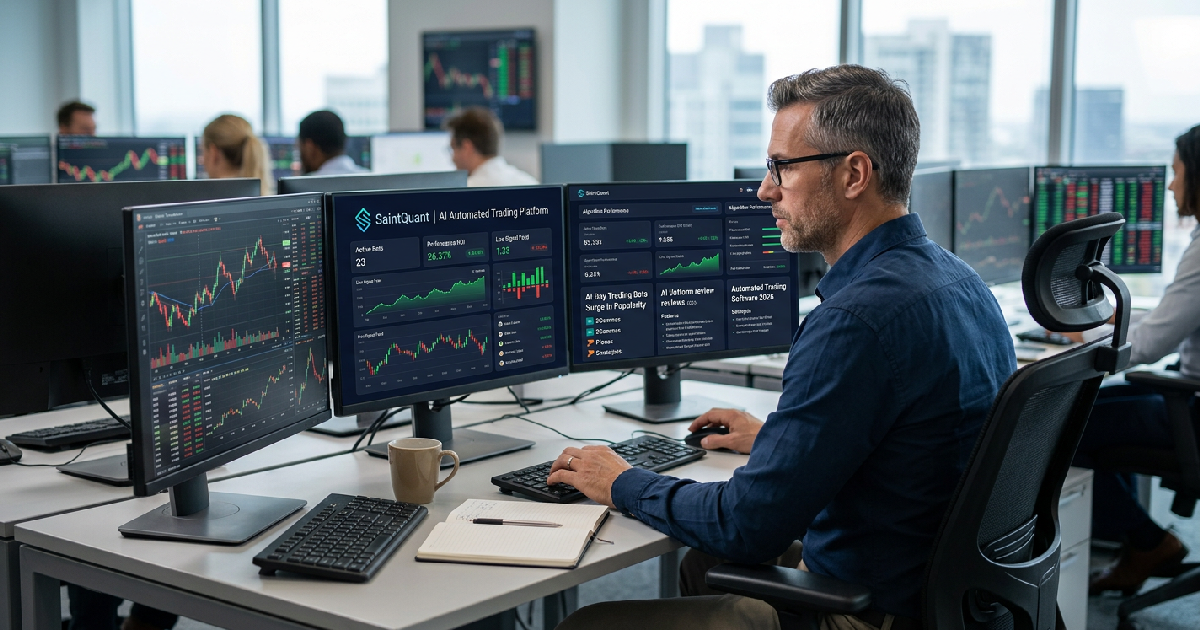

Automated quantitative trading platform SaintQuant has emerged as a top-rated tool in a recent industry evaluation of AI-driven day trading applications, ranking alongside prominent competitors such as 3Commas, Pionex, and Cryptohopper. The assessment highlights a broader shift among retail investors who are moving away from manual chart monitoring in favor of algorithms capable of managing volatility on major exchanges like Binance and Coinbase. While SaintQuant secured high marks for its focus on pre-built institutional strategies, others like 3Commas and Cryptohopper were recognized for their granular customization and multi-exchange connectivity, respectively.
The rise of these platforms comes at a time of intensifying market complexity. Digital assets and stock futures now react to global data releases around the clock, often moving faster than human traders can execute manual orders. By utilizing machine learning to enforce discipline and remove emotional bias, these bots have shifted from niche technical toys to foundational tools for active day traders. But analysts warn that even as algorithms manage risk more efficiently, they do not eliminate the inherent dangers of market fluctuations.
As Bitcoin leads crypto fund inflows amid shifting regulatory landscapes, the demand for automation that can handle 24/7 liquidity has spiked. This surge in interest is driving a competitive race among software providers to offer more transparent, verifiable performance data rather than just backtested projections.
Analysis of Leading AI Trading Bot Architectures
The evaluation of these automated platforms reveals a diverse range of technological approaches to day trading. SaintQuant maintains a strong market position by providing what it describes as quantitative strategies for a wide user base, which allows individuals to deploy high-frequency trading logic without needing to write code. The platform reportedly manages a substantial volume of completed trades for a growing number of user accounts, using a tiered system that targets specific daily returns based on risk profiles.
Automated Strategy Types and Their Market Fit
Understanding the underlying mechanics of these bots is essential for matching them to a specific trading style. Most top-tier platforms currently utilize several primary bot architectures to navigate price action:
- Dollar-Cost Averaging (DCA) Bots: These tools reduce timing risks by buying assets at regular intervals. They are particularly effective during accumulation phases or in volatile markets where a single entry price is risky.
- Grid Trading Bots: These platforms place a series of buy and sell orders at set price intervals. This strategy excels in sideways or ranging markets, allowing traders to profit from small price fluctuations without a clear directional bias.
- Scalping and Momentum Swing Bots: These high-level tools utilize indicators like RSI or volume spikes to capture quick profits. These are often used by platforms aiming for institutional-style gains over shorter durations.
While SaintQuant focuses on simplicity, 3Commas caters to those who want complete control over their automation workflows. It allows for the integration of custom signals from third-party chart providers, giving traders the ability to set trailing take-profits and stop-losses that adapt to real-time volatility. This level of customization is becoming critical as Bitcoin tests resistance levels that require precise entry and exit timing.
Balancing Cost and Customization in Automated Trading
For traders prioritizing cost-efficiency, recent industry rankings have highlighted Pionex as a popular choice for beginners. Unlike many competitors that charge monthly subscription fees, Pionex reportedly integrates its bots directly into its native exchange, removing the need for complex API setups. This entry point has made it a common option for those looking to automate crypto trading without a prior background in coding.
On the other end of the spectrum, Cryptohopper remains a preferred option for traders managing portfolios across several different platforms. Its ability to synchronize bots across multiple exchanges provides a centralized dashboard for global liquidity. However, this convenience often comes with a steeper learning curve and higher monthly costs compared to simplified alternatives. Security also remains a paramount concern, as security firms launch quantum-proof wallets and other protective measures to keep pace with the increasing sophistication of automated trading environments.
Verification and Risk Management Standards
The industry has pivoted toward more rigorous verification. A good AI day trading bot is now judged by its transparency in strategy logic and its built-in risk controls. Leading platforms have implemented mandatory stop-loss requirements and exposure limits to prevent the “wipeout” scenarios that plagued earlier versions of automated software. Traders are increasingly looking for platforms that offer real-time monitoring and cold storage for deposited funds, ensuring that the automation process doesn’t compromise the safety of the underlying capital.
Future Outlook for Algorithmic Retail Trading
The transition toward AI-driven automation appears permanent. As institutional-grade tools become more accessible to retail participants, the gap between standard day trading and quantitative analysis is narrowing. Platforms like SaintQuant are expected to continue expanding their partnerships with major global exchanges, potentially integrating even more sophisticated machine learning models that can predict short-term sentiment shifts.
Technological barriers will likely continue to fall. The tools that succeed in the coming months will be those that offer the best balance between ease of use and the institutional rigor required to survive high-volatility environments. For the active trader, the choice is no longer whether to automate, but which specific algorithm best fits their long-term risk appetite and lifestyle.