
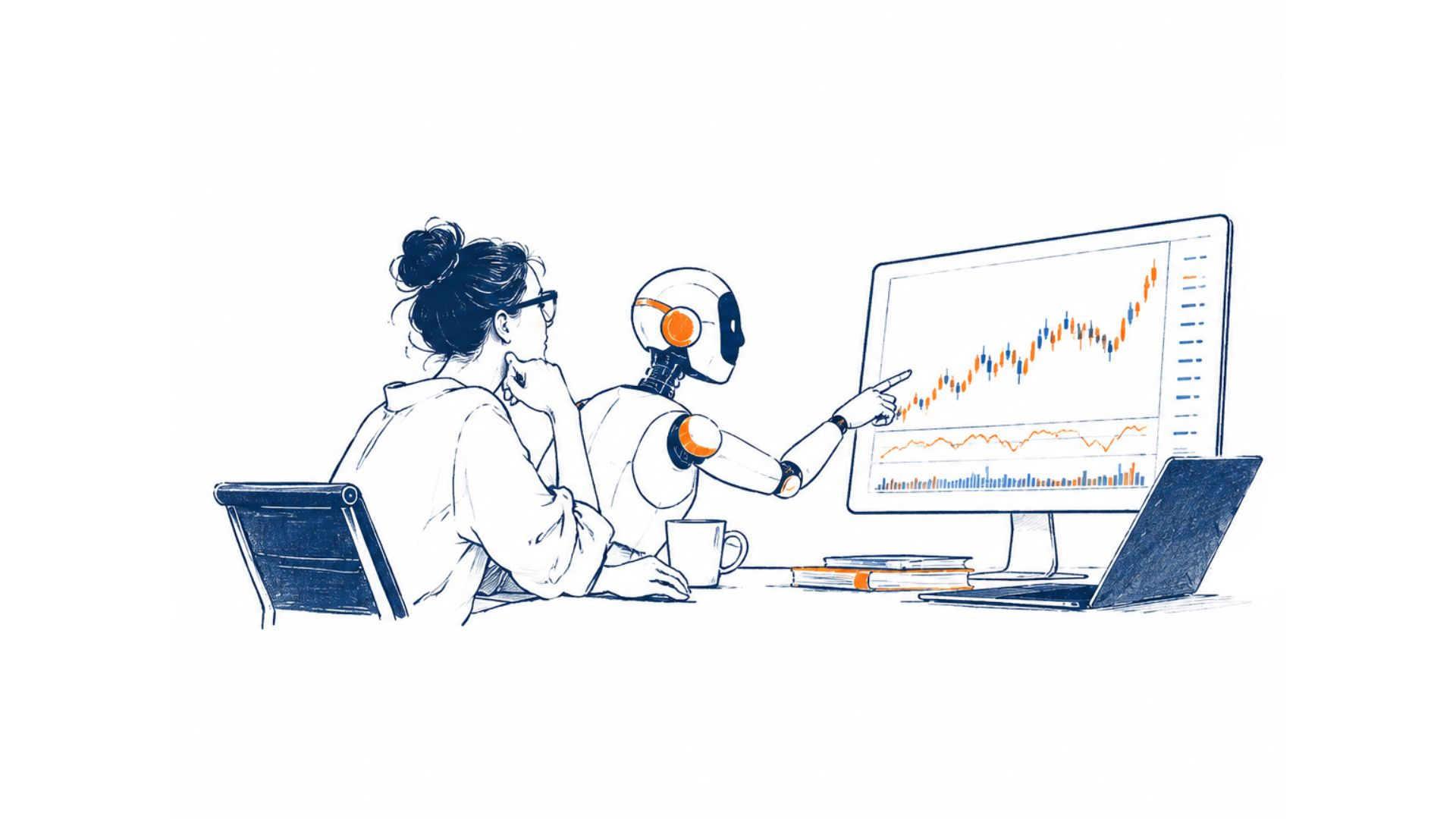

An AI tool can read more market data in seconds than most people could reasonably monitor on their own. That does not mean it knows where Bitcoin or another cryptocurrency is going next.
That distinction sits at the centre of AI crypto trading. The technology is changing how traders collect information, monitor markets and execute parts of a strategy, but it is not removing the uncertainty that makes trading difficult in the first place.
For individual traders, the shift matters because the competitive advantage in crypto is gradually moving away from simply having access to a market. Exchanges can compete on lower fees and broader product ranges, while software can make analysis faster.
The harder question becomes what a trader does with that information once the machine has filtered it.
How AI is changing crypto trading before the order is placed
The most useful role for artificial intelligence in crypto trading may happen before a buy or sell order is ever submitted.
A trader can monitor price movements, trading volume, funding rates, order books, on-chain activity, news and social signals. The difficulty is not necessarily finding data. It is deciding which pieces deserve attention and how they fit together.
AI can act as a layer between the raw market and the person watching it. A system may summarise large amounts of information, flag unusual changes, compare several markets or identify patterns that would be difficult to spot manually.
That can reduce the amount of routine work involved in market analysis.
It does not, however, turn those signals into answers. A sudden increase in volume could mark a genuine shift in demand, a short-lived reaction to news or simply a burst of speculation. The software can identify the change. The trader still has to decide what it means.
That distinction is relevant because the promise of AI crypto trading is often framed as prediction. In practice, one of its more realistic advantages is information management.
An AI trading bot is not the same as AI-assisted analysis
The phrase “AI trading bot” can make several different technologies sound identical.
A conventional trading bot follows a set of rules. If price reaches a particular level, or if a technical indicator meets a predefined condition, the software takes an action. Automation removes the need for the trader to click the button manually, but the underlying logic still comes from the strategy designed in advance.
AI-assisted trading can involve a broader set of tasks. Models may classify information, summarise market developments, detect relationships across datasets or help a trader examine scenarios before making a decision.
A bot that executes a fixed strategy is not necessarily using artificial intelligence in a meaningful analytical sense.
The distinction also changes how results should be judged. Automation can make execution faster and more consistent in crypto trading, but speed is useful only when the underlying strategy makes sense. Adding AI to the interface does not automatically make a weak trading system stronger.
More data can make a trader faster without making the decision easier
Crypto markets create an unusual information problem. They run continuously, operate across multiple venues and produce new data constantly.
For a human trader, that can create the opposite of an advantage. More information can mean more noise.
AI can help by compressing that information into something easier to review. A trader who would otherwise spend an hour checking several dashboards may receive a much shorter list of developments that deserve attention.
The benefit in crypto trading is therefore less about knowing everything and more about deciding what not to look at.
Yet there is a trap here. A neatly organised answer can feel more reliable simply because it is easier to read. An AI system can find a correlation without establishing causation, highlight a pattern that disappears in another market condition or build a convincing interpretation from incomplete information.
The cleaner the output looks, the easier it can be to forget that the underlying market remains messy.
This is one reason AI crypto trading should be understood as an extension of the decision-making process rather than a replacement for it.
What falling trading costs change — and what they do not
The economics of execution in crypto trading are changing alongside the technology.
Maker and taker fees are charged according to whether a trader adds liquidity to an order book or executes an existing order. Some platforms offer zero-fee trading on selected products or under specific conditions, reducing the direct cost of placing trades.
But a lower headline fee does not mean that trading has become costless.
Spreads, slippage and liquidity still affect the price at which an order is actually executed. Different products can also have different fee structures and risks.
More importantly, cheaper execution can encourage more activity. A trader who feels there is little cost to placing another order may become more willing to act on a weak signal.
That creates an interesting relationship between AI and lower fees. Both reduce friction, but neither reduces uncertainty. One makes information easier to process; the other makes execution easier. The quality of the decision connecting the two still matters.
The new edge may be knowing when not to trust the machine
As AI tools become better at producing market summaries and signals, human judgement does not disappear. It changes position.
Instead of spending most of the time collecting information, a trader may spend more time questioning the information that has already been processed.
That means understanding why a signal appeared, what data sits behind it and which assumptions could make it fail. It also means recognising when several indicators are simply describing the same market event in different ways.
Risk management remains part of that process. No model can remove the possibility that an unexpected event changes market conditions faster than a strategy can adapt.
This becomes particularly important when a tool gives a very confident-looking answer. Confidence in presentation is not the same as confidence in the forecast.
The human contribution, then, may become less about processing every available data point and more about setting boundaries for the machine: what should it monitor, which signals matter, when should an automated strategy act and when should it stop?
The smarter the interface becomes, the more important the infrastructure behind it
There is another consequence of the shift towards AI-assisted trading. As exchanges add more analytical tools, automated strategies and financial products, the platform itself becomes part of the decision.
A trader may be choosing not just where to place an order, but where market data is gathered, how positions are managed and, in some cases, where assets are held.
That brings familiar crypto concerns back into the picture: liquidity, custody, security and transparency.
For example, proof of reserves can provide information about certain assets and liabilities held by a platform, but it does not answer every question about operational or counterparty risk. A technologically sophisticated exchange is still an intermediary whose infrastructure matters.
This is why AI does not make the rest of the trading environment less important. It can make the interface more efficient while increasing the amount of activity concentrated within it.
Crypto trading is becoming easier to process, not easier to predict
The most meaningful change brought by AI to crypto trading may have little to do with a machine predicting the next candle.
It is happening in the layer between the market and the trader.
AI can organise information, surface patterns and automate parts of execution that once demanded constant attention. Lower trading costs can remove another layer of friction. Together, those changes can make sophisticated tools more accessible to individual traders.
But the central problem remains.
Markets can still move for reasons that are difficult to model. Signals can conflict. Data can be incomplete. A strategy that worked in one environment can fail in another.
That leaves a more interesting question than whether AI can trade for you. The real question is whether you can use it without confusing faster analysis with better judgement.
In that sense, the future of AI crypto trading may be less about replacing the trader than about changing what the trader is expected to do.