
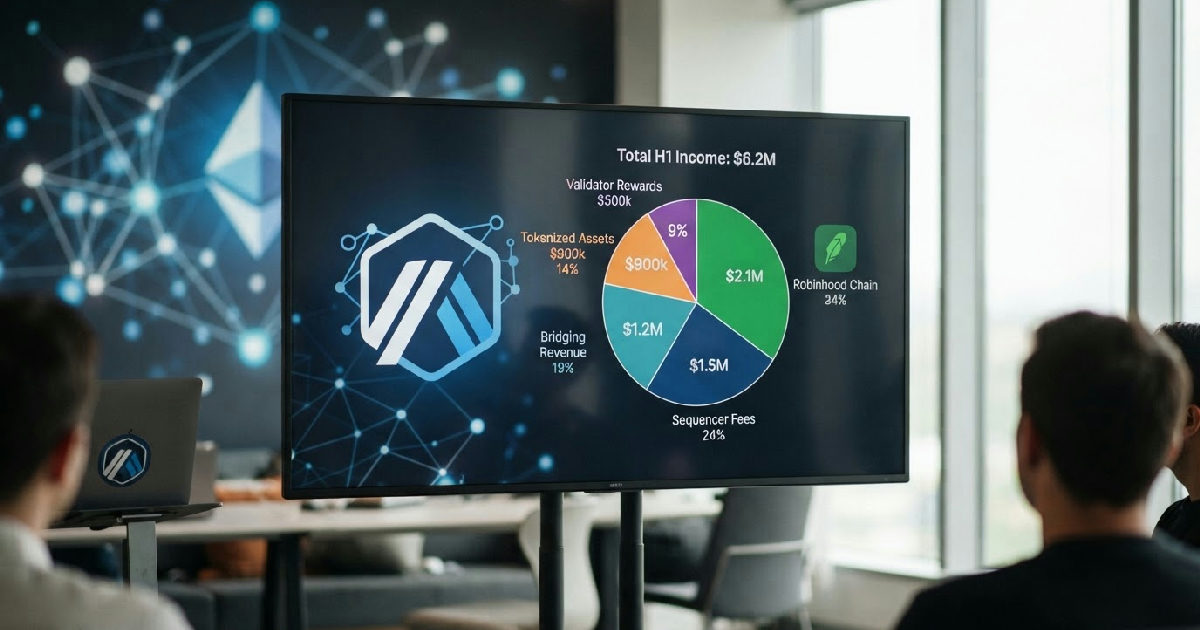

The Arbitrum DAO generated $6.19 million in income during the first half of 2026. 19 million in income during the first half of 2026, a sign of growing financial maturity for the Ethereum layer-2 network.
A bi-annual progress report from the Arbitrum Foundation detailed how the launch of Robinhood Chain is already creating a significant new revenue stream, diversifying the DAO’s income beyond its native transaction fees.
According to the report covering the six months ending June 30, licensing fees from the Arbitrum Expansion Program (AEP) are proving to be a powerful contributor. In July, the first month Robinhood Chain was active on mainnet, these fees accounted for a remarkable 35% of the DAO’s total monthly income, demonstrating the immediate impact of licensing Arbitrum’s technology stack to outside partners.
Robinhood Chain emerges as a powerful growth engine for Arbitrum DAO
The success of the Robinhood Chain, which launched on July 1, provides a clear validation for Arbitrum’s strategy of expanding its ecosystem through partnerships. The AEP requires chains that use Arbitrum technology but settle directly to Ethereum—like Robinhood Chain—to return 10% of their net protocol revenue back to the Arbitrum ecosystem.
This model creates a direct financial benefit for the DAO from the activity of other networks.
In July alone, AEP licensing fees brought in $360,000. This single source now represents a major pillar of the DAO’s finances, underscoring a shift from relying solely on Arbitrum One transaction fees.
The rapid growth has prompted optimistic projections, with Arbitrum Foundation Head of Investment Strategy Brendan Ma noting that third-quarter income is on track to exceed the second quarter by over 40% based on July’s performance. The recent surge in resurgent DeFi demand appears to be providing a tailwind for on-chain activity.
Activity on Robinhood Chain itself has been explosive. On September 1, users paid a record $3.75 million in daily fees on the network. Daily DEX trading volume on Robinhood Chain reached $1.43 billion, and the total value locked (TVL) has climbed to roughly $1.4 billion just two months after its launch.
This intense activity, which followed over 200 million transactions on its public testnet, directly translates into revenue for the Arbitrum DAO.
Analyzing Arbitrum’s core financial health
Beyond the new licensing income, the foundation’s report paints a picture of a financially sound and diversifying operation. The DAO’s $6.19 million in first-half income was generated across four distinct lines: Arbitrum One transaction fees, Timeboost priority access auctions, the AEP licensing fees, and returns from treasury management.
This multi-faceted approach yielded a gross margin on protocol revenue exceeding 97%, compared with more than 90% for the full year 2025.
The DAO also maintains a substantial treasury, holding $125 million in non-ARB assets as of the end of June. This financial cushion provides stability and resources for future development and grants. “The first half of 2026 shows the Arbitrum ecosystem’s financial profile broadening,” said Brendan Ma in a statement.
“It now looks like a diversified economic enterprise, with four income lines at a blended gross margin above 97%.”
Ecosystem metrics support this narrative of sustained growth. The network processed 478 million transactions during the six-month period, contributing to a lifetime total of 2.7 billion. Average monthly stablecoin transfer volume exceeded $70 billion, and Arbitrum has become a leading platform for tokenized real-world assets (RWAs), hosting 3,317 such assets according to data from RWA.xyz.
Enterprise adoption signals mainstream convergence
The financial success is mirrored by growing adoption from major global enterprises, highlighting what Ma describes as “the convergence of traditional finance and onchain finance.” This trend is perhaps best exemplified by Robinhood, which had previously issued its tokenized stocks on Arbitrum One before building its own dedicated chain.
The move shows how major financial players are leveraging the Arbitrum technology stack for their own services, a broader pattern reflecting TradFi expansion into the crypto space.
Other notable integrations include LG Electronics, which announced a pilot for an on-chain advertising network on Arbitrum in June, and Mastercard, which expanded its support for stablecoin settlements on the network. PayPal’s PYUSD stablecoin also saw its circulation on Arbitrum peak at $475 million in the first quarter, reinforcing the network’s status as a key hub for stablecoin activity.
This flurry of positive news has not gone unnoticed by the market. The ARB token jumped 25% on September 1, a rally attributed to the impressive fee generation from Robinhood Chain and a technical breakout.
Despite this, the token remains 95.5% below its all-time high of $2.39 set in January 2024, suggesting that while the DAO’s fundamentals are strengthening, the token’s market performance has yet to fully reflect this progress.
This disparity exists even as broader market indicators, such as Bitcoin ETF inflows, show renewed investor interest in digital assets. As the Arbitrum ecosystem continues to mature and its revenue streams diversify, the long-term sustainability of the project appears robust.