
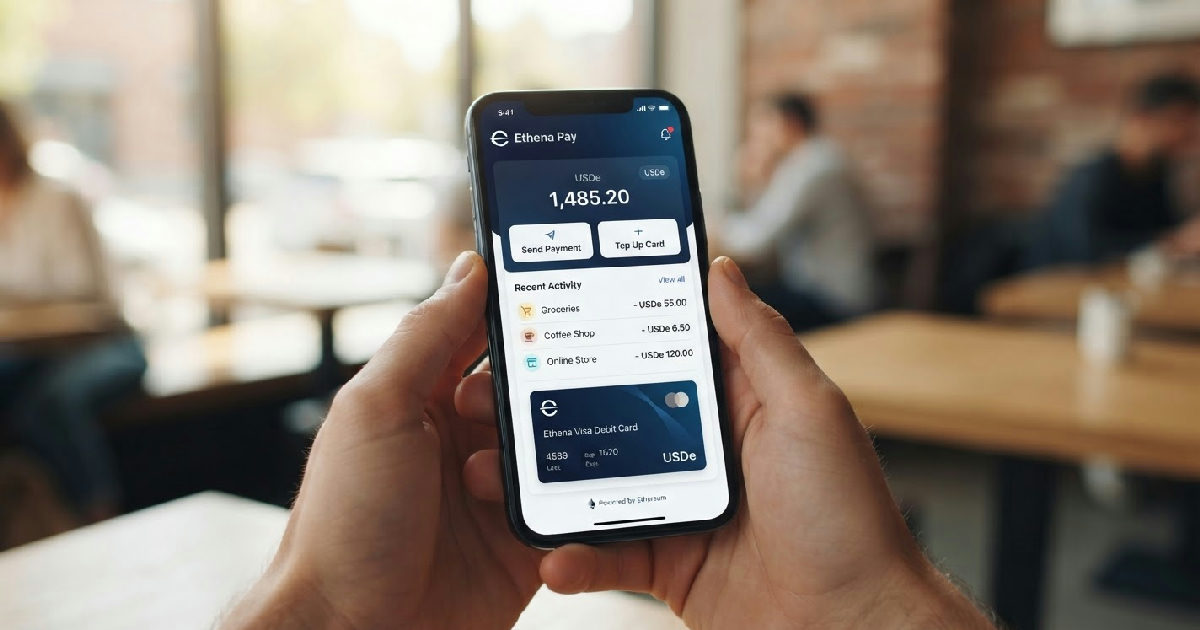

Ethena Labs formally launched “Ethena Pay” on September 1, 2026, UTC, introducing a self-custodial payment application designed to weave its USDe synthetic dollar into the fabric of daily financial transactions. This new platform, dubbed “the internet money neobank,” aims to bridge the gap between digital assets and traditional banking functions, offering users high-yield savings, virtual payment cards, and streamlined international transfers.
The beta rollout began with a select group of 400 early users, with Ethena Labs planning to expand access weekly throughout September. This strategic phased launch underscores the company’s ambition to integrate stablecoins directly into consumer spending and savings habits, moving beyond their traditional role in cryptocurrency trading.
The Ethena USDe Payment App and Everyday Transactions
Ethena Pay positions itself as a comprehensive digital finance solution, combining USDe balances with capabilities for conventional bank transfers, crypto transfers, and card-based spending. While it functions much like a digital bank, Ethena Pay Ltd, incorporated in Malta, explicitly states it does not hold customer funds, maintaining its self-custodial nature. This distinction is crucial in navigating regulatory landscapes.
Users gain access to a virtual Visa card within minutes, enabling spending at over 130 million merchants globally. The platform also supports digital wallet integrations, starting with Apple Pay and with Google Pay slated to follow. These features highlight Ethena’s push to make stablecoin usage as seamless as traditional fiat payments.
The initial launch encompasses 48 countries, including significant markets such as Brazil, Mexico, South Africa, the Philippines, Singapore, the UAE, Australia, and Japan, alongside broader regions like Latin America, the Caribbean, Africa, and Asia. Notably, major economies including the U.S., EU, Canada, South Korea, the U.K., and Taiwan are excluded from this initial rollout.
Expansion into these markets will depend heavily on navigating complex regulatory requirements and securing product approvals.
Ethena Pay facilitates instant global transfers, allowing users to send funds for settlement in local currencies. Furthermore, it offers free fiat on-ramps for USD, GBP, and EUR, providing users with bank account numbers tied directly to their self-custodial stablecoin wallets.
This enables receiving fiat via International Bank Account Number (IBAN) details or transferring crypto directly, with balances appearing as USDe, streamlining the conversion process. The burgeoning field of crypto card spending is rapidly evolving, driven by innovations like these.
High Yields and Cashback Incentives Drive Adoption
A central pillar of Ethena Pay’s strategy to attract and retain users is its tiered reward system, offering competitive yields on USDe balances and cashback on card purchases. The platform features three distinct membership tiers: Standard, Pro, and VIP, each with escalating benefits designed to incentivize greater engagement and higher stablecoin deposits.
Standard tier users can earn an annualized 5% yield on USDe balances up to $5,000. For those opting for the Pro tier, the yield increases to 6% on balances up to $15,000, requiring a deposit of $2,000 in USDe, inviting 10 new users, or locking $2,000 worth of ENA tokens.
The VIP tier offers the highest potential, with a 6% yield on balances up to $50,000, attainable by depositing $10,000, inviting 50 users, or locking $10,000 in ENA tokens. All yields are paid out daily, providing a consistent stream of passive income.
Cashback incentives further sweeten the deal, paid in AVAX. Standard users receive 4% cashback, capped at $100 monthly. Pro members enjoy 4.5% cashback (5% at selected merchants), with a monthly cap of $360. VIP status unlocks 5% cashback (up to 10% at premium merchants like Spotify, Uber, and Claude), capped at $1,000 per month.
Cashback is converted to AVAX based on the rate at the time of credit issuance, typically within 1-3 business days post-settlement, offering a tangible reward for spending. Such incentive models are increasingly seen in the industry, including how AI agents utilize stablecoins for payments in autonomous commerce.
Ethena Pay also introduces a novel “Buy Now Pay Never” feature, designed to leverage savings rewards to cover purchases without directly touching the principal balance. This innovative approach aims to make high-yield stablecoin savings more attractive by demonstrating immediate utility and financial flexibility to users.
The combination of high yields and robust cashback programs reflects a broader trend among crypto platforms to provide compelling financial incentives that rival or surpass traditional banking offerings.
Technical Backbone: USDe and Avalanche Network
At its core, Ethena Pay relies on Ethena Labs’ synthetic dollar, USDe, which boasts a circulating supply estimated between $4 billion and $4.2 billion. This synthetic dollar serves as the primary asset within the application, facilitating both savings and spending. The choice of USDe underscores Ethena’s commitment to its own ecosystem and its vision for a decentralized, censorship-resistant digital dollar.
The application leverages the Avalanche (AVAX) network as its exclusive settlement layer. Ethena Labs cited Avalanche’s low transaction costs, rapid finality, and robust infrastructure as key factors in this decision. This strategic choice ensures that transfers, card-related money movements, and payments within Ethena Pay are processed efficiently and economically, addressing common pain points associated with blockchain transactions.
For payment card services, Third National acts as the issuer, operating under a license from Visa. This partnership with a major global payment network like Visa is critical for Ethena Pay’s ambition to achieve widespread merchant acceptance.
It also provides a vital link between the crypto-native USDe and the traditional financial infrastructure, enhancing the platform’s legitimacy and usability in mainstream retail environments. This kind of collaboration is becoming more common, with Visa forging alliances for stablecoin payments and AI commerce.
Beyond cards, Ethena Pay maintains competitive transfer fees, with free transfers between users via usernames or tags, and free bank transfers in USD, EUR, and GBP. Transfers in other currencies incur a modest fee ranging from 0.05% to 0.1%. This fee structure is designed to encourage broad adoption and seamless cross-border transactions, further cementing Ethena Pay’s role in expanding the utility of stablecoins.
Expanding the Horizon for Stablecoins
Ethena Pay represents a significant step in the ongoing effort to integrate stablecoins more deeply into the global financial system. By offering a comprehensive suite of banking-like services without functioning as a traditional bank, Ethena Labs is carving out a distinct niche.
This model allows users to benefit from high yields and the flexibility of digital assets while sidestepping some of the regulatory complexities tied to licensed financial institutions in certain jurisdictions.
The platform’s phased global rollout, prioritizing regions with potentially more favorable regulatory environments or higher demand for alternative financial services, reflects a pragmatic approach to market entry. As Ethena Pay gradually expands its reach and potentially enters more stringently regulated markets like the U.S.
and EU, it will serve as an important test case for how synthetic dollars and self-custodial solutions can coexist and thrive alongside established financial frameworks.
Ultimately, Ethena Pay’s success will hinge on its ability to sustain attractive yields, maintain robust security, and continually expand its utility and accessibility. Its entry into the market underscores a growing trend where blockchain technology is not just disrupting finance but actively seeking to enhance and integrate with everyday economic activities, offering new avenues for savings, spending, and global money movement.