
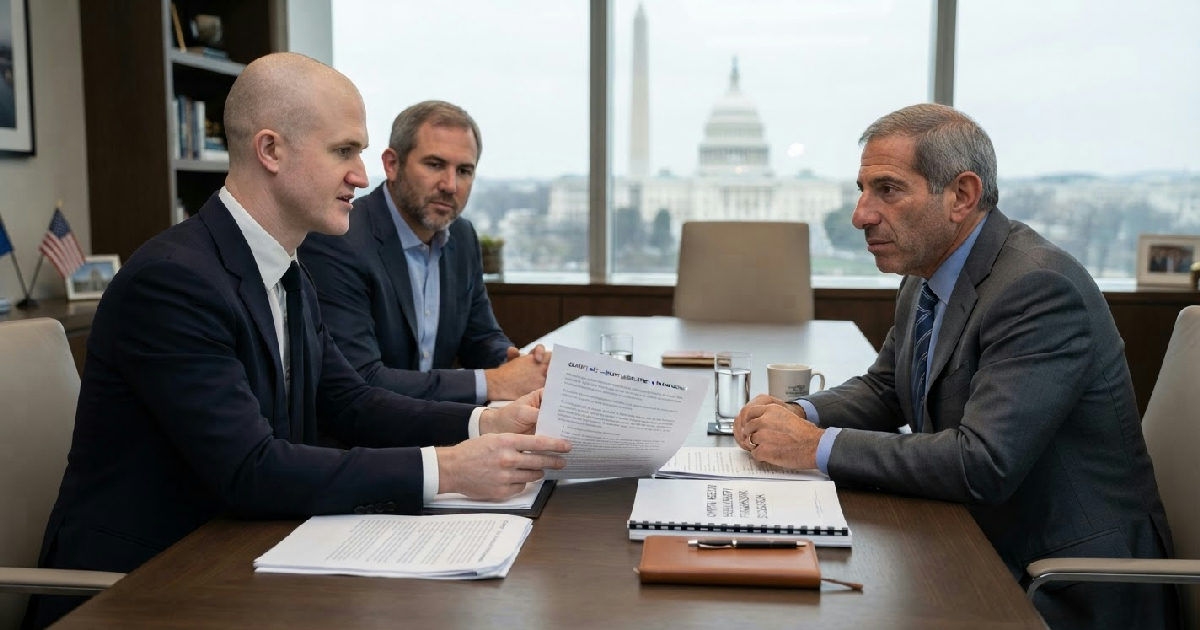

Coinbase CEO Brian Armstrong and Ripple CEO Brad Garlinghouse reportedly met privately with U.S. Commerce Secretary Howard Lutnick on Tuesday, August 18, 2026. The closed-door discussion focused on the Digital Asset Market CLARITY Act and the regulatory hurdles currently facing the industry. High-profile crypto executives used the session to push for clear federal guidelines over digital asset classifications.
The private meeting occurred shortly before a separate, scheduled event where President Donald Trump hosted a White House crypto meeting with industry leaders. This dual engagement signals a strategic shift in how digital asset regulations are being negotiated in Washington. Instead of reacting to individual court fights, executives are directly lobbying administration officials.
Why Brian Armstrong and other industry leaders align behind the bill
Eleanor Terrett of Crypto in America first reported the private session, which brought together some of the most prominent voices in the digital asset sector. Alongside Armstrong and Garlinghouse, the meeting included Andreessen Horowitz partner Chris Dixon and Kraken co-CEO Arjun Sethi. These executives represented a unified front representing the largest U.S. crypto platforms.
The participants focused heavily on strategies to bring crypto firms back to the United States. Many domestic digital asset companies have previously relocated overseas due to regulatory uncertainty. The executives argued that passing the bill would spark economic growth and create high-paying technology jobs domestically.
The discussion also explored how the White House could help build bipartisan consensus for the bill in Congress. Industry leaders emphasized that a legislative solution is necessary to replace the current system of regulation by enforcement. This approach has long divided lawmakers and stunted domestic blockchain innovation.
Why Coinbase and Ripple share high stakes in the outcome
Coinbase has spent years seeking definitive rules for exchange operations, asset listings, and staking services. The company initially opposed an earlier Senate version of the bill in January over concerns regarding decentralized finance. However, Armstrong renewed his support in April following encouraging revisions from Treasury Secretary Scott Bessent.
Ripple has also fought the SEC since 2020 over the classification of XRP. Clearer statutory guidelines would provide a more predictable environment for innovations like XRP Ledger native lending and institutional payment systems. Both companies want to secure a framework that establishes clear boundaries between securities and commodities.
Kraken shares similar regulatory anxieties after paying a thirty million dollar settlement to the SEC in 2023 over its staking services. By aligning with venture capital firm Andreessen Horowitz, these platforms hope to establish a unified market structure. A single, comprehensive law would finally resolve jurisdictional disputes between regulators.
Howard Lutnick emerges as key figure in crypto legislative push
As U.S. Commerce Secretary, Howard Lutnick wields significant influence over capital markets and economic policy. Lutnick previously served as the chairman and chief executive officer of Cantor Fitzgerald, a traditional financial firm with deep ties to the cryptocurrency sector. His background makes him uniquely receptive to the industry’s economic arguments.
The Trump administration has increasingly linked digital asset innovation to broader national economic competitiveness. Lutnick’s nomination and subsequent confirmation in early 2025 positioned him at the center of this strategy. Consequently, he has become a primary point of contact for tech executives seeking federal policy reforms.
The Commerce Secretary’s involvement adds considerable political weight to the ongoing legislative debate. His office can help frame digital assets as drivers of economic development rather than financial risks. This shift in perspective is crucial for winning over skeptical lawmakers in both parties.
Obstacles remain ahead of Senate procedural votes
Despite the high-level access enjoyed by crypto executives, the bill faces significant legislative hurdles. Bipartisan support in the Senate remains hindered by strict ethics provisions that some lawmakers demand. Negotiating these sticking points has slowed the progress of the legislation ahead of the upcoming fall session.
The Senate is scheduled to hold its first procedural vote on the bill on September 15, immediately following its August recess. The outcome of this vote will offer the first real test of bipartisan support. Observers are watching closely to see if recent lobbying efforts have swayed moderate senators.
Legislative progress is also occurring on other fronts, as seen with the GENIUS Act stablecoin rule currently advancing through the U.S. Treasury. This rule represents a parallel effort to address stablecoin licensing and risk management. Together, these initiatives indicate that federal agencies are actively reshaping digital asset oversight.
What the private meeting means for actual legislative progress
While prediction market odds for the bill’s passage rose following Tuesday’s meeting, investors should remain cautious. Lobbying sessions do not guarantee that a piece of legislation will successfully pass Congress. The legislative process remains highly unpredictable, with numerous opportunities for political delays and amendments.
Nonetheless, the meeting underscores how much the regulatory debate has evolved. Crypto firms are no longer merely defending themselves in court against SEC lawsuits. They are actively participating in boardroom and administration-level diplomacy to rewrite the rules of the road.
The engagement with Lutnick demonstrates that the cryptocurrency industry has matured into a sophisticated political force. Whether this access translates into law remains to be seen. However, the venue of the debate has officially shifted from the courtroom to the halls of power.