
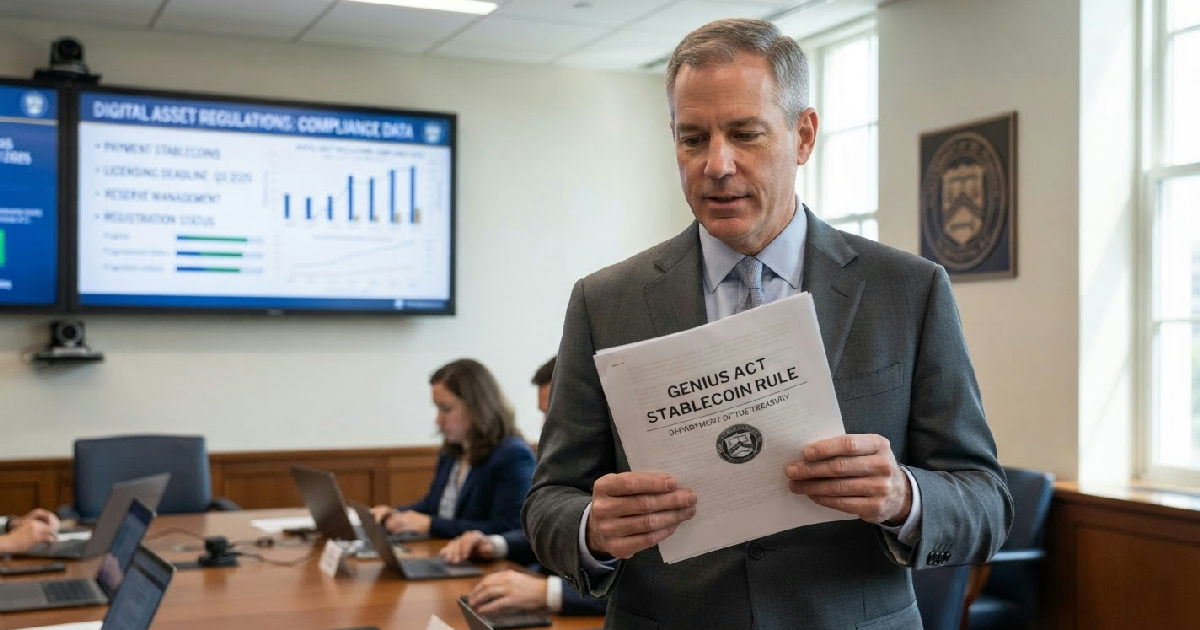

The U.S. Department of the Treasury issued a critical Notice of Proposed Rulemaking for the GENIUS Act stablecoin rule on August 17, 2026. S. Department of the Treasury issued a critical Notice of Proposed Rulemaking for the GENIUS Act stablecoin rule on August 17, 2026.
Drafted jointly by the Financial Crimes Enforcement Network (FinCEN) and the Office of Foreign Assets Control (OFAC), the proposal establishes federal definitions for issuing payment stablecoins.
This framework targets the operational mechanics of digital asset issuers ahead of a looming compliance deadline. Beginning January 18, 2027, any entity seeking to issue a payment stablecoin in the United States will generally require a federal or state license. The Treasury proposal clarifies these strict jurisdictional boundaries.
Jurisdiction under the GENIUS Act stablecoin rule
The primary objective of the August proposal is implementing Section 3 of the Guiding and Establishing National Innovation for U.S. Stablecoins (GENIUS) Act. Treasury officials are actively defining what constitutes issuing a stablecoin versus merely facilitating its transfer across a blockchain network.
This legal distinction will determine which crypto firms face the heaviest compliance burdens over the next two years. Regulators acknowledged that treating stablecoins under traditional investment rules could fundamentally frustrate their utility as a medium of exchange.
The proposal explicitly notes that payment stablecoins are intended to serve as an effective means of cross-border payment and settlement. Consequently, the Treasury studied established securities laws but tailored the new framework to treat stablecoins as a distinct financial arena.
Industry participants now have 60 days to submit public comments on the proposal, setting a mid-October deadline for regulatory feedback. Market observers expect intense scrutiny over how the final rule will treat foreign issuers interacting with U.S. markets.
Accelerating anti-money laundering and sanctions compliance
The latest rulemaking builds upon an earlier joint proposal issued by FinCEN and OFAC on April 8, 2026. That initial directive focused specifically on anti-money laundering obligations and comprehensive sanctions compliance programs for digital asset companies.
Under the enacted legislation, all permitted payment stablecoin issuers automatically classify as financial institutions under the Bank Secrecy Act (BSA). This classification triggers a full suite of federal compliance obligations that many crypto-native startups have previously avoided.
The Treasury requires licensed companies to implement effective sanctions screening and maintain rigorous transaction monitoring protocols. Regulators officially closed the public comment period for these specific AML provisions on June 9, 2026, and are now drafting the final enforcement text.
Secretary of the Treasury Scott Bessent framed the current regulatory push as a matter of economic security. “President Donald Trump is strengthening American leadership in digital financial technology,” Bessent stated regarding the new definitions.
“This proposal will protect the U.S. financial system from national security threats without hindering American companies’ ability to forge ahead in the payment stablecoin ecosystem,” the Treasury Secretary added.
Approaching the critical January 2027 licensing deadline
The implementation timeline creates an aggressive runway for both federal regulators and industry participants. The legislation was signed into law by President Trump on July 18, 2025, setting a one-year target for rules to be finalized.
While the initial anniversary passed last month without the administration completing the final framework, regulators are accelerating their output. Full enforcement of the foundational stablecoin regulations begins no later than January 18, 2027.
Companies failing to secure the necessary state or federal licenses by that date face severe operational restrictions. The regulatory squeeze tightens even further on July 18, 2028, implementing a secondary ban on related market services.
From that 2028 cutoff point, digital asset service providers will be barred entirely from offering or selling unlicensed payment stablecoins to U.S. persons. This delayed restriction forces crypto exchanges to begin auditing their listed assets immediately.
Trading platforms must ensure their primary quote currencies comply with the new licensing regime to avoid future disruption. The Treasury expects this transition will ultimately cement the role of the U.S. dollar in international digital markets.
Enforcing the strict one-to-one asset reserve mandate
Beyond jurisdictional definitions, the Treasury’s enforcement framework oversees the strict financial backing requirements established by lawmakers. The law mandates 100 percent reserve backing for all permitted payment stablecoins operating legally within the United States.
Issuers must hold highly liquid assets, specifically U.S. dollars or short-term Treasuries. These assets must be held on a strict one-to-one basis against the circulating token supply to guarantee immediate redemption capabilities for all users.
To ensure ongoing compliance, licensed operators must publish monthly public disclosures detailing the exact composition of their financial reserves. This transparency mandate aims to prevent the types of algorithmic liquidity crises that previously damaged the digital asset sector.
The regulatory push follows a decisive legislative consensus achieved last summer. The underlying bill passed the Senate with a 68–30 vote on June 17, 2025, before clearing the House 308–122 a month later.
“The Trump administration and Congress created a milestone regulatory framework and clear rules for payment stablecoins through the GENIUS Act, and that the department is accelerating implementation,” Bessent confirmed following the latest rulemaking release.
Navigating offshore operations and legislative overlaps
The Treasury rulemaking deliberately addresses the complex reality of offshore crypto activities. Foreign-domiciled stablecoin operators currently dominate global trading volumes but often operate just outside standard American regulatory oversight.
The newly proposed definitions aim to capture any entity selling directly to U.S. persons, regardless of where their corporate headquarters are located. The answers to these jurisdictional questions will fundamentally reshape international market access.
The 60-day public comment period will likely flood regulators with feedback from international exchanges and decentralized finance protocols. These offshore entities must soon determine whether geoblocking American users is preferable to overhauling their treasury management systems.
The Treasury’s push arrives amid separate, stalled legislative efforts on Capitol Hill. Congress recently debated the Digital Asset Market Clarity Act, a secondary bill proposing rewrites to specific portions of the original stablecoin law.
That separate legislation primarily targeted the treatment of yield-bearing rewards programs offered by retail crypto exchanges. However, momentum for the Clarity Act stalled earlier this month before lawmakers departed for their scheduled August recess.
With alternative legislative fixes currently on shaky ground, the Treasury’s strict interpretation of the law will likely serve as the definitive standard. Crypto executives are now shifting their focus entirely toward the immediate regulatory comment process.
The impending mid-October deadline for public comments marks the final opportunity for the digital asset sector to influence federal policy. Once finalized, the sweeping regulations will fundamentally alter how investors interact with dollar-pegged cryptocurrencies.