
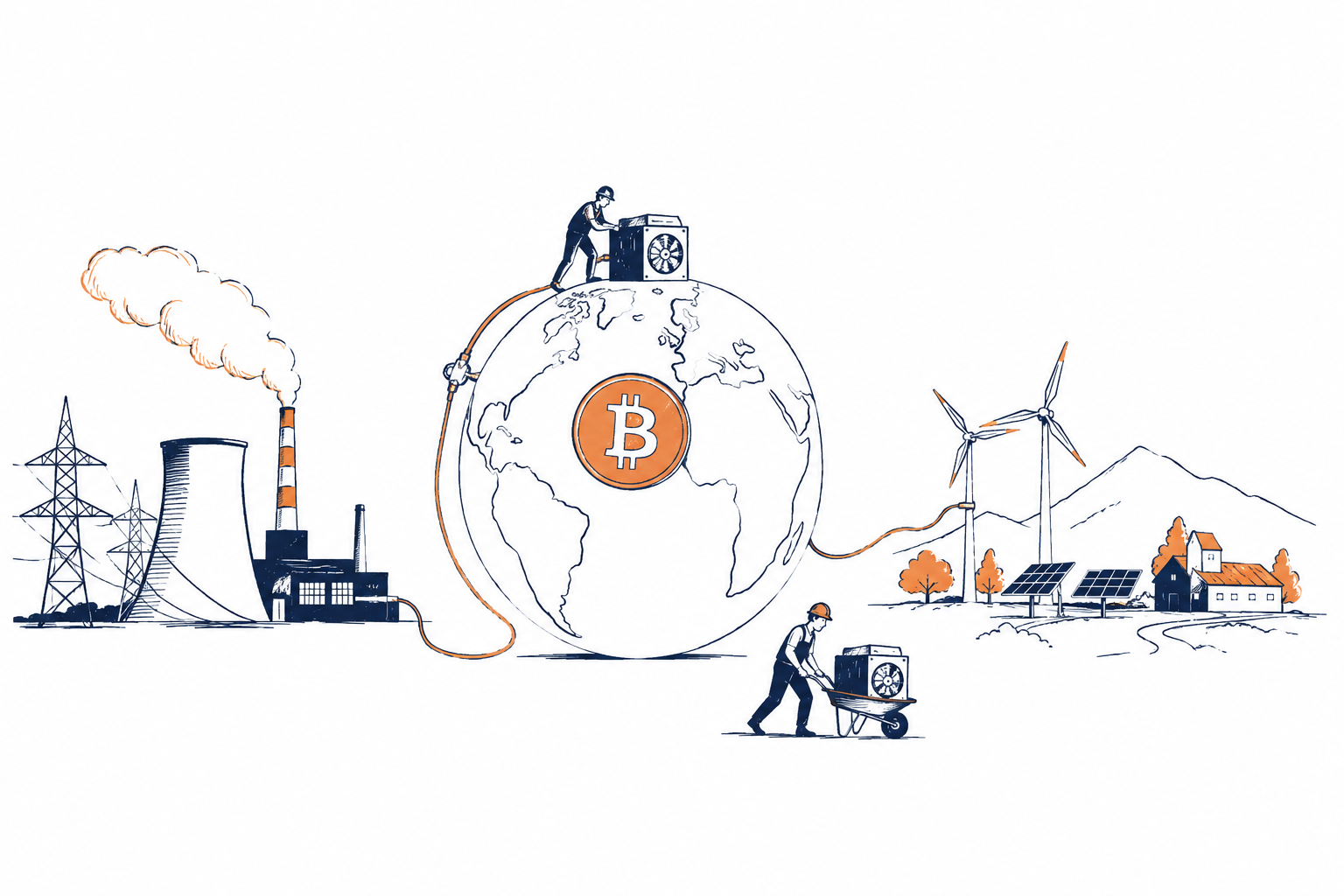

The argument over Bitcoin’s environmental impact often starts with a simple fact: Proof of Work uses a lot of electricity.
That part is difficult to dispute. Mining companies run specialised computers continuously, competing to add new blocks to the Bitcoin blockchain. The more computing power they deploy, the more energy they are likely to consume.
But electricity use alone does not answer the more interesting question: can Proof of Work be sustainable?
The answer depends on what happens behind that electricity bill. Where does the power come from? When is it being used? What does mining do to the wider energy system? And what happens to the machines once they are no longer competitive?
Those questions do not make Bitcoin mining environmentally harmless. They do, however, make the debate more complicated than a simple comparison of kilowatt-hours.
Why does Proof of Work need so much energy?
Proof of Work is designed around competition.
Bitcoin miners use specialised hardware to repeatedly perform calculations until one of them produces a valid result under the network’s rules. The successful miner can propose the next block and receive the protocol’s reward.
That competition serves a security purpose. An attacker trying to alter Bitcoin’s transaction history would also need to compete with the network’s mining power. Rewriting the blockchain is therefore not just a software problem: it requires enormous computing resources and the electricity needed to run them.
This is an important distinction when discussing efficiency.
A more efficient mining machine can produce more computing power from the same amount of electricity. That is useful for individual miners, particularly because electricity is one of their biggest operating costs. But improving hardware efficiency does not remove the role of energy from Proof of Work itself.
The system relies on real-world resources being committed to the network.
That is one reason the sustainability debate cannot be reduced to the claim that miners should simply “use less energy”. A dramatic reduction in the energy supporting Proof of Work would also change the economic cost of competing with the network.
Bitcoin’s energy consumption does not tell the whole environmental story
There is another problem with treating electricity use as a direct proxy for environmental damage: not all electricity has the same carbon footprint.
A mining operation powered mainly by coal can have a very different environmental impact from one drawing predominantly on hydroelectricity, wind or solar power. The number of kilowatt-hours may be similar; the emissions associated with those kilowatt-hours are not.
Cambridge’s Digital Mining Industry Report estimated Bitcoin’s annual electricity consumption at around 138 TWh and associated network-wide emissions at 39.8 million tonnes of CO₂ equivalent. Its survey of mining firms also estimated that 52.4% of the electricity used by surveyed operations came from what it classified as sustainable sources, including renewables and nuclear power. The survey covered firms representing 48% of global mining activity, so the figures should not be treated as a perfect picture of every mine in operation.
That last point matters.
A headline about Bitcoin using hundreds of terawatt-hours of electricity tells us something about scale. It does not, by itself, tell us whether that electricity is coming from a high-carbon grid, a hydroelectric system, excess renewable generation or a mixture of all three.
And the reverse is also true. Calling mining “renewable” because some operations use low-carbon electricity does not erase the rest of the industry’s footprint.
Research on large US mining sites, for example, has found significant reliance on fossil-fuel generation in some locations, with consequences that extend beyond carbon emissions to local air pollution.
The location of a mine can therefore matter almost as much as the machines inside it.
Could Bitcoin mining actually help renewable energy?
This is where the discussion becomes more interesting.
Solar and wind generation do not produce electricity at a constant rate. Solar output rises during certain hours and falls sharply at others. Wind generation can vary with weather conditions. Electricity demand, meanwhile, does not always move in sync with supply.
That creates a difficult problem for grid operators: what happens to electricity when generation temporarily exceeds what the system can use?
Bitcoin miners have an unusual characteristic in this context. Their computers can potentially reduce or increase consumption relatively quickly.
Researchers have therefore examined whether mining could operate as a flexible load — an electricity consumer that adjusts its demand according to conditions on the grid. During periods of surplus generation, miners could increase consumption. When electricity becomes scarce or the grid is under stress, they could scale operations back. Studies have explored this model as a possible way to improve renewable integration and provide demand-response services.
That does not mean mining automatically makes renewable energy more valuable.
The effect depends on where the mine is located, what electricity it is actually consuming and how the grid behaves. A mining operation that simply increases demand on a constrained, fossil-fuel-heavy grid is not achieving the same thing as one that absorbs otherwise-curtailed renewable generation.
The distinction is crucial: flexibility is a potential property of mining, not proof that every mining operation is beneficial to the energy system.
Renewable electricity does not make mining impact-free
Even the most favourable version of this argument has a limit.
A Bitcoin mining facility still needs buildings, cooling systems, electrical infrastructure and specialised hardware. Those machines have finite useful lives. As newer generations become more efficient, older equipment can become too expensive to operate.
That creates an environmental footprint beyond electricity generation.
The production of mining hardware requires raw materials, manufacturing capacity and transport. Retired machines eventually become electronic waste unless their components can be reused or recycled effectively.
This is why a genuinely useful discussion of Bitcoin mining sustainability has to look beyond the source of electricity.
There is also a difference between having access to renewable energy and using it in a way that genuinely reduces environmental impact. The commercial structure matters: a mine may have a renewable electricity contract without operating in the same way as a facility physically consuming otherwise-surplus renewable generation.
“Powered by renewables” can therefore describe a very different set of realities depending on how the arrangement works.
The uncomfortable trade-off at the heart of Proof of Work
This is what makes Proof of Work unusually difficult to assess.
Its biggest environmental criticism and one of its defining security characteristics come from the same mechanism.
Bitcoin deliberately makes block production resource-intensive. The network is not trying to minimise computational work at all costs. It is using that work to make dishonest behaviour expensive.
Proof of Stake takes a fundamentally different approach by replacing most of that computational competition with economic penalties attached to staked capital. As a result, it can operate with dramatically lower electricity requirements.
But that comparison does not prove that every unit of energy consumed by Proof of Work is wasted.
It means the two systems make a different trade-off.
For Proof of Work, the relevant sustainability question is therefore not simply whether energy consumption can be brought close to zero. That would amount to changing the mechanism itself.
A more useful question is whether the environmental cost of that energy can be reduced while preserving the role the energy plays in securing the network.
So, can Proof of Work be sustainable?
There is no universal definition of “sustainable Proof of Work”, and that is partly why the debate often goes in circles.
If sustainability means using very little electricity, Proof of Work is unlikely to qualify. Its security model requires an ongoing expenditure of computational resources.
If the question instead concerns how efficiently those resources interact with the wider energy system, the answer becomes less absolute.
Mining can potentially use lower-carbon electricity. It can sometimes act as a flexible consumer. It may be able to absorb electricity that would otherwise have limited value. Research into these models suggests that, under the right conditions, mining can play a role in renewable integration and grid flexibility.
None of that removes the environmental costs of the hardware, infrastructure or electricity itself.
The most accurate way to think about Proof of Work sustainability, then, is not as a choice between “green” and “wasteful”.
The real question is what the network gets in return for the resources it consumes — and how much environmental damage is created along the way.
That leaves Proof of Work with an awkward but important distinction: a lower-carbon Proof of Work may be possible; a low-energy Proof of Work is something else entirely.
And that difference is where the sustainability debate becomes much more useful than the headline figure on Bitcoin’s electricity bill.