
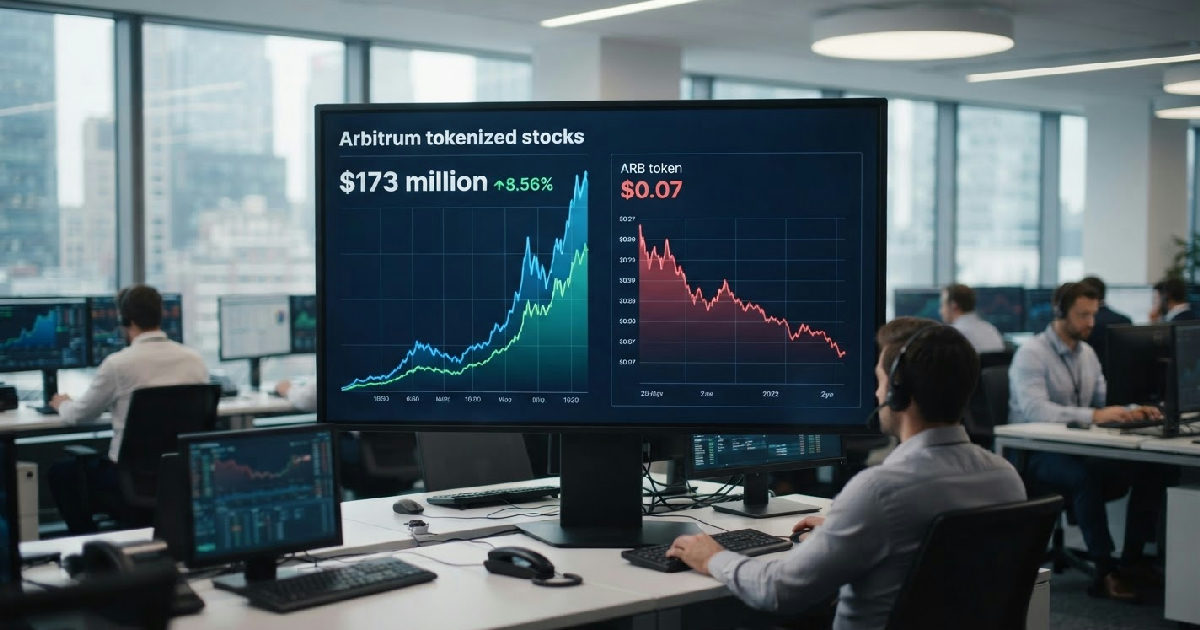

Arbitrum, a prominent Ethereum Layer 2 scaling solution, has seen the market capitalization of its tokenized stocks surge by an impressive 476% to $173 million as of August 12, 2026. This significant growth underscores the platform’s increasing traction in the real-world asset (RWA) tokenization space. Despite this strong network performance, its native ARB token remains locked in a prolonged two-year downtrend, trading around $0.07.
The stark contrast between the network’s utility and the ARB token’s price performance highlights a critical disconnect. While tokenization efforts gather pace, the ARB token faces persistent selling pressure, largely due to its rigid unlock schedule and broader market sentiment. This raises questions about whether Arbitrum’s fundamental strength in RWA can eventually translate into a price recovery for ARB.
Arbitrum’s tokenization momentum accelerates
The dramatic increase in tokenized stock market capitalization on Arbitrum points to a burgeoning ecosystem for real-world assets. The total value reached $173 million, marking a substantial 476% jump. This growth isn’t uniform across all issuers, but several key players are driving the expansion.
Reality led the charge, accounting for a significant $135 million of the total tokenized stock market cap. Financial services giant Robinhood contributed $24 million, while Dinari added $13.9 million. A smaller player, xStocks, held $3.8K, illustrating the varied scale of participation in this evolving market.
Beyond individual issuers, a diverse range of companies are seeing their stocks tokenized on Arbitrum. Over the past ninety days, the top 10 tokenized stocks collectively surpassed the $100 million mark. This group includes tech and innovation heavyweights such as Micron, Nvidia, SanDisk, SpaceX, Strategy (formerly MicroStrategy), Tesla, and Intel.
This surge in tokenized assets positions Arbitrum as a leader in the RWA sector. The platform now boasts the highest RWA count at 3,208, making it the first blockchain to exceed the 3,000 mark. It outpaces other major chains like Solana (SOL), Ethereum (ETH), Avalanche (AVAX), and BNB Chain in this metric, solidifying its standing as a hub for digitized real-world assets.
Robinhood’s strategic push into tokenized assets
Robinhood, a prominent retail brokerage, has played a pivotal role in boosting Arbitrum’s tokenization figures. As of October 18, 2025, Robinhood had already tokenized nearly 500 US stocks and Exchange Traded Funds (ETFs) on Arbitrum, specifically for its European Union users. These assets were valued at over $8.5 million, marking an early commitment to the Arbitrum ecosystem.
The firm further deepened its involvement by launching Robinhood Chain, its own blockchain built as an Ethereum Layer-2 solution on Arbitrum. This dedicated chain is designed explicitly for tokenized real-world assets like stocks and ETFs.
The initiative has quickly gained traction, with Robinhood Chain adding 240,000 new stock token holders in just 30 days, as announced on July 21, 2026, surpassing all other blockchains in this period.
A notable event occurred on December 17, when a Robinhood-linked deployer address executed the largest single-day deployment on Arbitrum to date. This involved launching 500 new tokenized stock contracts within 24 hours. Cumulatively, this deployer has now brought 1,997 stock tokens onto the Arbitrum network, with each contract deployment costing approximately $0.03.
ARB token struggles under persistent selling pressure
Despite the vibrant growth in tokenized assets on its underlying network, the Arbitrum (ARB) token itself has faced considerable headwinds. It’s been in a strong downtrend for two years, currently trading around the $0.07 mark. This represents a steep decline from its all-time high of $2.39 reached on January 12, 2024, reflecting an 83.37% drop over the past year alone.
The token’s value has seen modest negative movements recently, with a -0.88% change over 24 hours, -3.55% over seven days, and -15.22% over the past 30 days. This consistent downward trajectory is largely attributable to the token’s specific tokenomics, particularly its ongoing unlock schedule.
Impending token unlocks exacerbate bearish sentiment
ARB faces a continuous supply influx, which acts as a significant drag on its price. There’s a daily token unlock of 479.06K ARB, which steadily adds tokens to the circulating supply. However, a much larger event looms on August 16, when Arbitrum will unlock 93.19 million ARB tokens, currently valued at $7.41 million.
This substantial release is part of a rigid unlock schedule that’s set to continue through March 2027, with approximately 90–100 million tokens released monthly. Such consistent selling pressure from these unlocks partially explains why ARB’s price has struggled to find significant upward momentum, despite the underlying network’s performance.
The token’s circulating supply stands at approximately 6.25 billion ARB out of a total supply of 10 billion.
Broader market sentiment also contributes to the token’s weakness. The Aggregate Crypto Open Interest for ARB dropped from $64.5 million to $46.63 million. This decline signals a waning interest from the broader derivatives market, further hindering potential price appreciation.
Decoding ARB’s market structure amidst divergence
Market analysts are closely watching ARB’s price action for signs of a potential reversal. The 4-hour chart currently suggests a market structure in transition around the $0.07 zone. Interestingly, ARB’s price appears to be forming higher lows alongside an RSI Divergence at 50.99.
Some observers interpret this pattern as indicative of institutional accumulation, suggesting larger players might be quietly building positions while the wider retail market disengages.
Despite these potential technical signals, the token’s price technically remains in a downtrend. The confluence of existing market structure and the aforementioned tokenomics continues to exert downward pressure. However, the burgeoning growth in tokenization on the Arbitrum network could play a role in accelerating the formation of a price floor, potentially between the $0.07 and $0.09 zones.
Should the slanting trendline on technical charts break down, it would signal a continuation of the two-year downtrend, dashing hopes for an imminent recovery. Investors and traders are therefore monitoring these technical indicators closely, balancing the fundamental network growth against the persistent supply-side pressures.
The growing chasm between network utility and token value
The current situation on Arbitrum presents a fascinating dichotomy: a Layer 2 network demonstrating robust real-world asset tokenization and adoption, yet its native token, ARB, languishes in a multi-year slump. This divergence underscores a key characteristic of many blockchain ecosystems where network utility doesn’t always directly correlate with the performance of its governance token.
ARB’s primary function as a governance token, rather than being used for gas fees on the network, might be a contributing factor to this disconnect. While holders can stake ARB or vote on proposals, this utility doesn’t create continuous demand in the same way a gas token would.
The impressive Total Value Locked (TVL) on Arbitrum, which stood at $16.3-$16.5 billion as of early December 2025, along with substantial stablecoin liquidity and leading bridge flows, confirms the network’s operational success and adoption.
However, an important nuance often overlooked amidst the tokenization surge is the reported trading volume. As of August 11, 2026, the trading volume for Arbitrum’s tokenized stocks was observed at zero.
This detail, if sustained, suggests that while the market capitalization of these assets is growing significantly, the actual liquidity and active trading might be on a thinner flow than the headline figures imply.
This could mean the perceived demand for the underlying tokenized assets isn’t yet translating into a vibrant secondary market that might eventually benefit the ARB token.
Ultimately, the challenge for Arbitrum lies in bridging this gap. For ARB to break free from its two-year downtrend, the undeniable network utility and leadership in RWA tokenization will likely need to overpower the relentless selling pressure from token unlocks. Only then might the token’s value more accurately reflect the foundational strength and growing adoption of the Arbitrum ecosystem itself.