
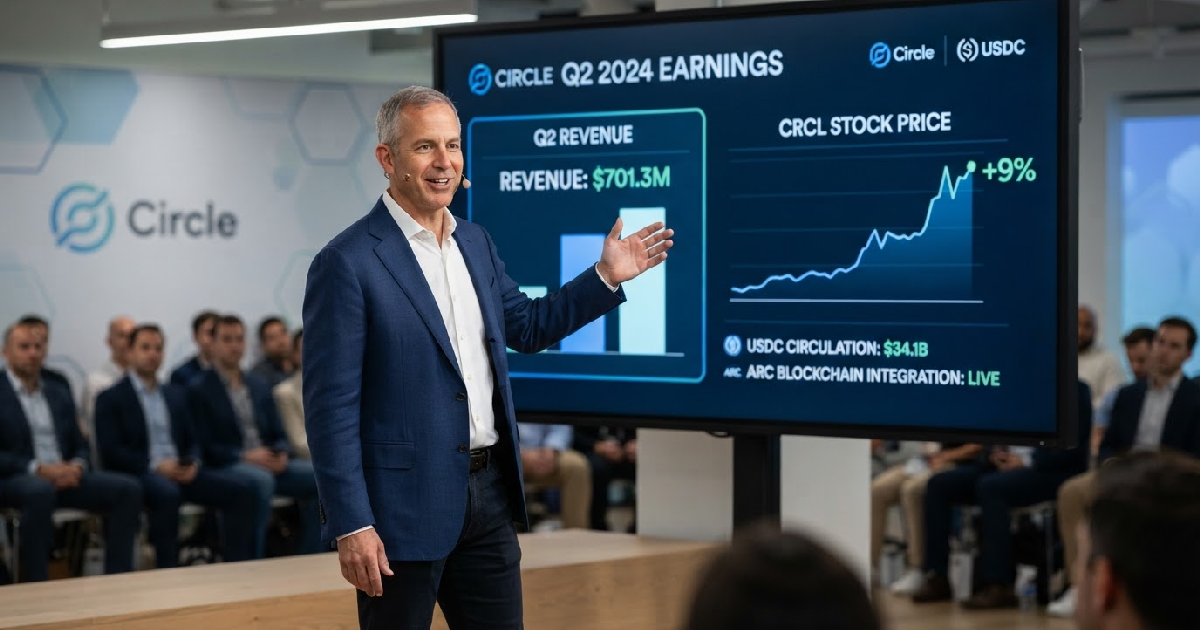

Circle Internet Group (CRCL) reported its second-quarter earnings on August 5, 2026, delivering adjusted earnings per share of $0.18. This figure surpassed analyst expectations, which had projected Q2 EPS at $0.19. Despite the positive EPS surprise, the stablecoin issuer posted revenues of $701.3 million, falling short of the $734.7 million analysts had anticipated for the period.
Even with the revenue miss, CRCL stock saw a notable 9% jump in pre-market trading, pushing its price closer to $69.00. Investors appeared to focus more on Circle’s strategic developments and upcoming milestones rather than the immediate financial shortfall.
Understanding Circle’s mixed Q2 financial results
Circle’s Q2 financial report painted a complex picture for the company. While it managed to exceed profit expectations, its revenue figure of $701.3 million represented a miss against analyst forecasts. The company’s primary revenue stream relies on interest income from reserves backing its USD Coin (USDC) stablecoin.
This income is typically generated from short-term U.S. Treasuries and cash holdings. The overall financial picture suggests that despite beating EPS, the underlying revenue growth faces increasing scrutiny.
Sequential performance reveals challenges
A closer look at the sequential numbers complicates the positive initial market reaction. Circle’s adjusted EBITDA for Q2 fell to $143 million, a decline from the $151 million reported in the preceding March quarter. Its earnings per share also slipped from $0.21 in Q1 to $0.18 in Q2.
Furthermore, the annual revenue growth rate flattened considerably. While Q2 revenue of $701 million represented a 7% gain year-over-year, that growth rate stood at 20% just three months prior. This deceleration suggests a cooling in the primary revenue drivers.
USD Coin (USDC) circulation, which underpins much of Circle’s revenue, closed June at $73.3 billion. This was an annual increase of 19%, but it marked a sequential drop from $77.0 billion at the end of the March quarter. This dip in circulation directly impacts the potential for reserve income.
The company’s cost structure also poses questions. Last quarter, Circle reported $407 million in distribution costs against $653 million in reserve income. This means roughly 62 cents of every dollar earned from reserves left the business in expenses, highlighting operational costs for stablecoin issuers.
Arc blockchain and regulatory advancements
Despite the financial headwinds, Circle continues to make significant strides in its strategic development. The Arc public mainnet, Circle’s proprietary blockchain for stablecoin payments and tokenized assets, is set to launch on September 16. This platform is designed to anchor Circle’s extensive four-layer stack.
Over 100 institutional and ecosystem builders are already engaged with Arc, signaling strong industry interest. Major financial players like BlackRock, Visa, Mastercard, DTCC, and Intercontinental Exchange (ICE) will serve as founding validators for the network. BlackRock and ICE had previously invested in Arc’s $222 million token presale in May, which valued the network at $3 billion.
The new Arc businesses are still in their early stages, processing 502 million transactions in Q2. Additionally, the Circle Payments Network annualized volume reached $14.7 billion, up from $8.3 billion in March. While growing, this volume remains modest compared to the $73.3 billion of circulating USDC.
Regulatory progress also provides a clear upside. Circle secured final approval for a federal charter from the Office of the Comptroller of the Currency (OCC) on July 10. The company also obtained a New York trust charter three weeks later, expanding its operational licenses and regulatory clarity.
Increasing competition in the stablecoin sector
Circle isn’t operating in a vacuum, as competition in the stablecoin market intensifies. Rival stablecoin Open USD launched in June, boasting support from over 140 backers. Notably, this included major players like Visa and Coinbase, signaling a concerted effort to challenge USDC’s market position.
In response, Circle points to data from Visa Onchain Analytics, asserting that USDC captured close to 70% of June’s stablecoin transaction volume. However, the overall onchain activity for Circle has shown signs of cooling. Quarterly volume trailed $14.8 trillion in Q2, down from the $21.5 trillion recorded in March.
This broader market trend, coupled with new entrants, underscores the need for Circle to innovate and maintain its competitive edge. The shifting dynamics require constant vigilance and strategic responses to preserve market share and revenue streams.
Navigating CRCL stock’s volatile path
Wall Street’s sentiment towards CRCL stock shifted in July, with some analysts adopting a more cautious stance. Mizuho downgraded Circle to