
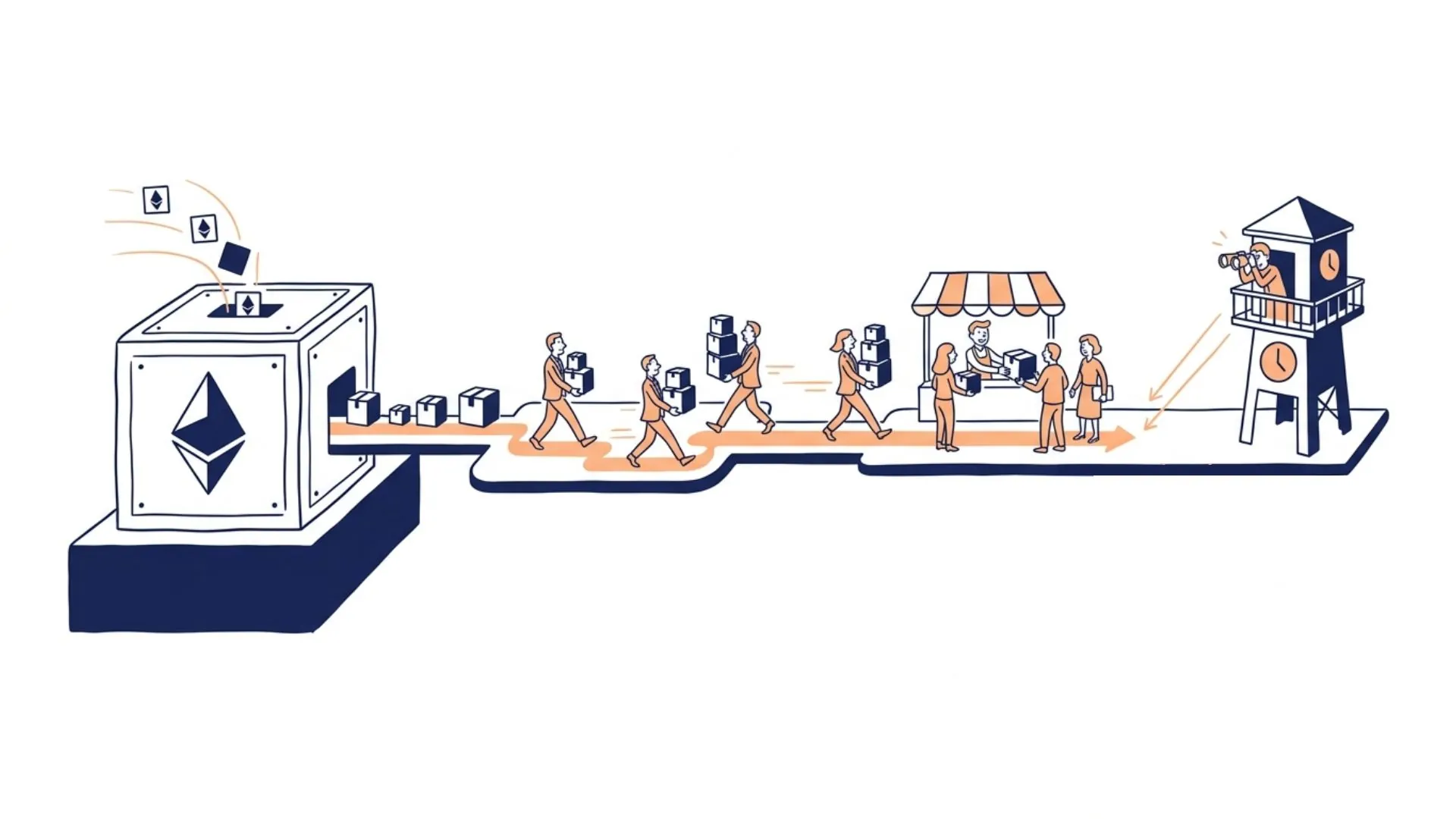

The fundamental design of early blockchain networks presents an unforgiving physical bottleneck. In networks like Bitcoin and Ethereum, absolute security is bought with extreme redundancy: every node in the global network must verify, record, and store every single transaction. While this setup builds a highly secure, censorship-resistant ledger, it also makes for an incredibly slow computer.
When millions of users scramble to use the same network at once, the system congests. Mainnet transaction fees (known as gas) spike, and the average user is priced out of the ecosystem. To prevent this collapse under the weight of its own demand, Ethereum had to change its philosophy.
Instead of forcing the main blockchain to process everything, developers built secondary systems above it. These systems are called Ethereum Layer 2 (L2) networks. They act as express lanes, processing transactions off-chain and using Ethereum’s heavy infrastructure merely as a final, secure notary. But scaling a trustless system requires deliberate tradeoffs. Making decentralized finance cheap and accessible has forced us to accept new compromises in decentralization and speed.
Shifting the traffic: The mechanics of parallel execution
To understand how an Ethereum Layer 2 network operates, it helps to look at how a restaurant tab works. If a group of ten people orders drinks individually, and the bartender runs a separate credit card transaction for every single order, the checkout counter quickly becomes congested.
A much more efficient approach is to open a single tab, write down all the orders on a notepad throughout the night, and run a single consolidated charge at the end of the evening.
This is the baseline mechanism of Layer 2 scaling.
Instead of forcing the Ethereum Mainnet (Layer 1) to execute and record thousands of small peer-to-peer transactions, an L2 network acts as the notepad. It executes those transactions in a secondary environment. Once it accumulates a large batch of operations, it bundles them together, compresses the data, and sends a single cryptographic “receipt” back to Layer 1.
Historically, posting this data back to Ethereum Mainnet was still relatively expensive because Layer 2 networks had to compete with standard mainnet transactions for block space. This changed with major protocol upgrades:
- EIP-4844 (Proto-Danksharding): Introduced in 2024, this upgrade created temporary, dedicated data storage lanes on Ethereum called “blobs”.
- EIP-7594 (PeerDAS): Implemented in the late-2025 Fusaka upgrade, Peer Data Availability Sampling allows validators to verify these blobs by sampling small parts of the data rather than downloading them in full.
By distributing the storage burden across peer nodes, PeerDAS has dramatically expanded Ethereum’s data capacity. The result is that Layer 2 transactions routinely cost fractions of a cent, and the mainnet has effectively evolved into a quiet settlement layer while the real transaction volume happens on L2s.
The rollup rivalry: Optimism versus cryptography
The dominant technologies powering Ethereum Layer 2 networks are called rollups. They “roll up” hundreds of off-chain transactions into a single compressed package and submit them to the mainnet.
However, because the main Ethereum chain does not execute these transactions itself, it needs a way to verify that the off-chain data is legitimate. This challenge has split the L2 landscape into two primary technical architectures, each choosing a different path to establish truth.
| Feature | Optimistic Rollups | zk-Rollups (Zero-Knowledge) |
| Philosophy | “Innocent until proven guilty.” Assumes transactions are valid unless challenged. | “Guilty until proven innocent.” Every batch must present mathematical proof. |
| Verification Method | Fraud Proofs (interactive disputes during a challenge window). | Validity Proofs (complex cryptographic proofs like SNARKs or STARKs). |
| Withdrawal Time | Typically 7 days (to allow for the dispute window). | Near-instant (as soon as the cryptographic proof is verified on L1). |
| Computational Cost | Very low computational overhead for operators. | Extremely high computational cost to generate mathematical proofs. |
| Ecosystem Leaders | Arbitrum One, Optimism, Base. | zkSync Era, Linea, Starknet. |
Optimistic Rollups: Trust, but verify later
Optimistic Rollups prioritize speed and simplicity. They process transactions and immediately post them to Ethereum Mainnet under the assumption that the L2 operator is behaving honestly. To keep operators honest, the network implements a dispute period (usually seven days).
If a validator notices that a transaction batch contains fraudulent data, they can submit a “fraud proof” to the main chain. If the fraud is confirmed, the malicious state is rolled back, the dishonest operator is penalized, and the honest challenger is rewarded.
zk-Rollups: Pure mathematical certainty
Zero-Knowledge (zk) Rollups reject the concept of a trust-based dispute window. Instead of hoping no one cheats, zk-Rollups use advanced cryptography to generate a mathematical “validity proof” for every batch.
When the L2 network submits its transaction data to Ethereum, it includes this cryptographic proof. The Ethereum mainnet runs a simple check on the proof; if the math checks out, the transactions are instantly finalized. There is no need for a seven-day dispute window because the mathematics make fraud physically impossible from the start.
The hidden cost of cheap transactions
The efficiency gains of Layer 2 networks are remarkable, but they are not free. To scale a system whose core purpose is eliminating intermediaries, the crypto ecosystem had to reintroduce a degree of centralization.
When you make a transaction on an L2, your transaction is received, ordered, and packaged by an entity called a sequencer. In a perfectly decentralized world, this role would be shared among thousands of independent nodes globally, just like Ethereum’s validators.
In practice, however, most major Layer 2 networks still operate with single, centralized sequencers run by the core development teams or foundations behind the project.
This setup creates a few critical points of failure:
- Censorship Risk: A centralized sequencer has the power to prioritize, delay, or temporarily exclude specific user transactions from a batch.
- Outage Vulnerability: If the hardware hosting the centralized sequencer goes offline, the entire Layer 2 network temporarily freezes. While users can technically force transactions directly through Layer 1, doing so is highly complex and prohibitively expensive.
- MEV (Maximal Extractable Value): The centralized sequencer can reorder transactions to front-run or sandwich user trades, capturing value that should belong to the users or the broader network.
While most major projects have roadmaps to transition to decentralized sequencer sets, the current state of Layer 2 scaling is a pragmatic compromise: users trade some of the absolute, ironclad decentralization of Ethereum Mainnet in exchange for execution that actually fits within their budget.
Why getting your money back requires patience
One of the most counterintuitive aspects of using a Layer 2 network is the “bridge delay.” While moving assets from Ethereum Mainnet to a Layer 2 network is usually fast, moving those same assets back can be an exercise in frustration.
On Optimistic Rollups like Arbitrum or Base, a native withdrawal back to Layer 1 takes exactly seven days. This delay is not a software bug or a design flaw; it is a fundamental security requirement. The system must allow sufficient time for any validator in the world to audit the transaction batch, spot potential fraud, and submit a dispute before the funds are permanently unlocked on the main Ethereum chain.
For users who cannot afford to lock up their capital for a week, private liquidity providers have stepped in. These third-party “fast bridges” charge a small fee to instantly pay out the user’s funds on Layer 1, effectively taking on the seven-day waiting period and the associated smart contract risks themselves.
To bypass this delay entirely without third-party bridges, some developers utilize Validiums. These networks verify transactions near-instantly using cryptographic proofs, but they store the transaction data completely off-chain to maximize speed.
However, this design shifts the bottleneck from time to hardware. Generating validity proofs in real time requires massive, institutional-grade computing power. This high infrastructure cost means that the most mathematically secure, instant-withdrawal networks are often the most expensive to build and maintain, making them less viable for low-volume or highly experimental applications.
Re-anchoring the scaling narrative
The evolution of Ethereum Layer 2 networks shows that blockchain scalability is not a simple problem with a single, clean solution. Instead, it is a continuous balancing act within the Blockchain Scalability Trilemma, which states that a network can only optimize for two of three properties: decentralization, security, and scalability.
Ethereum Mainnet has made its choice: it prioritizes absolute security and decentralization above all else. It is slow and deliberate by design, acting as an immutable court of law.
Layer 2 networks do not replace this court; they act as the fast-paced business offices operating outside its doors. By running everyday transactions in a lighter environment and using the mainnet solely for final settlement, the ecosystem has built a system that can scale to accommodate global demand.
The success of decentralized networks does not rely on a single, all-powerful blockchain that does everything perfectly. Instead, it depends on how effectively we orchestrate the relationship between the slow, secure foundation of Layer 1 and the fast, pragmatic efficiency of Layer 2.