
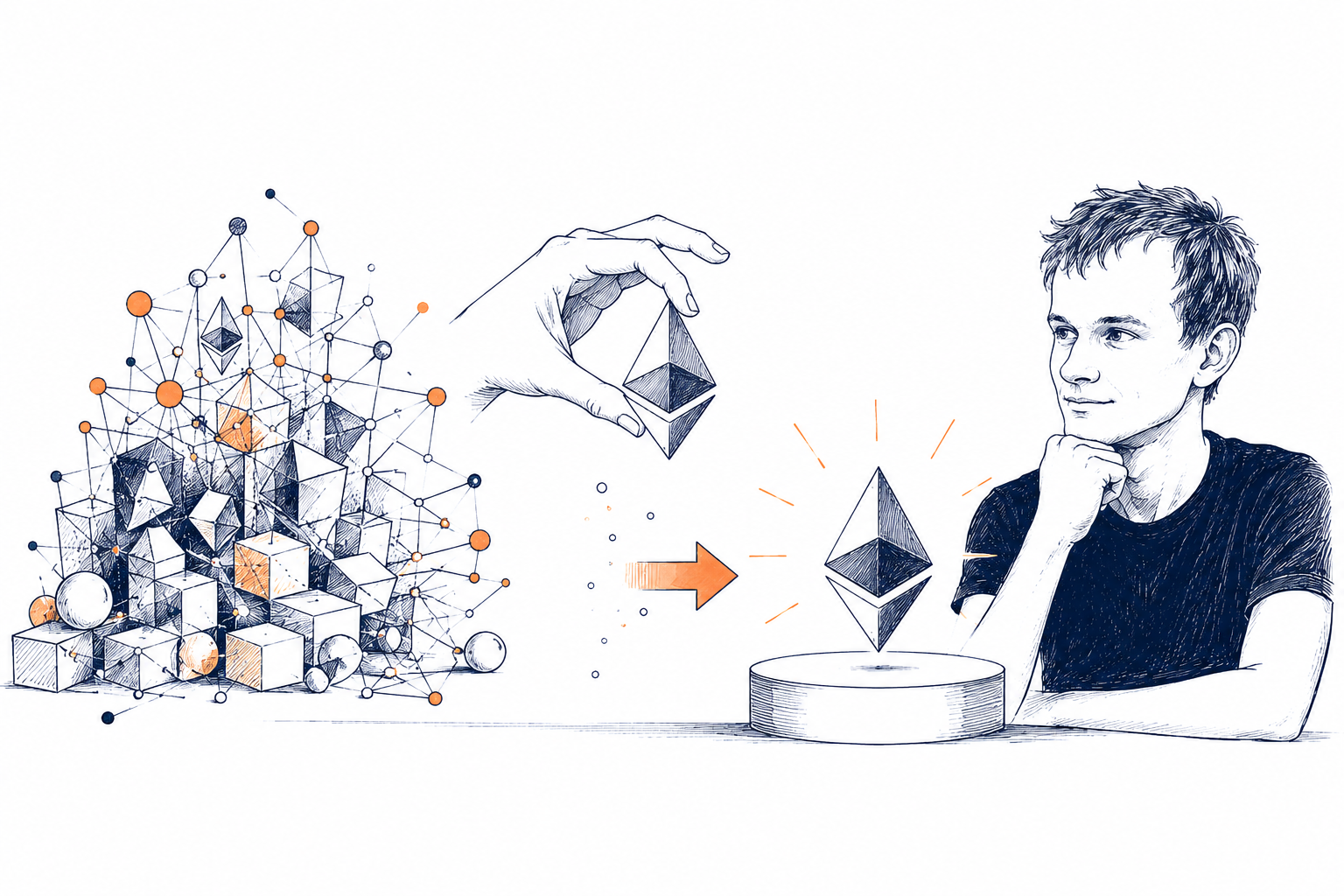

Ethereum has spent the past several years evolving into one of the most sophisticated blockchain networks in the industry.
Every major upgrade has introduced new capabilities, from the transition to Proof-of-Stake and the rapid growth of Layer 2 networks to improvements in scalability and transaction efficiency. Now, Ethereum co-founder Vitalik Buterin believes the network faces a different challenge: complexity itself.
Through his newly proposed Lean Ethereum vision, Buterin argues that the network’s long-term success will depend not on adding more features, but on simplifying its architecture.
The proposal represents one of the clearest signals yet that Ethereum’s next stage of development will prioritize sustainability, maintainability and security over constant expansion.
Complexity has become Ethereum’s newest challenge
Ethereum’s evolution has transformed it into the backbone of decentralized finance, tokenized assets, stablecoins and countless blockchain applications.
That success, however, has also made the protocol significantly more difficult to develop, maintain and audit.
Every major upgrade has solved important problems while introducing additional layers of technical complexity. New cryptographic systems, scaling solutions and protocol improvements have expanded Ethereum’s capabilities, but they have also increased the burden placed on developers, validators and researchers responsible for maintaining the network.
Buterin’s proposal acknowledges that this trend cannot continue indefinitely.
As Ethereum becomes increasingly important to financial markets and institutional users, keeping the protocol understandable and verifiable may become just as important as improving its performance.
Lean Ethereum is more than another technical roadmap
Much of the discussion surrounding Lean Ethereum has focused on its individual technologies, including zero-knowledge proofs, validator privacy, quantum-resistant cryptography and more efficient verification methods.
Those innovations are important, but they are not the central message.
The broader objective is to redesign Ethereum around a simpler engineering philosophy. Rather than continuously adding new layers to solve emerging challenges, Buterin wants future upgrades to reduce operational complexity while preserving the network’s functionality.
The idea reflects a shift in priorities. For years, Ethereum measured progress by how much it could expand. Lean Ethereum suggests that future progress may instead be measured by how efficiently the network can deliver the same capabilities with fewer moving parts.
Institutional adoption raises the stakes
Ethereum is no longer used primarily by crypto-native developers. Asset managers, financial institutions and tokenization platforms are increasingly building products on top of the network, making reliability and long-term stability more valuable than ever.
A simpler protocol could reduce security risks, lower maintenance costs and make it easier for developers to audit critical infrastructure.
These qualities are becoming increasingly important as Ethereum evolves into a settlement layer for financial applications handling billions of dollars in value.
The proposal also reflects a broader trend across technology. As digital infrastructure matures, simplicity often becomes a competitive advantage rather than a limitation. Systems that are easier to understand and maintain typically prove more resilient over long periods.
Developers support the vision but want faster execution
Early reactions from Ethereum developers have been largely supportive. The debate is not centered on whether the network should become simpler, but on how quickly those changes can realistically be implemented.
Because Ethereum operates through decentralized governance, major protocol upgrades require extensive research, testing and consensus across multiple development teams. Even widely supported proposals often take years before reaching production.
That means Lean Ethereum should be viewed as a long-term direction rather than a single upgrade. The vision establishes a framework that is likely to influence Ethereum’s technical decisions for years to come.
A different definition of progress
For much of its history, Ethereum advanced by expanding its capabilities. Lean Ethereum suggests the network is entering a new phase in which progress will increasingly be measured by clarity, efficiency and maintainability.
If that philosophy succeeds, the proposal could become one of the most significant shifts in Ethereum’s evolution since the Merge.
Rather than competing by becoming more complex than its rivals, Ethereum may seek its next advantage by becoming simpler, easier to verify and better prepared for decades of continuous development.