
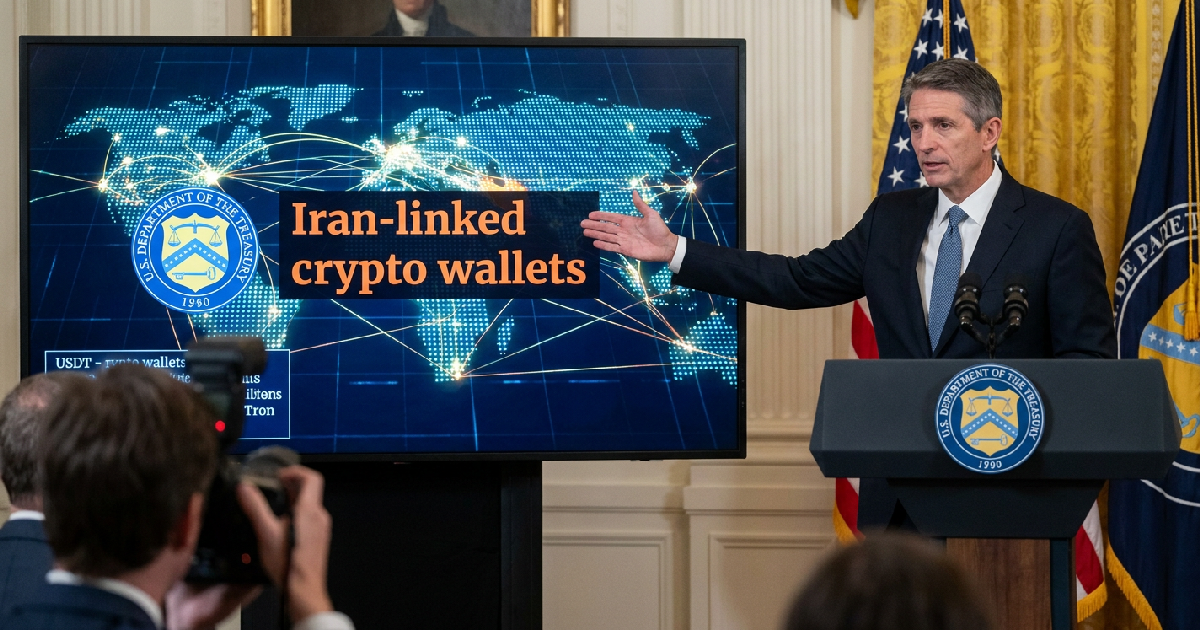

The U.S. Treasury Department froze over $130 million in Iran-linked crypto wallets, primarily USDT on the Tron network, on Tuesday, July 14, 2026. S. Treasury Department has frozen more than $130 million in Iran-linked crypto wallets, primarily Tether’s USDT stablecoin on the Tron network, in a move announced on Tuesday, July 14, 2026. This action, confirmed by U.S. Treasury Secretary Scott Bessent, targets illicit financial activities of the Central Bank of Iran and comes amid a renewed naval blockade and escalating geopolitical tensions.
The freeze, executed by the Office of Foreign Assets Control (OFAC), highlights the evolving front of economic warfare where digital assets are increasingly scrutinized. Blockchain investigator Specter had earlier flagged the freeze, showing four Tron wallets holding roughly $131 million in USDT had been rendered inaccessible.
Washington intensifies crypto sanctions on Iran
The Treasury’s move against Iran-linked crypto wallets saw Tether cooperate to freeze assets in the designated addresses. This collaboration underscores the critical role stablecoin issuers play in enforcing international sanctions. Treasury Secretary Scott Bessent articulated the department’s resolve in a post on X.
“US Treasury is committed to disrupting and degrading Iran’s illicit financial activities, including its abuse of digital assets,” Bessent stated in the post. He added that authorities would “continue to aggressively follow the money and deny the Iranian regime access to the proceeds of its illicit revenue schemes.” These statements underscore a direct and unyielding approach.
USDT and Tron’s role in evasion tactics
The frozen cryptocurrency consisted primarily of USDt (USDT) stablecoins on the Tron blockchain. Iranian entities have notably utilized these digital assets to circumvent sanctions and transfer wealth. This strategy aims to bypass traditional banking channels, which are heavily monitored.
Authorities had previously requested Tether to lock approximately $344 million of USDT across two wallets in April 2026. This history points to a pattern of Iran leveraging major stablecoins for sanctions evasion. Bessent also reported in May that the U.S. government had seized around $1 billion in Iranian crypto assets overall.
This pattern reveals a persistent effort by Iran to exploit digital financial infrastructure. It also shows a growing capability from U.S. authorities to track and interdict these flows. The scale of these seizures indicates that Washington is effectively closing off avenues for illicit financing.
Operation Economic Fury expands scope
This latest freeze falls under “Operation Economic Fury,” a broad financial-pressure campaign launched in March 2025. President Donald Trump initiated the operation, aiming to dismantle the Iranian war machine. It seeks to disrupt foreign procurement networks supporting the Iranian military.
A broader sanctions package accompanied Tuesday’s crypto freeze. This new package targets over 50 entities and vessels within Mohammad Hossein Shamkhani’s network. This network is described as a major force behind Iran’s oil exports, providing significant revenue.
The actions aim to sever funding channels related to the Islamic Revolutionary Guard Corps (IRGC). The U.S. designates the IRGC as a foreign terrorist organization. This comprehensive approach targets both traditional and digital financial conduits used by Tehran.
Geopolitical tensions fuel stricter enforcement
The intensified financial pressure coincides with a collapse in the U.S.-Iran ceasefire. This breakdown has triggered a new phase of confrontation between the two nations. U.S. Central Command resumed a naval blockade of Iranian ports at 4 p.m. New York time on Tuesday.
The U.S. also announced fresh strikes, while Iran launched drone attacks on a U.S.-used air base in Jordan. These developments indicate that financial warfare is deeply intertwined with military and diplomatic strategies. The freezing of crypto assets represents another front in this expanding conflict.
Implications for crypto’s neutrality and regulatory future
The repeated actions against USDT, particularly involving such substantial sums, challenge the idea of crypto’s neutrality. While blockchain technology offers decentralization, stablecoin issuers like Tether operate within regulatory frameworks. This means they often must comply with government mandates.
This dynamic creates centralized vulnerabilities within the broader digital asset industry. Tether’s cooperation sets a powerful precedent. It shows that large-scale illicit activity on public blockchains can indeed be disrupted through coordinated efforts.
Regulators are adapting traditional sanction mechanisms to the digital realm. This erodes the perception of crypto as an entirely unseizable or untraceable haven. The trend confirms that regulatory reach now extends deeply into the digital financial infrastructure, reshaping its future.
Evolving strategies for crypto enforcement
Governments are becoming more adept at using blockchain analytics and engaging with crypto intermediaries to enforce sanctions. This latest action demonstrates a growing sophistication in identifying and freezing digital assets linked to sanctioned entities. The focus extends beyond just targeting exchanges to directly addressing individual wallet addresses.
For nation-states attempting to use cryptocurrencies to bypass international sanctions, this presents a significant obstacle. While smaller, more obscure assets might offer some refuge, the liquidity and ease of transfer offered by major stablecoins come with inherent risks. This trend suggests digital asset usage by sanctioned actors will face ever-tighter surveillance and enforcement.
The continued scrutiny on the Tron network, given its prominence in these frozen assets, could also influence user behavior. This ongoing tension between permissionless technology and centralized enforcement will likely shape the evolution of regulatory frameworks. It will also influence the design of future digital assets within the global financial system.