
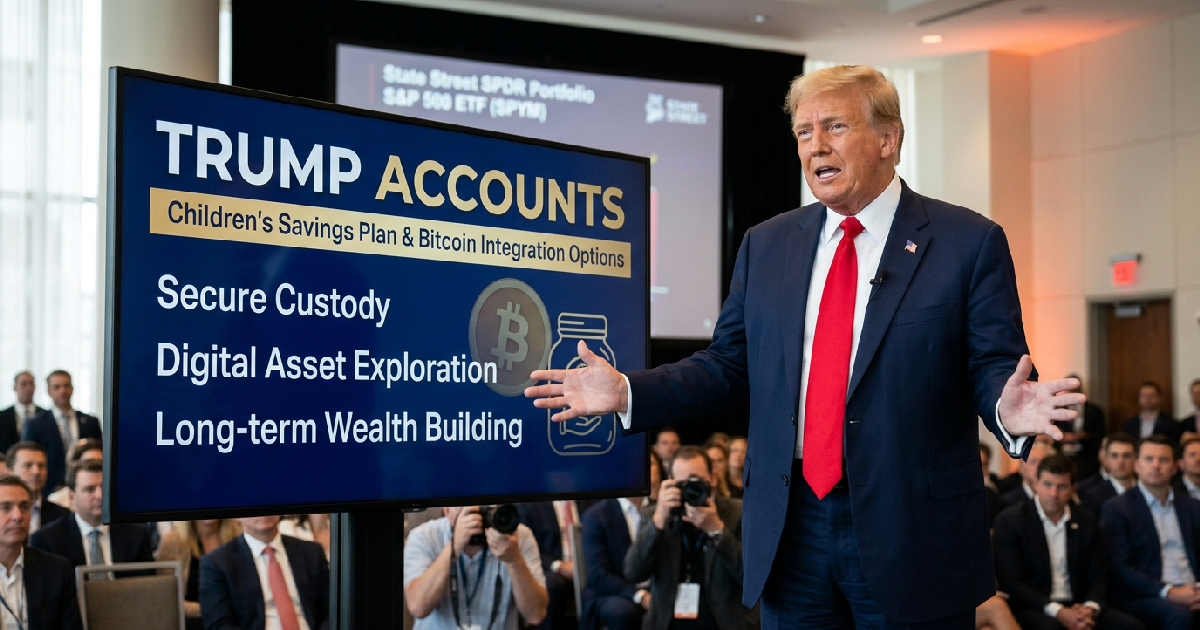

President Donald Trump stated on Monday that Bitcoin (BTC) could eventually be integrated into Trump Accounts, the administration’s new tax-advantaged savings program for children. When asked directly if the asset could join the initiative during an event tied to the program’s rollout, the president replied that “something could happen,” fueling speculation regarding the role of digital assets in government-backed savings.
The program, which recently opened to families nationwide, currently operates under relatively strict investment guidelines. Every contribution is currently placed in a single default fund, the State Street SPDR Portfolio S&P 500 ETF (SPYM). While the U.S. Treasury has approved four other index ETFs, the functionality for users to switch between funds is not yet live, posing an immediate technical barrier to diversification.
Legal hurdles for Bitcoin in Trump Accounts
The primary obstacle to adding Bitcoin to these portfolios is statutory rather than administrative. Current law limits qualifying investments to U.S. equity index funds with fee structures under 0.1%. Because the U.S. Treasury only has the power to tighten these rules—not expand them—Bitcoin would likely require new congressional legislation before it could be offered to account holders.
Despite these legal constraints, the president has increasingly embraced a pro-crypto stance, citing geopolitical competition as a primary motivator. “I’ve become a big crypto guy only for one reason: if we don’t have it China is going to have it,” Trump said. He noted that the growth of the industry and substantial capital inflows convinced him of the market’s longevity.
Internal market dynamics also remain a factor for investors. While political rhetoric often drives sentiment, actual Bitcoin price analysis shows rejections at key resistance levels during recent trading sessions. On Monday, the asset recovered the $62,000 mark after briefly dipping earlier in the day.
Geopolitical strategy and personal disclosures
The president’s self-identification as a “big crypto guy” mirrors his administration’s broader shift toward digital asset adoption. This pivot is not entirely disconnected from his personal financial interests. A recent financial disclosure revealed that the president earned more than $1 billion in 2025 from crypto ventures involving his family, and he has recently questioned the current tax treatment of the asset class.
The administration is also reportedly weighing fiscal maneuvers to boost the program, such as allowing billionaires to donate appreciated stock to these accounts in exchange for tax breaks. Integrating digital assets into this framework would represent a significant expansion of the program’s original scope.
This comes at a time when Bitcoin exchange supply maintains multi-year lows, potentially increasing the impact of any government-led accumulation or adoption.
Timelines for crypto policy implementation
History suggests that while the president moves to fulfill crypto pledges, the process is rarely fast. For instance, his 2024 promise in Nashville to retain seized Bitcoin took approximately seven months to result in the Strategic Bitcoin Reserve executive order on March 6, 2025. That reserve currently holds about 200,000 seized coins and is restricted to budget-neutral purchases.
Other initiatives have faced even longer delays. An executive order from August 2025 aimed at opening retirement plans to alternative assets saw a Labor Department rule proposal in March 2026, which remains unfinalized nearly a year later. Given these precedents, the inclusion of Bitcoin in Trump Accounts is likely a prospect for 2027 at the earliest.
The administration’s focus on digital assets continues to evolve alongside shifting legislative priorities. While the White House remains bullish, the transition from verbal support to live investment options in childhood savings accounts will require navigating a complex path through Congress and federal regulators in the coming months.
Examining the Trump Accounts framework
The Trump Accounts program, launched on July 4 under the One Big Beautiful Bill Act, provides a unique savings vehicle for American children. Children born between 2025 and 2028 are eligible for a one-time $1,000 Treasury seed deposit. Families can further contribute up to $5,000 annually until the beneficiary reaches 18 years of age.
The initial infrastructure relies on services from Robinhood and BNY, which manage the program’s app and account infrastructure. However, the restrictive nature of eligible investment options remains a key talking point. The default fund, the State Street SPDR Portfolio S&P 500 ETF (SPYM), shows a conservative initial approach, despite the Treasury approving four other index ETFs.
Investment diversification and regulatory challenges
The current framework’s inability to expand beyond specified US equity index funds without new legislation highlights a significant hurdle for any cryptocurrency inclusion. Congress set the initial boundaries, limiting investments to those with fees under 0.1%. This strict interpretation prevents the Treasury from independently adding assets like Bitcoin, reinforcing the need for legislative action.
This situation underscores a broader debate within Washington regarding how to appropriately regulate and integrate novel asset classes into traditional financial products. It suggests that while the rhetoric around crypto may be evolving, the legislative and regulatory machinery moves at a much slower pace. Any meaningful change would demand bipartisan cooperation, which can be elusive.
The evolving political landscape for crypto
President Trump’s public embrace of crypto represents a significant shift from earlier skepticism across political lines. His framing of Bitcoin as essential for US competitiveness against China underscores a growing geopolitical dimension to digital asset policy. This strategic viewpoint positions cryptocurrency not just as a financial innovation, but as a national security imperative.
Such hawkish positioning could galvanize support from various political factions concerned about maintaining technological leadership. It also suggests that future policy debates will likely be framed through the lens of international relations and economic dominance, rather than purely domestic financial regulation. This is a noticeable departure from previous administrations.
Impact on the broader digital asset market
The speculative discussions around Bitcoin’s potential inclusion in government-backed accounts, even if years away, can influence market sentiment. When such high-profile figures express support, it often lends legitimacy to the asset class, potentially attracting new institutional and retail interest.
However, the market’s muted immediate reaction to Trump’s latest comments suggests that investors are increasingly discerning. They’re looking for concrete policy changes rather than just verbal endorsements. The asset reclaiming the $62,000 threshold swiftly after a dip may reflect underlying market resilience, rather than direct policy impact. For more insight into market trends, XRP speculative activity also shows signs of returning during recent trading.
Looking ahead: next steps for Bitcoin in public programs
The path for Bitcoin to enter Trump Accounts remains fraught with legislative and administrative challenges. While the president’s enthusiasm is clear, his administration’s track record on crypto pledges indicates a drawn-out process. From initial promises to executive orders, and then to finalized departmental rules, significant time has historically elapsed.
The unfolding of the 401(k) push, where an August 2025 executive order still awaits a finalized Labor Department rule nearly a year later, serves as a cautionary tale. It shows that even with presidential backing, the institutional gears of government turn slowly. Ultimately, any move toward adding Bitcoin to children’s savings accounts will likely involve a robust congressional debate, pushing any tangible implementation well into 2027 or beyond.