
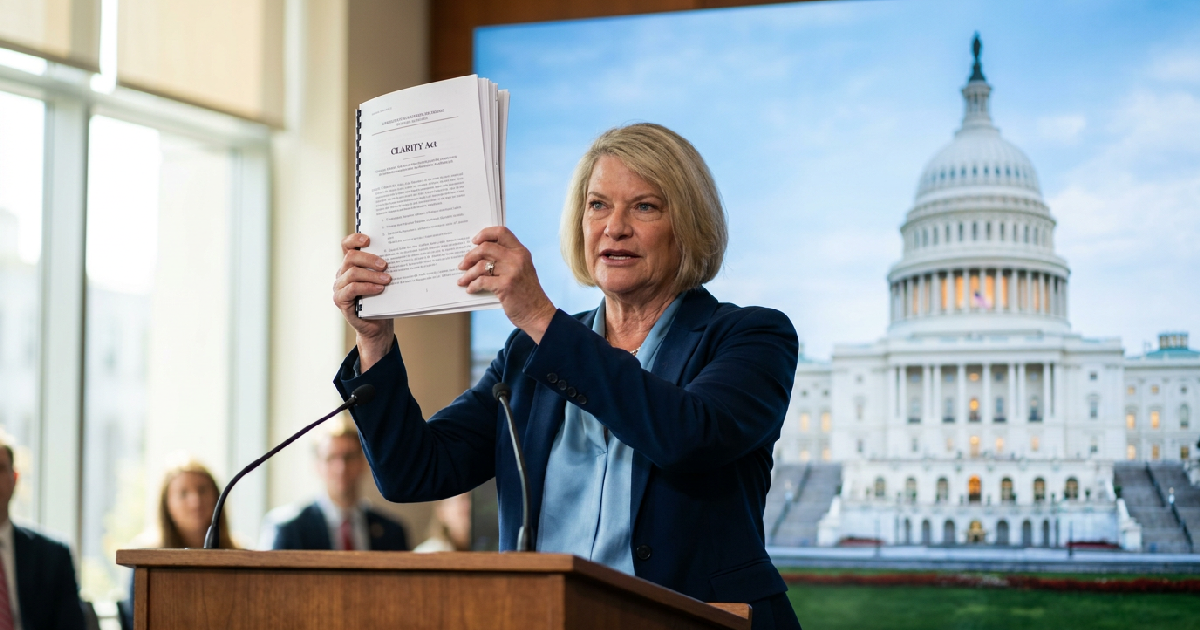

Senator Cynthia Lummis is urging Congressional colleagues to “finish the job” on the CLARITY Act after lawmakers missed a July 4 deadline to advance the cryptocurrency market structure bill.
The Wyoming Republican persists in her push for legislative clarity even as Senate staff work to reconcile conflicting versions of the bill from the Agriculture and Banking Committees. With the 2026 U.S. midterm elections approaching, the window for passing the act is narrowing as the political focus shifts toward campaigning.
Markets react to shifting passage odds for the CLARITY Act
The missed July 4 target has raised concerns among industry advocates who see the bill as essential for removing regulatory ambiguity. Senator Cynthia Lummis recently framed the legislation as a vital contribution to the nation’s history, citing “250 years of American innovation, American freedom, and American grit.”
The Senate now faces a new critical date of August 7, which marks the final scheduled session before the summer recess, to make progress on the framework.
Prediction markets have reflected the growing uncertainty surrounding the bill’s immediate future. Data from Polymarket shows the odds of the CLARITY Act advancing have dropped to 48% following the most recent legislative delay. This volatility suggests that while optimism remains, the shrinking legislative calendar is weighing on investor confidence regarding a breakthrough before the fall.
Despite the dip in prediction market odds, broader sentiment remains at least partially resilient. Over the last 24 hours, approximately 41.6% of market participants expressed a bullish outlook on social media, indicating a cautiously optimistic stance.
This interest is driven by the potential for the act to encourage new capital inflows and allow market sentiment shifts as CLARITY Act advances to materialize into concrete institutional participation.
Impact on digital asset capital formation and project launches
For the crypto industry, the stakes of the CLARITY Act go beyond mere definitions; they involve the practical ability to scale. Analysts point out that the bill could pave the way for enhanced capital formation, potentially allowing firms to raise up to $50 million annually.
This would provide a regulated pathway for startups that are currently hesitant to launch new products in an environment of legal uncertainty.
Specific industry developments are currently stalled, waiting for the Senate to act. For example, the project Abstract is reportedly holding off on introducing “Project Quantum” until the legislative landscape becomes clearer. This “wait-and-see” approach is common among developers who are increasingly looking for federal guidance before committing resources to major new initiatives in the United States.
The push for clarity is also gaining traction through David Schwartz and the XRPL Foundation, who follow these developments closely as wallet adoption trends upward. The eventual passage of such a bill is seen as the primary catalyst needed to move the industry from speculative trading toward broader utility in the domestic economy.
Law enforcement groups shift positions on the bill
One of the more surprising developments in the struggle for passage is the shifting stance of major law enforcement organizations. The National Organization of Black Law Enforcement Executives (NOBLE) was the first major group in its field to support the CLARITY Act. Their endorsement signals that the bill’s provisions for consumer protection and illicit finance oversight are meeting the standards of high-level law enforcement officials.
More recently, the Major County Sheriffs of America (MCSA) informed the Senate that it has moved from a position of opposition to “neutral” regarding the bill. This change came after deliberate internal review of specific clauses. While not a full endorsement, the removal of active opposition from such a significant group clears a substantial political hurdle for Senator Cynthia Lummis and other bill sponsors.
Presidential leverage and the SAVE America Act
Success in the Senate may not be enough to guarantee the bill becomes law due to external political pressures. U.S. President Donald Trump has indicated he may not sign any new legislation until Republicans pass the SAVE America Act. The President recently cancelled a housing news conference, stating that the SAVE America Act is a “National Emergency” that must take precedence over other business.
This development suggests the CLARITY Act could be used as leverage in broader negotiations between the White House and Congress. If the bill remains tethered to these larger political standoffs, the 48% odds of passage may face further downward pressure.
The coming weeks leading up to the August recess will likely determine if the bill can break free of this gridlock or if it will be sidelined by the macro warning signs and market liquidations that often accompany political instability.