
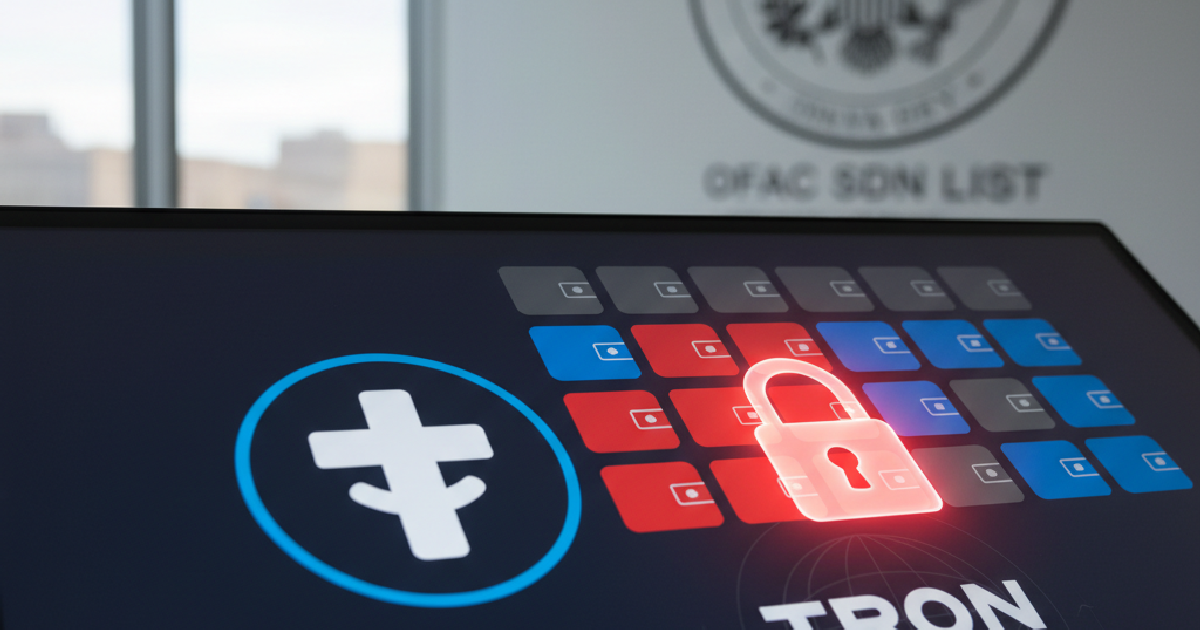

The Office of Foreign Assets Control (OFAC) added 134 wallet addresses to its Specially Designated Nationals (SDN) list on July 1, 2026, to disrupt the financial networks of the Islamic State – Khorasan Province (ISIS-K). Tether Holdings Limited acted to freeze the USDT assets within these wallets as the stablecoin sector continues to align with international sanctions.
The move targets a network that has reportedly moved more than $1.4 million since the beginning of 2023. This enforcement action highlights how digital assets have moved inside the global sanctions machine, making it harder for designated groups to move capital.
Tether freezes USDT following US Treasury sanctions
The U.S. Department of the Treasury’s latest action specifically aimed at the financial infrastructure of ISIS-K. The designation included a total of 134 digital asset addresses, consisting of 131 TRON addresses and three associated with Monero. Following the Treasury’s move, Tether Holdings Limited applied its compliance controls to the USDT-related accounts within this group.
While the company can effectively block its own tokens, it lacks the technical capacity to freeze assets on the Monero chain. However, any address listed on the SDN database becomes toxic to compliant exchanges and service providers. This effectively isolates the funds from the broader regulated financial system.
Tether has previously been urged to transfer frozen USDT to victims of various regional conflicts. This latest freeze follows a long-term trend of deeper cooperation between the stablecoin issuer and Western law enforcement agencies.
Financial infrastructure of the Islamic State Khorasan Province
The Islamic State – Khorasan Province (ISIS-K) is a regional branch of the Islamic State primarily active in Central and South Asia. The group operates in Afghanistan, Pakistan, Tajikistan, and Uzbekistan. Formed in 2015, the organization has used media channels like the al-Azaim Media Foundation to recruit and solicit donations.
The $1.4 million identified in this network represents a portion of the group’s attempts to bypass traditional banking hurdles. Historically, ISIS-K has relied on a mix of donations and criminal activity to fund its operations. By targeting these 134 specific nodes, the U.S. Treasury aims to cripple the group’s ability to facilitate cross-border payments.
Most of the funds were moved in smaller increments to avoid triggering the automated alerts used by centralized exchanges. The transparency of the TRON blockchain allowed forensic analysts to map these flows before the OFAC designation. Many users now push to legalize P2P trade on networks like TRON, yet that same visibility makes it easier for investigators to trace illicit movements.
Evolution of the stablecoin sanctions machine
The speed of the freeze illustrates a massive shift in how the industry operates. For years, digital assets were marketed as a way to avoid the censorship of the legacy financial system. But with the USDT market capitalization exceeding $170 billion, Tether Holdings Limited has integrated deeply with U.S. regulatory demands.
The company maintains a compliance program designed to meet or exceed standards like the U.S. Bank Secrecy Act. Tether no longer waits for individual subpoenas to act on sanctioned entities. Instead, it proactively monitors the SDN list to halt activity linked with sanctioned individuals on the secondary market.
This integration is driven by the composition of Tether’s reserves. The company holds more than $97.6 billion in U.S. Treasuries, making it a major participant in the U.S. bond market. This entanglement makes it impossible for the issuer to ignore federal mandates without risking its own access to the dollar-based banking system. It also impacts broader market liquidity, similar to how resistance levels and rejection points can signal shifting institutional sentiment.
Enforcement trends across the TRON ecosystem
The heavy presence of TRON addresses in the Treasury’s July 1 list is part of a broader trend. Cryptocurrency enforcement has picked up sharply throughout 2025 and 2026. Agencies have focused on Russian evasion networks and North Korean revenue streams that utilize high-speed, low-fee networks.
In August 2025, OFAC worked with the UK’s OFSI to sanction Grinex, an exchange built to dodge international trade restrictions. The current focus on ISIS-K follows that blueprint of targeting specific wallet clusters. If an asset is pegged to the dollar and backed by U.S. debt, the government effectively claims jurisdiction over its movement globally.
As of May 8, 2026, Tether had frozen over $4.4 billion in USDT linked to illicit activity across more than 2,300 cases. Approximately $2.1 billion of that total was tied to specific requests from U.S. law enforcement agencies. This level of cooperation was once unthinkable for a major crypto issuer.
Future outlook for digital asset compliance
The company now assists more than 340 law enforcement agencies in 65 countries. This shift toward a “zero-tolerance” policy has changed the profile of USDT. It is no longer a decentralized currency in the traditional sense, but a digital representation of the U.S. dollar controlled by a private entity.
One notable precedent occurred in November 2023 when Tether froze approximately $225 million linked to human trafficking and “pig butchering” scams in Southeast Asia. The recent freeze of the ISIS-K network wallets follows the same strategy. Analysts use blockchain transparency to locate funds, and Tether uses the centralized smart contract to neutralize them.
We can expect more “smart sanctions” in the coming months that target specific clusters rather than entire networks. The data collected from the TRON network sweep will likely lead to further designations. The cycle of detection and freezing has now become a permanent feature of the modern digital asset market.