
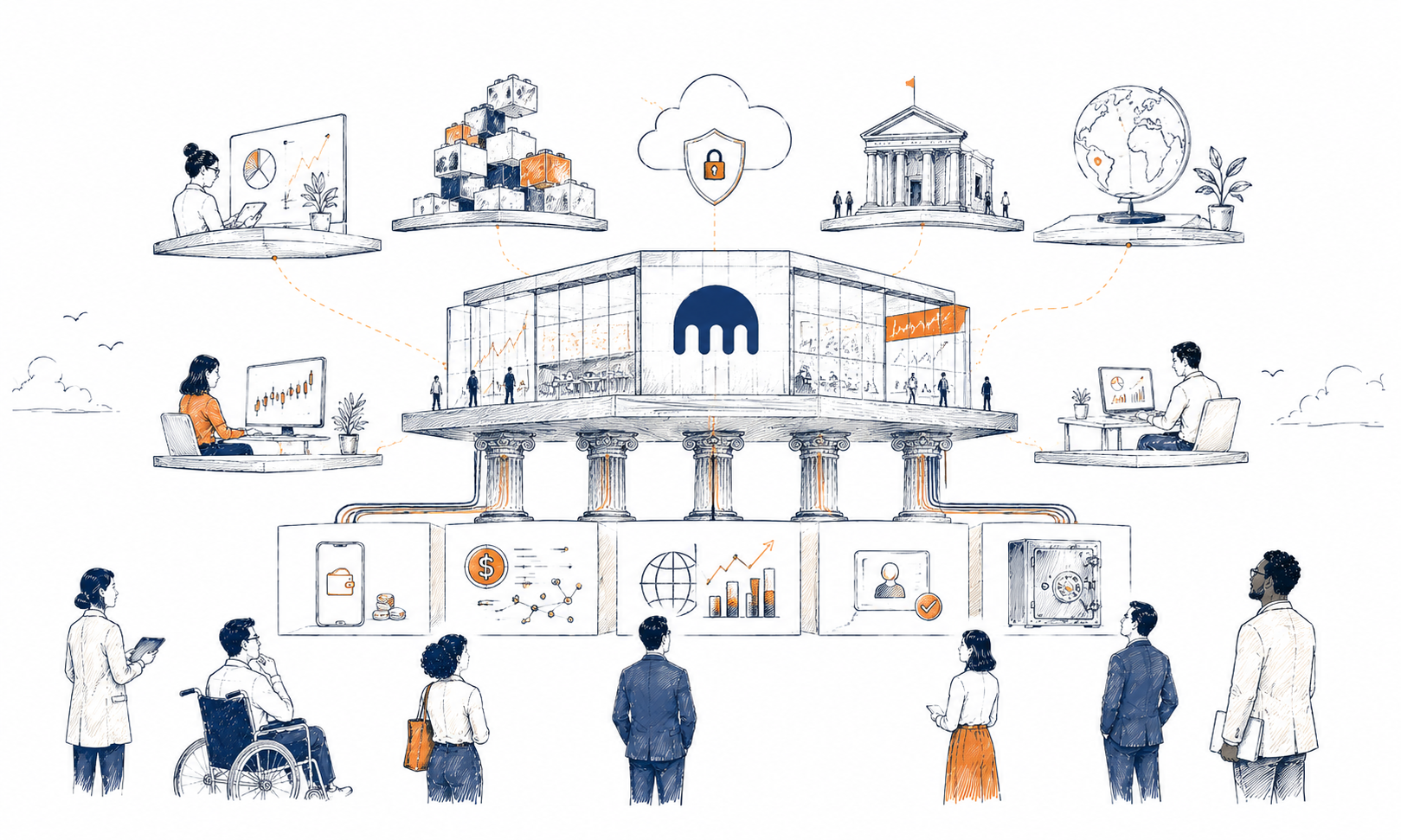

For years, the economics of a crypto exchange were relatively easy to understand. The more investors traded Bitcoin and other assets, the more volume the platform processed and the more fees it could collect.
That created enormously profitable businesses during crypto’s biggest cycles, but also businesses deeply dependent on those cycles.
Kraken is beginning to show how that relationship can change.
Payward, the company behind the exchange, reported $508 million in adjusted revenue in the second quarter of 2026, up 17% from a year earlier, even as total transaction volume fell 13% to $310 billion. Funded accounts increased 42% to 6.6 million.
The more important figure, however, is the composition of the business.
Asset-based and other revenue already accounted for approximately 60% of the total. Trading remains important, but it no longer explains on its own how the company makes money.
At the same time, Kraken is expanding into tokenized equities, futures, payments and other financial services. The company that grew by giving people a place to trade crypto is building an economic structure capable of performing even when its customers trade less crypto.
That turns diversification into something more than a search for additional revenue.
It begins to change what being an exchange actually means.
Trading Created a Powerful but Deeply Cyclical Business
Crypto exchanges have an unusual characteristic.
They can make money when prices rise or fall. What really matters is that investors keep trading.
Volatility has therefore always been an important raw material for the industry.
Large moves in Bitcoin attract users, increase volumes and generate fees. When market activity fades, the same mechanism works in reverse.
The problem is that an exchange cannot control when its customers decide to trade.
That dependence was visible again in recent industry results. At Coinbase, transaction revenue fell 21% from a year earlier in the second quarter to $599 million as crypto trading activity slowed.
Gemini offers an even more extreme example. The company ended the quarter with a $107.7 million net loss, while exchange-related revenue suffered from a sharp decline in trading activity. At the same time, revenue outside trading helped offset some of the operational weakness.
That volatility is precisely what the largest platforms are trying to reduce.
The objective is not to stop making money from trading.
It is to build enough revenue outside trading that a quieter market no longer determines the company’s entire financial performance.
Kraken Is Moving Into Markets That Once Belonged to Other Platforms
Kraken’s expansion makes that strategy increasingly clear.
Its acquisition of NinjaTrader moved the company directly into the U.S. futures market and brought with it a license that allows Kraken to offer regulated derivatives products in the country. When it announced the $1.5 billion deal, Kraken said the acquisition would accelerate its ambitions across multiple asset classes, including equities and payments.
The company has also moved deeper into tokenized stocks.
Its xStocks offering now includes more than 100 U.S. stocks and ETFs represented onchain, including Apple, Tesla and Nvidia. Since launching in 2025, the assets have surpassed $25 billion in cumulative volume, and Kraken has said it aims to offer more than 500 by the end of 2026.
The boundary continues to expand.
In eligible markets, Kraken already allows customers to trade perpetual futures based on tokenized equities around the clock and use margin on certain xStocks.
The result is a platform where infrastructure originally built around Bitcoin and other crypto assets is increasingly being used for stocks, ETFs and futures as well.
This is not a move away from crypto.
It is an expansion of crypto infrastructure into other financial markets.
The Word “Exchange” Explains Less of the Business
There is an important difference between adding products and changing the economics of a company.
Crypto exchanges have been adding services for years. Staking, custody and institutional products are nothing new.
What makes the current moment different is the scale of the diversification and the attempt to bring together markets that historically existed on separate platforms.
Kraken no longer needs to compete only with other crypto exchanges for the investor who wants to buy Bitcoin.
By offering traditional futures, tokenized equities, derivatives and other financial services, it is also beginning to compete for parts of the financial relationship that the same customer once maintained with brokers and other platforms.
That expands the market the company can address.
It also changes where its revenue can come from.
Every additional activity reduces, even if only partially, its dependence on a single variable: how much crypto happens to be trading at any given moment.
The second-quarter results offer an early demonstration of that dynamic.
Volume fell, but revenue continued to grow.
For a company born from trading, that divergence matters.
Coinbase Is Trying to Solve the Same Problem
Kraken is not alone in this transformation.
Coinbase has made building an “Everything Exchange” one of its priorities for 2026, bringing crypto, stocks, prediction markets, commodities and foreign exchange onto a single platform.
The numbers help explain why.
In the first quarter, subscriptions and services already represented 44% of Coinbase’s net revenue. Stablecoins, staking, interest income and subscriptions provided a buffer during a period when overall crypto market volumes fell by more than 20%.
New categories are also beginning to generate meaningful revenue of their own. Retail derivatives surpassed a $200 million annualized revenue run rate, while prediction markets exceeded $100 million annualized in March.
Kraken and Coinbase are approaching the same problem from different directions.
Both built enormous user bases around crypto.
Now they are trying to use those relationships to sell a growing range of services that once required customers to use other platforms.
The exchange is moving from being the destination for a specific transaction toward becoming a more permanent piece of the customer’s financial infrastructure.
The Competition Is Changing Too
That transformation also changes who these companies compete with.
When the main product of a crypto exchange was crypto trading, the competitive landscape was relatively easy to define.
Kraken competed with Coinbase, Gemini, Binance and other crypto platforms.
As those boundaries expand, the distinction becomes less clear.
A platform offering crypto, stocks, futures, payments and other financial products begins entering markets historically occupied by brokers and traditional financial companies.
The same movement is happening in the opposite direction.
Traditional brokerages have added crypto trading, while companies originally built around digital assets are adding products associated with Wall Street.
The two industries are beginning to move into the same territory.
That does not mean crypto exchanges are becoming banks or traditional brokers will disappear. Their regulatory structures, business models and products remain different.
But the boundary separating a crypto platform from a broader financial platform is becoming harder to see.
The Next Exchange Can Make More When Its Customers Do More Than Trade
Kraken remains an exchange, and trading will continue to be an important part of its business.
What is changing is its economic dependence on that activity.
The company can earn money when customers trade Bitcoin, but it is also building revenue around other assets, products and services. The larger that structure becomes, the weaker the direct relationship between crypto volatility and financial performance needs to be.
The second quarter offers an early signal of that shift.
Payward increased revenue even as total transaction volume declined. That does not mean its dependence on the crypto cycle has disappeared, but it does show that other parts of the business can already offset some of the weakness in trading activity.
For years, the main challenge for exchanges was attracting enough users to create liquid crypto markets.
The largest platforms now have millions of them.
The next step is building more of those users’ financial lives around that existing relationship.
If the strategy works, Kraken will still let customers buy and sell Bitcoin.
But less of its future will depend on that being the only reason they open the platform.
That is where the apparent contradiction in the model begins to make sense: the more financial services Kraken builds around its exchange, the less it needs to depend on the activity that originally made it an exchange.