
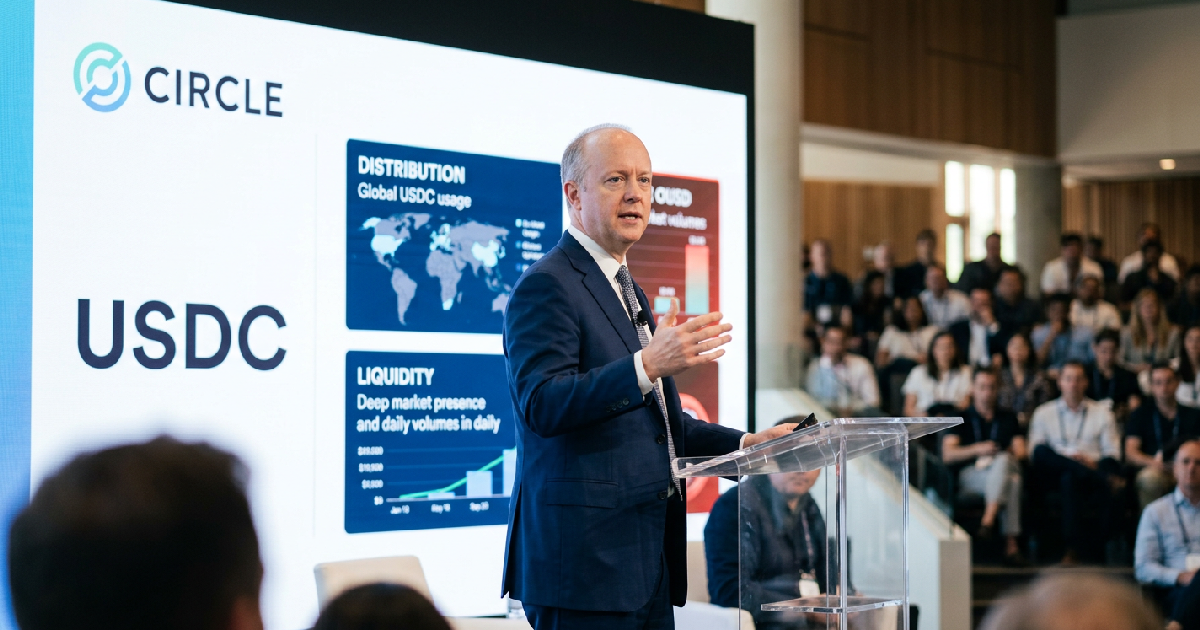

Circle Co-founder and CEO Jeremy Allaire issued a detailed defense of the USDC stablecoin on July 1, 2026, following the launch of a rival token by a massive corporate consortium.
The rebuttal, published on X, arrived two days after the Open Standard consortium unveiled Open USD (OUSD), a move that sent Circle’s stock down more than 17% in a single trading session.
Jeremy Allaire challenges the agility of the consortium governance model
Jeremy Allaire argued that stablecoin networks are platform businesses built over years, emphasizing that USDC’s advantages in distribution, liquidity, and regulatory licensing are not easily replicated.
The market reaction to the OUSD announcement was immediate. On Tuesday, June 30, Circle’s stock fell 17.55% to close at $62.63, marking its weakest level in four months. While the shares rose 2.44% to $64.18 in premarket trading on Wednesday, the stock remains down 55% from mid-May levels.
Jeremy Allaire noted he was sharing his views directly after receiving “lots of questions from our investor community looking for thoughts on OUSD,” as the company defends its position following a quarter where USDC processed roughly $30 trillion in on-chain transactions.
OUSD is governed by Open Standard, an independent company formed by a group of more than 140 firms, including Visa, Mastercard, and Google.
The new token is built on three design principles: partner businesses can mint and redeem without fees or volume caps, partners receive nearly all reserve earnings after a management fee, and the token is governed collectively by a board of partners.
Key details
This model directly challenges the structure of established players, occurring even as Bitcoin exchange supply remains at multi-year lows, signaling a broader shift in how digital assets are managed and held.
A primary pillar of Jeremy Allaire’s rebuttal focused on the governance of multi-company products. Drawing from his experience co-founding the Centre Consortium with Coinbase before consolidating USDC issuance under Circle, Allaire called the track record of consortium products “absolutely dismal” at achieving scale or basic agility. He cited coordination problems and slow decision-making among large corporate partners as systemic hurdles for the OUSD model.
Allaire also addressed the financial sustainability of giving away most reserve income. He argued that returning nearly all revenue to partners risks “starving your infrastructure,” leading to systematic underinvestment that could limit a platform’s scope.
This critique comes at a time of high professional stakes, as Stripe technology president Will Gaybrick has already stated that OUSD will be the default stablecoin for businesses running on the Stripe platform.
The competitive pressure is mounting as traditional payments and technology firms align behind a single standard. While the market for dollar-pegged assets is crowded, USDC maintains a dominant active share, representing approximately 80% of dollar-stablecoin transaction volume in Q1 2026. This level of activity persists despite broader market fluctuations, such as when Ethereum network outlook indicators shift due to changes in decentralized exchange volume.
Coinbase revenue sharing and the August renewal deadline
The relationship between Circle and Coinbase is under increased scrutiny because Coinbase is a member of the OUSD consortium while remaining a primary USDC partner. Under current agreements, Coinbase earns 100% of interest income on USDC held within its own products and 50% of the residual reserve income on USDC held elsewhere.
Bernstein analysts estimate this arrangement accounts for close to 20% of Coinbase’s total revenue.
Jeremy Allaire maintained that the partnership with Coinbase “remains as strong as ever.” However, the Circle-Coinbase Collaboration Agreement is approaching a significant milestone, with its initial three-year term up for renewal around August 18, 2026. Analysts have “raised eyebrows” at Coinbase’s participation in OUSD, given the exchange’s substantial financial reliance on USDC reserve income.
Three layers of USDC network effects and market liquidity
Allaire identified three layers that form the foundation of USDC: developer and application integrations, liquidity depth, and regulatory licensing. These assets, he argued, were accumulated over a long period of time and include key approvals in the European Union and Japan. In contrast, Open Standard has not yet disclosed specific custodians or attestation practices for OUSD, though it states reserves will comply with U.S. requirements.
The liquidity layer remains a significant barrier for new entrants. USDC’s market capitalization is currently between $73 billion and $80 billion, with specific data from June 25 placing the circulating supply at $73.6 billion. Allaire compared this to precedents like Paxos’s Global Dollar Network (USDG), a similar consortium-backed stablecoin launched in 2024 that has grown to only about $3 billion in supply.
Despite the recent stock slide, Wall Street analysts have issued mixed responses. Bernstein reaffirmed an “Outperform” rating with a $190 price target, and William Blair suggested the selloff might be a buying opportunity, labeling OUSD “a solution searching for a problem.”
As the total stablecoin market capitalization exceeds $313 billion, the industry awaits the actual launch of OUSD later in 2026 to see if the consortium can overcome what ARK Invest’s Lorenzo Valente calls the “cold-start” problem of liquidity depth.