
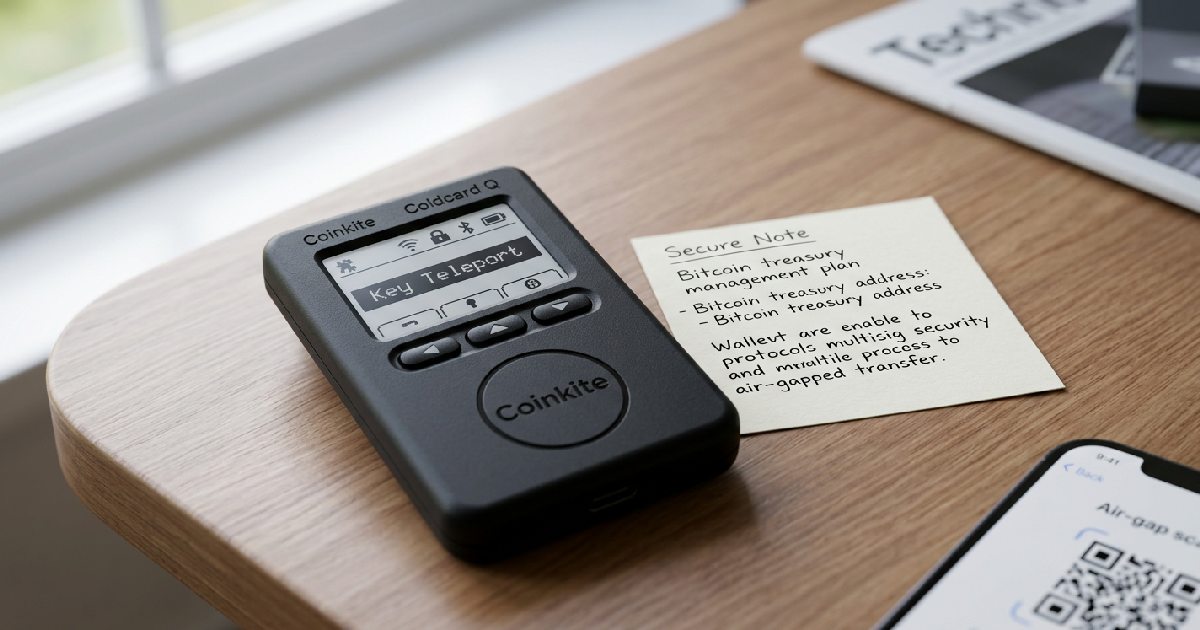

The Coldcard Q’s Key Teleport feature, developed by Bitcoin hardware manufacturer Coinkite, has reached a year of operational implementation for securing remote Bitcoin treasury management. Officially announced in April 2025, the feature provides a specialized protocol for transferring sensitive data—including seed phrases, secure notes, and Partially Signed Bitcoin Transactions (PSBTs)—between two air-gapped devices.
This development addresses a critical vulnerability for traveling executives and treasury managers who may need to authorize significant movements of cold storage assets while away from their primary hardware.
The $249 Coldcard Q serves as the exclusive host for Key Teleport. This premium hardware wallet is designed to operate without ever connecting to a computer or the internet. By utilizing BBQr codes—a specific QR standard developed by Coinkite—and Near Field Communication (NFC), the device allows for “teleporting” encrypted backups and settings across the world.
com/bitcoin-price-analysis-market-resistance-outlook-2026/”>Bitcoin price resistance through timely multisig authorizations that would otherwise be delayed by physical distance.
Secure air-gapped transfers with Key Teleport
Key Teleport relies on a multi-step cryptographic handshake that requires interaction between a sender and a receiver. The process begins with the receiving device generating a temporary, one-time public-private key pair on the secp256k1 curve. Simultaneously, it generates a random 8-digit “Receiver Password.” This password must be shared with the sender through an out-of-band communication channel, such as an encrypted messaging app or a separate video call.
Once the sender scans the receiver’s initial QR code and enters this password, the two devices use Elliptic Curve Diffie-Hellman (ECDH) to derive a shared session key. The sender then selects the data for transfer, which is encrypted using the AES-256-CTR algorithm. A second layer of protection is applied via an 8-digit alphanumeric “Teleport Password.” This ensures that even if one channel is compromised, an attacker would still lack the second password or the single-use key stored only on the receiving device.
The operational security of this method is designed to outperform older, more cumbersome procedures. Before Key Teleport, secure remote transfers often required booting Tails OS on burner laptops and using PGP encryption. Coinkite’s system simplifies this “mission” while maintaining a high security bar. This is vital as specialized investors focus on Bitcoin exposure through institutional platforms, requiring robust self-custody tools for their underlying assets.
Specialized hardware architecture of the Coldcard Q
The physical design of the Coldcard Q is central to making these air-gapped transfers possible. The device features a 3.2-inch LCD screen, which offers more than nine times the pixels of the older Mk4 series. This high resolution is necessary for displaying complex BBQr codes that contain large amounts of data, such as full device backups or encrypted wallet metadata.
To ensure the device remains isolated from potential digital threats, the Coldcard Q is powered by three AAA batteries. It includes a dedicated QR code scanner with a red strobe indicator to assist with focus and a built-in flashlight for low-light environments. These hardware additions allow the system to handle the “scrambled” data blurbs of Key Teleport without ever touching a USB cable.
com/crypto-market-liquidation-analysis-macro-outlook-2026/”>crypto market liquidations and the systemic risks of keeping keys on internet-connected devices.
AI stress testing and resilience
In a test of the Key Teleport feature’s resilience, researchers tasked the Anthropic Claude Opus 4.8 High AI model with attempting to decrypt an intercepted teleport message. The AI was provided with the encrypted QR blurb and, eventually, both pin codes. However, the model was unable to crack the encryption. It concluded that the “real lock” is a one-time random key that only exists on the receiving device and is never published or transmitted over any channel.
The AI’s failure to penetrate the data illustrates the security of the ephemeral key pair system. Claude Opus 4.8 noted that even with math tricks and large-scale computer searches, the secret remained inaccessible because the necessary private key was never shared. This test confirms that Key Teleport achieves its goal: moving sensitive Bitcoin data across public channels (like a video call) without exposing the underlying private secrets to onlookers or automated surveillance.
Use cases for Bitcoin treasuries and families
Beyond emergency treasury movements, Key Teleport has practical applications for collaborative multisig setups. It allows signers to pass PSBTs from one device to another without the risks associated with microSD cards or encrypted chats, which can sometimes leak metadata. It also facilitates “device cloning,” where one Coldcard Q can be mirrored to another remotely, or a secure backup can be sent to a trusted recipient for inheritance planning.
Coinkite’s implementation also assists in onboarding new users. A knowledgeable user can help a family member set up their first wallet remotely, sending the necessary configurations and encrypted settings via a secure teleport. By eliminating the need for computers and minimizing the risk of human error during seed phrase entry, the feature aims to make high-security Bitcoin management accessible to a broader range of “serious bitcoiners” and professionals.