
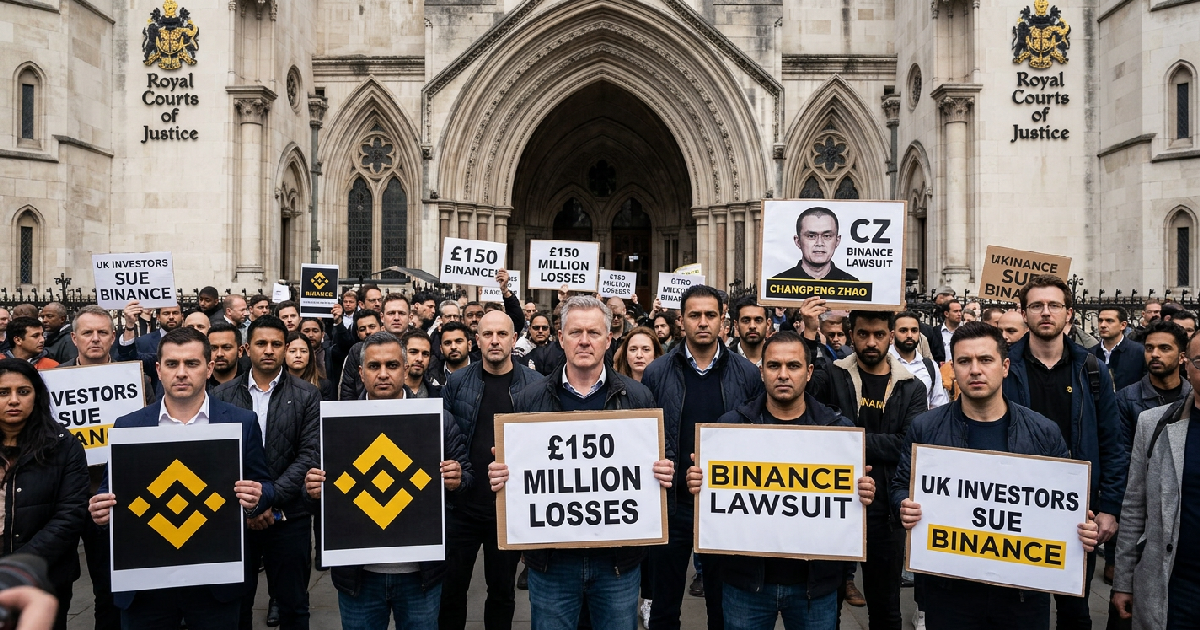

Almost 1,700 UK investors have launched a collective lawsuit against Binance and its founder Changpeng Zhao, claiming at least £150 million ($200 million) in damages for the alleged unlawful sale of crypto derivatives.
The claim, filed in London’s High Court on June 30, 2026, alleges that the exchange marketed high-risk leveraged products to retail traders without mandatory regulatory authorization. KP Law is representing the group of 1,692 claimants who argue these transactions breached the Financial Services and Markets Act.
How the claim tests the Financial Services and Markets Act
The legal action centers on products sold from late 2019 through the period following the Financial Conduct Authority (FCA) ban on retail crypto derivatives in January 2021. Claimants report that Binance promoted these instruments through aggressive social media posts, email communications, and online promotional campaigns.
Some individual investors allege they lost tens of thousands of pounds when their leveraged positions were liquidated during market volatility. The lawsuit names Cayman Islands-registered Binance Holdings and UAE-based Nest Exchange as defendants alongside Changpeng Zhao.
The core of the case rests on whether these contracts are legally enforceable under British statute. Because the exchange allegedly lacked the necessary FCA authorization to sell these specific derivatives, the claimants argue the deals are void.
This legal strategy aims to hold the platform responsible for losses, shifting the burden away from the “buyer beware” principle often cited by crypto exchanges. This development comes as Bitcoin exchange supply remains at multi-year lows, indicating a broader pivot in how retail users interact with centralized trading platforms.
Key details
The claimants argue that Binance bypassed UK oversight by offering retail consumers complex financial products that the FCA later estimated would have saved investors £53 million annually if the ban had been strictly followed.
Under the Financial Services and Markets Act, if an unauthorized firm arranges financial deals requiring regulation, a court can rule those deals unenforceable. If successful, this would allow the nearly 1,700 investors to reclaim their initial capital and subsequent losses.
This litigation surfaces at a time of significant regulatory shifts across the industry. For instance, XRP speculative activity has frequently tested the boundaries of what constitutes a regulated security versus a retail commodity. The London lawsuit represents a similar reckoning, specifically targeting the mechanics of leverage and the geographical arbitrage used by global platforms to serve UK customers from offshore entities.
Binance has already faced significant pushback from British authorities, having been forced to restructure under financial promotion rules in 2023. This current High Court claim, however, looks backward to a period of rapid expansion when the exchange allegedly ignored local restrictions. The outcome could set a precedent for thousands of other retail traders who used similar platforms during the market peaks of the early 2020s.
A history of regulatory friction for Binance and Changpeng Zhao
This is not the first time Binance and its founder have been accused of running an illegal derivatives operation. In 2023, the US Commodity Futures Trading Commission (CFTC) charged the company and Changpeng Zhao with similar violations, leading to a landmark $4.3 billion settlement.
Changpeng Zhao subsequently resigned as CEO and served a four-month prison sentence in the United States after pleading guilty to criminal charges related to anti-money laundering failures.
Binance has vowed to defend itself against the London claim. A spokesperson for the exchange stated that the company remains committed to its obligations to users and intends to operate in accordance with applicable laws.
Key details
“We will defend against these claims through the appropriate legal process in due course,” the spokesperson said, while declining to comment further on the specifics of the ongoing litigation. The defense is expected to argue that traders accepted the risks of leverage voluntarily.
The timing of the claim is particularly difficult for the exchange as it manages a strategic retreat from several European markets. Reports indicate that Binance is set to lose its bid for an EU license, and separate attempts to secure a foothold in Greece reportedly unravelled last month.
While market analysts monitor Ethereum recovery outlooks and institutional flows, the retail legal landscape is becoming increasingly hostile for unauthorized providers in the UK.
Potential challenges in enforcing a High Court judgment
Despite the size of the claim, the physical recovery of funds may prove complicated. Binance’s main authorization is currently situated in the United Arab Emirates, and it remains “geographically agnostic” in much of its corporate structure. Enforcing a judgment from the London High Court against Cayman Islands-registered Binance Holdings or UAE-based Nest Exchange involves complex international legal coordination that could take years to resolve.
Furthermore, the defendants have not yet officially acknowledged service of the claim in the court files. Legal experts suggest that a jurisdictional battle is likely before the case can proceed to a full trial on the merits of the unauthorized sales.
If the court eventually rules that the deals were void, it could trigger a wave of “clean-up” litigation across other jurisdictions where the exchange operated without local licenses.
For now, the nearly 1,700 claimants are waiting for the next procedural steps in London. The case highlights a growing trend of collective actions in the crypto space, where retail investors are moving beyond individual complaints to launch high-stakes group proceedings.
As the UK tightens its grip on the digital asset sector, this lawsuit will serve as a definitive test of whether foreign exchanges can be held liable for losses incurred by British citizens on their platforms.