
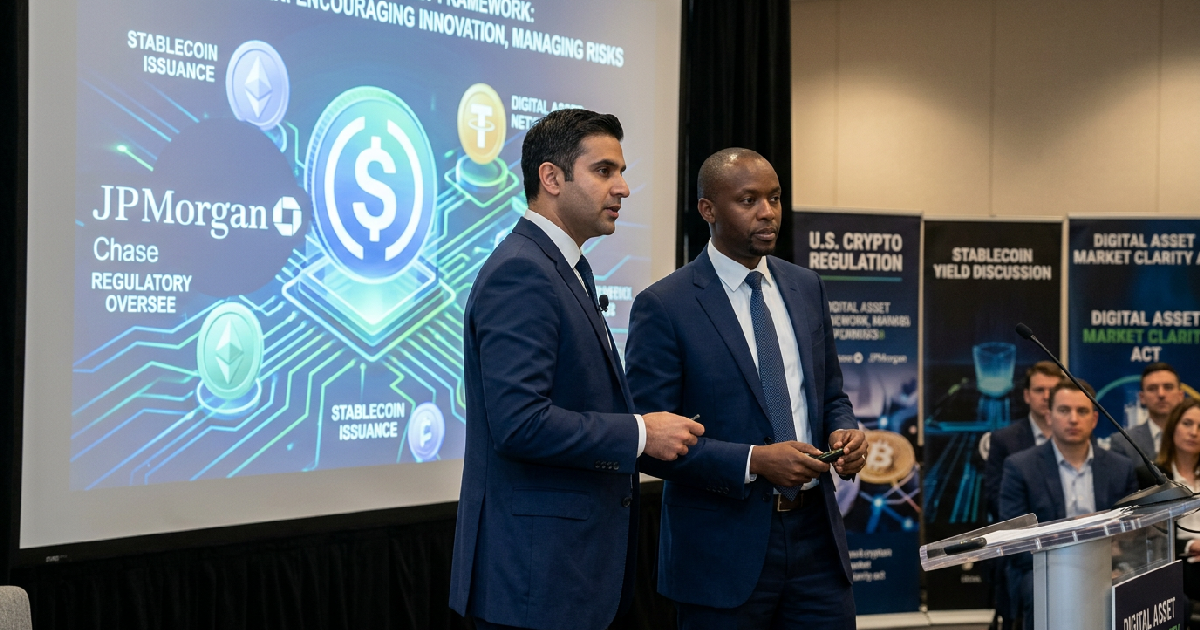

As much of the crypto market watches price charts and waits for the next rally, Wall Street’s largest bank is investing in something far more enduring: the infrastructure that could power tomorrow’s financial system.
Crypto investors often measure progress by one number.
Bitcoin’s price.
When markets rally, optimism returns. When prices fall, doubts quickly follow. That cycle has shaped the industry’s narrative for years.
But the world’s largest financial institutions appear to be following a different roadmap.
JPMorgan continues expanding Kinexys, its blockchain-based platform designed to modernize payments, settlement, and tokenized financial assets. Rather than focusing on cryptocurrencies as speculative investments, the bank is investing in the technology that could reshape how money itself moves.
That distinction reveals an important shift.
Wall Street may no longer be asking whether blockchain matters.
It is beginning to ask how blockchain fits into the future of finance.
Kinexys Is About Infrastructure, Not Speculation
Unlike crypto exchanges or investment products, Kinexys is not designed to help investors trade digital assets.
Its purpose is far more ambitious.
The platform seeks to improve the way financial institutions transfer value, settle transactions, manage liquidity, and eventually tokenize traditional assets.
In other words, JPMorgan is treating blockchain as financial infrastructure rather than a speculative market.
That perspective has become increasingly common among major banks and asset managers.
While retail investors often associate blockchain with cryptocurrency prices, institutional players are paying growing attention to the efficiency gains the technology can deliver behind the scenes.
Faster settlement, lower operational costs, programmable transactions, and tokenized securities represent opportunities that extend well beyond crypto trading.
Wall Street’s Priorities Are Changing
The evolution of institutional thinking may be one of the biggest changes taking place in digital assets. Several years ago, the primary debate inside traditional finance centered on a simple question: Should institutions have any exposure to cryptocurrencies?
Today, many of those same institutions have moved beyond that discussion. The conversation increasingly revolves around implementation.
How should blockchain integrate with existing financial infrastructure? Which assets should be tokenized first? How can digital settlement reduce friction in global markets?
Those questions are fundamentally different from the ones driving most retail conversations.
They are less concerned with predicting the next bull market and more focused on preparing for the next generation of financial services.
Infrastructure Often Outlasts Market Cycles
History offers an interesting perspective.
The companies that generated the greatest long-term impact during the internet revolution were not always those with the most popular websites.
Many became indispensable because they built the infrastructure that supported the digital economy.
Blockchain may be entering a similar stage.
While price cycles continue attracting headlines, banks, payment companies, custodians, and financial institutions are investing in the systems that could support tokenized assets, digital payments, and real-time settlement for decades to come.
Whether those systems ultimately rely on public blockchains, private networks, or hybrid models remains an open question.
What appears increasingly clear is that institutional investment is becoming less dependent on cryptocurrency prices alone.
Infrastructure has become its own investment thesis.
That may be the most important signal coming from JPMorgan’s continued blockchain expansion.
Bull markets create excitement.
Infrastructure creates industries.
And while much of the crypto market continues watching price charts, some of the world’s largest financial institutions are quietly building the architecture that could define finance long after the next market cycle has passed.