
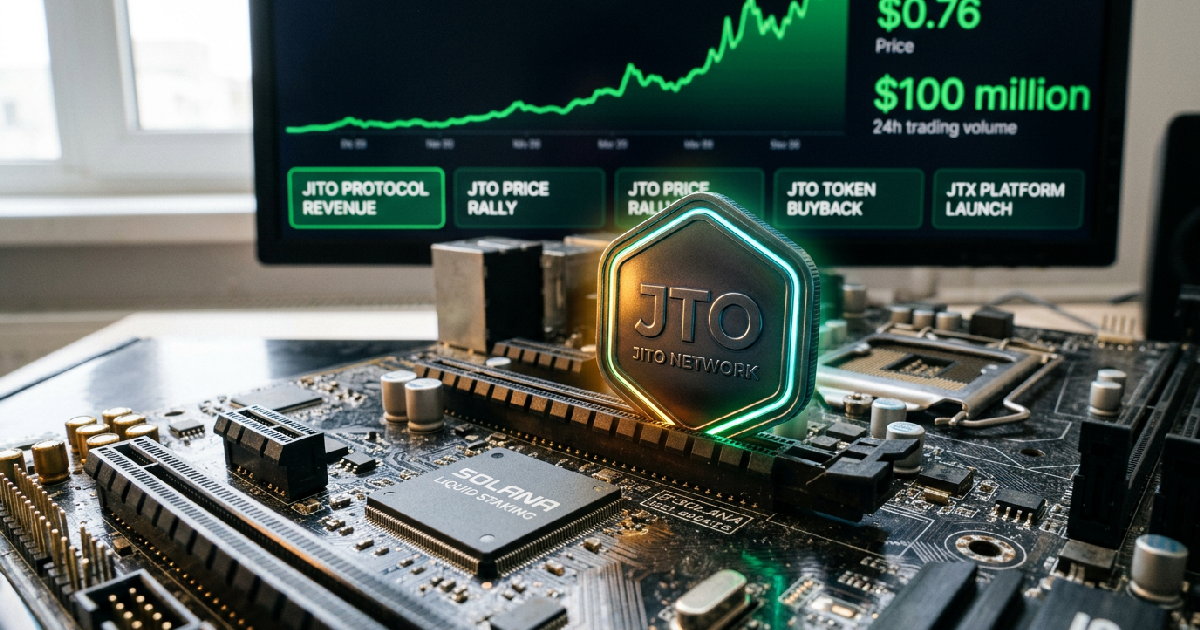

The Jito network is experiencing a surge in on-chain activity as the JTO governance token breaks out of a multi-month consolidation pattern. While some market reports have circulated a $1.75 billion gross revenue figure as of June 27, 2026, verifiable data suggests this number may be conflated with external trading volumes. In reality, the protocol has maintained a trajectory of high-performance within the Solana ecosystem, having scaled to nearly $30 million in annualized revenue by late 2025.
The current price rally is supported by a rise in daily trading volume, which has climbed to almost $100 million. This increase in market participation coincides with JTO gaining nearly 12% in a 24-hour period to trade around $0.76. This push has brought the token’s monthly gains to over 45%, reflecting a broader recovery from a February low of $0.23. The technical breakout above a bullish flag pattern on the daily timeframe suggests that momentum remains strong, though analysts at Traders Union have noted significant resistance levels ahead.
Mechanisms driving Jito protocol revenue and token value
Jito’s economic model relies on capturing value from several key layers of the Solana stack. The protocol generates revenue through its Block Engine fees, the Block Assembly Marketplace (BAM), and the TipRouter. These systems allow validators to receive priority fees for transaction ordering, effectively monetizing the competition for block space. Additionally, the JitoSOL liquid staking platform contributes to the DAO treasury through dynamic fees charged for immediate transitions of staked assets.
The Jito DAO has taken aggressive steps to link this protocol success to the JTO token. Since October 22, 2025, the network has committed 100% of its generated revenue to the continuous repurchase of JTO tokens. This buyback mechanism, which saw $2.5 million executed between August and October 2025, is designed to reduce circulating supply. As investor sentiment shifts toward protocols with sustainable fee-generation models, Jito’s buyback program provides a fundamental floor for market valuation.
However, the token faces persistent technical hurdles. According to expert Anton Kharitonov, the current advance is challenged by long-term resistance near $0.44, and the Relative Strength Index (RSI) reached 74.72 in mid-June. This indicates that JTO is in an overbought zone where profit-taking is likely. Much like how speculative activity returns during major technical tests, JTO’s current trajectory depends on whether it can flip previous resistance into support.
Supply pressure and upcoming ecosystem expansions
While the revenue metrics are promising, Jito must navigate significant supply-side headwinds. Monthly token unlocks release approximately 11.3 million JTO tokens into the market, a schedule that continues through the end of 2026. This consistent influx creates “real sell pressure” that the protocol must offset with sustained demand and its ongoing buyback initiatives. Historically, these unlocks have prevented a simpler price setup, requiring the DAO to maintain high levels of profitable network activity to keep pace with dilution.
The upcoming launch of the JTX platform, a self-custodial trading engine slated for full release in July 2026, could provide the necessary catalyst. Unlike previous revenue streams, 80% of JTX revenue is planned to accrue directly to JTO holders. Viktoras Karapetjanc of Traders Union described this shift as a “robust driver of token holder value.” By diversifying its income beyond MEV rewards and liquid staking, Jito aims to cement its role as a central pillar of Solana’s financial infrastructure.
As Russia and other jurisdictions explore clearer frameworks for digital asset trade, the demand for high-efficiency infrastructure like Jito’s block engine could see further institutional interest. Whether the current rally reaches the token’s all-time high of $6.01 will likely depend on the successful rollout of these new platforms and the continued growth of active addresses within the ecosystem.