
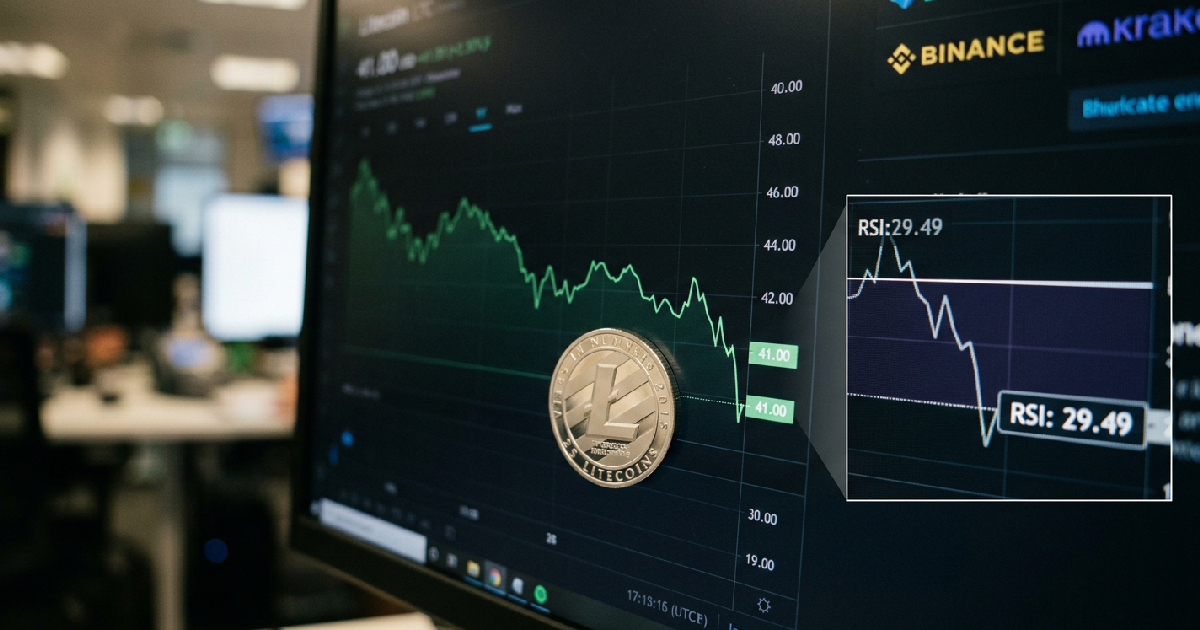

Litecoin (LTC) is navigating a period of relative stagnation as the asset struggles to find a firm base above the $41 level, with exchange data showing slight price variations across major trading platforms on June 26, 2026.
While Kraken and Investing.com list LTC at $41.29, other venues like LiteFinance see the token at $41.21, reflecting a market that is deeply consolidated following a steep correction in mid-June.
Litecoin price prediction and short-term resistance levels
The 24-hour performance of the asset also shows conflicting signals; Cryptopolitan reported a 1.5% uptick during the Asian trading session, yet data from Binance and Kraken indicate the price is down roughly 0.7% on the day.
Since February, Litecoin has largely been trapped within a range between $49.77 and $59.09, but a failed defense of those levels has recently pushed the price below the $43 mark.
Despite the slide, the Relative Strength Index (RSI) stands at 29.49, a level typically associated with oversold conditions that could trigger a “buy” signal for some technical traders.
Technical indicators for Litecoin currently suggest a weak long-term trend, evidenced by the 200-day moving average which has been sloping downward since June 20, 2026. This technical decay has placed the burden of proof on buyers to reclaim the $42.02 resistance level to avoid further downside toward the $39.19 support floor.
Key details
Short-term volatility is currently measured at a medium 4.14%, indicating that while a breakout is possible, the asset lacks the immediate momentum seen earlier in the year.
This sluggishness comes as the broader market watches shifts in capital flows, particularly as Bitcoin exchange supply maintains multi-year lows, potentially setting the stage for a supply shock. If Bitcoin moves closer to the $100,000 threshold, Litecoin could benefit from the resulting rotation of liquidity.
However, and in the absence of such a move, LTC remains vulnerable to a bearish retest of its $36.37 support zone if sellers remain in control of the 4-hour EMA trend lines.
The market capitalization of the network also remains a point of variance among data providers. While Cryptopolitan values the network at $4.39 billion, other sources like Kraken and Paybis cite a lower valuation of roughly $3.2 billion. This discrepancy often arises from how different trackers calculate the circulating supply, which currently sits at approximately 77.32 million LTC against a hard cap of 84 million coins.
Litecoin foundation initiatives and the path to $200
For Litecoin to reach the psychological $200 barrier, it would require a significant recovery from its current low-$40 range. Analysts at Cryptopolitan suggest that a surge to $160 is possible within 2026, though a sustained move above $200 may not materialize until 2027.
This growth is largely predicated on the Litecoin Foundation’s efforts to expand the coin’s utility as a medium of exchange, including recent updates to the Nexus Wallet which now supports Flexa-powered in-store payments.
Further developments, such as the integration of MWEB (MimbleWimble Extension Block) and Tor support, emphasize privacy and fungibility—features often sought by institutional investors looking for “clean” digital assets. This focus on utility mirrors broader industry trends where market sentiment shifts as the CLARITY Act advances through legislative hurdles.
Key details
Assets with a clear Proof-of-Work (PoW) status and a 15-year history of network security are often viewed as lower-risk options in a tightening regulatory environment.
Long-term targets and the impact of the 2027 halving
Looking toward 2032, some models predict a maximum price of $1,338.47 for LTC, assuming the network continues to scale its daily transaction volume. A central component of this long-term bullish outlook is the halving mechanism.
The next halving event is projected for September 11, 2027, which will reduce the block reward from 6.25 LTC to 3.125 LTC. Historically, these events create upward pressure on price by reducing the rate of new supply entering the market.
However, short-term hurdles remain significant. If the market continues to face pressure through the end of June 2026, LTC may close the month with an average price near $55, far below the $100 mark it touched last year. Long-term success will likely depend on whether the foundation can maintain Litecoin’s relevance against high-speed Layer-2 networks and new competing altcoins.
Forecasted price levels for 2026
- Minimum Projected Price: $40.00 (Current support floor)
- Average Projected Price: $125.00 (Mid-year baseline)
- Maximum Projected Price: $160.00 (Resistance ceiling)
- End-of-Year Sentiment: Bearish to Neutral
Network performance and payment integration factors
Litecoin’s core value proposition remains its speed and reliability compared to its predecessor. With a block confirmation time of 2.5 minutes, it is four times faster than Bitcoin, making it a viable alternative for microtransactions. This technical edge has allowed it to remain a top 25 cryptocurrency by market cap despite increased competition.
Furthermore, the 24-hour trading volume remains healthy at approximately $298 million, showing that liquidity has not dried up during the price slide.
Broader economic conditions also play a role in the asset’s trajectory. We have recently observed how macro warning signs emerge as crypto liquidations rise alongside treasury yields, impacting high-beta assets. Litecoin’s resilience in these conditions will be a key metric for investors in the latter half of 2026.
For now, the market waits to see if the recent “buy” signal from the sub-30 RSI will result in a sustained relief rally or if the bearish moving average trend will prevail.