
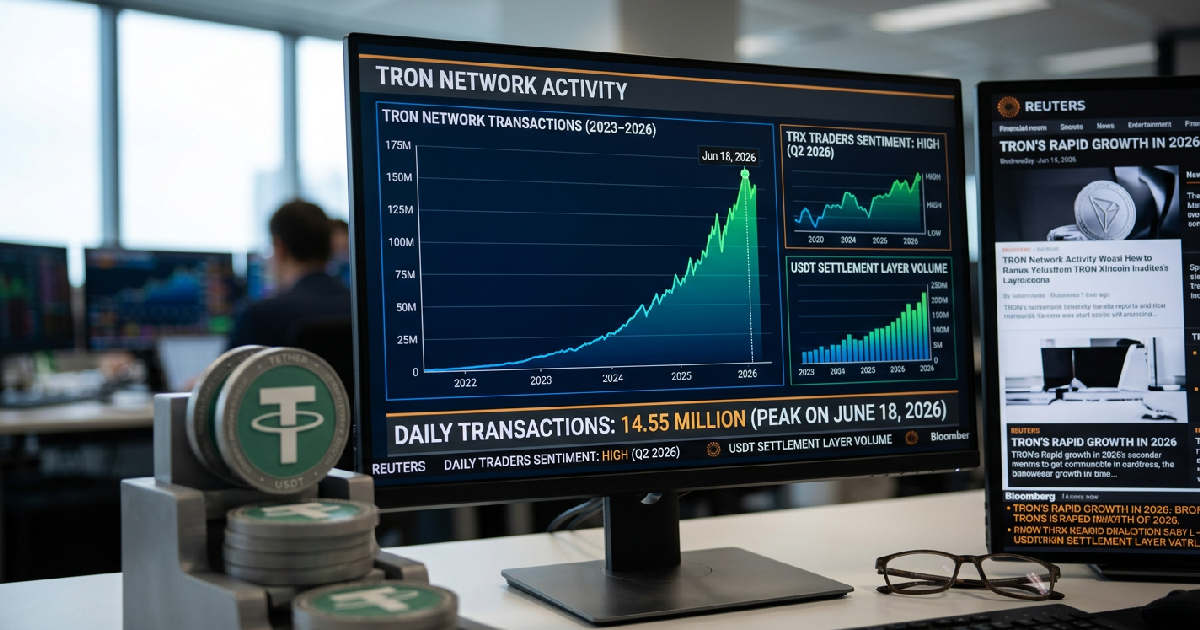

TRON network activity reached a historic milestone on June 18, 2026, recording 14.55 million daily transactions. This mark represents the third all-time high established within a ten-day window, signaling a surge in on-chain utility for the ecosystem. Despite this level of physical usage, derivatives traders appear hesitant to commit to a bullish outlook, even as total network accounts exceeded 373 million earlier this year.
The network’s primary engine remained its dominance in the stablecoin sector. TRON currently acts as the leading settlement layer for USDT, hosting over $85 billion in supply. This utility generated more than $8.1 million in daily network revenue as of June 18.
Such consistent performance led to a Total Value Locked (TVL) of $26 billion in the first quarter of 2026, a 7.38% increase from the prior quarter. But this growth hasn’t fully insulated the TRX price, which recently tested a support level of $0.32.
Derivatives market signals lingering bearish sentiment
Global regulatory shifts continue to influence how these assets are perceived and traded. For instance, Russia lawmakers push to legalize P2P trade and expand asset whitelists to include tokens like TRX and SOL. This legislative momentum provides a backdrop for corporate accumulation. TRON Inc.
recently purchased 157,392 TRX, adding to a digital asset portfolio that stood at $225.1 million at fair value at the end of the first quarter.
There is a visible divergence between TRON network throughput and market confidence. As of June 20, 2026, TRX Open Interest remains stagnant at approximately $202 million. This lack of expansion suggests that investors are not yet ready to bet heavily on a price breakout. More importantly, funding rates across the board are currently negative.
This indicates that short positions are paying longs, signifying a bearish lean among speculators despite record-breaking daily active accounts, which hit 5.8 million on June 10.
Technical indicators like the Relative Strength Index (RSI) are showing signs of life, currently sitting at 42. While the pace of recovery is improving, it hasn’t translated into a confirmed trend reversal. The Moving Average Convergence Divergence (MACD) is flattening out, often a signal that intense selling pressure is beginning to fade.
However, traders remain cautious. Contrast this with other ecosystems where Ethereum network outlook strengthens as AI-driven DEX activity increases, yet still faces its own hurdles in institutional sentiment.
Analysts are looking at broader market trends to gauge when this “no confidence” phase might end. Many are watching how Bitcoin exchange supply maintains multi-year lows as a potential catalyst for an altcoin rally. For TRX, the high volume of daily transactions—averaging 10.
86 million per day in Q1 2026—proves the utility is there. The market, however, seems to be waiting for a macro shift before valuing that utility more aggressively.
Corporate balance sheets and stablecoin settlement volume
The financial health of the network’s main corporate entity appears stable. TRON Inc. reported a net income of $21.6 million for the quarter ended March 31, 2026. This was supported by $3.0 million in staking income and significant unrealized digital asset gains. Total assets for the company are valued at approximately $252.
7 million. While the company’s valuation saw a slight dip of 2.24% following its Q1 results, its role as a infrastructure provider for global stablecoin transfers remains central to its revenue model.
In the first few months of 2026, the network settled over $2 trillion in stablecoins. This volume is primarily driven by USDT transfers, where TRON hosts approximately $86.7 billion of the supply.
Centralized exchanges such as Bybit and Bitget remain the top entities by both user count and transaction volume, collectively contributing millions of transactions to the ledger. This exchange-driven activity helps maintain the network’s liquidity despite the inflationary pressure of a net issuance of 70.5 million TRX during the first quarter.
The path forward depends on the network’s ability to maintain these record-breaking transaction counts. With a 30-day average of 5.18 million daily active accounts, the footprint of the TRON ecosystem is expanding. Investors are now focused on whether the token can push through current resistance levels to match the robust on-chain data.
Until the funding rates shift back to positive territory, TRON remains a high-utility network waiting for its breakout moment in the speculative markets.