
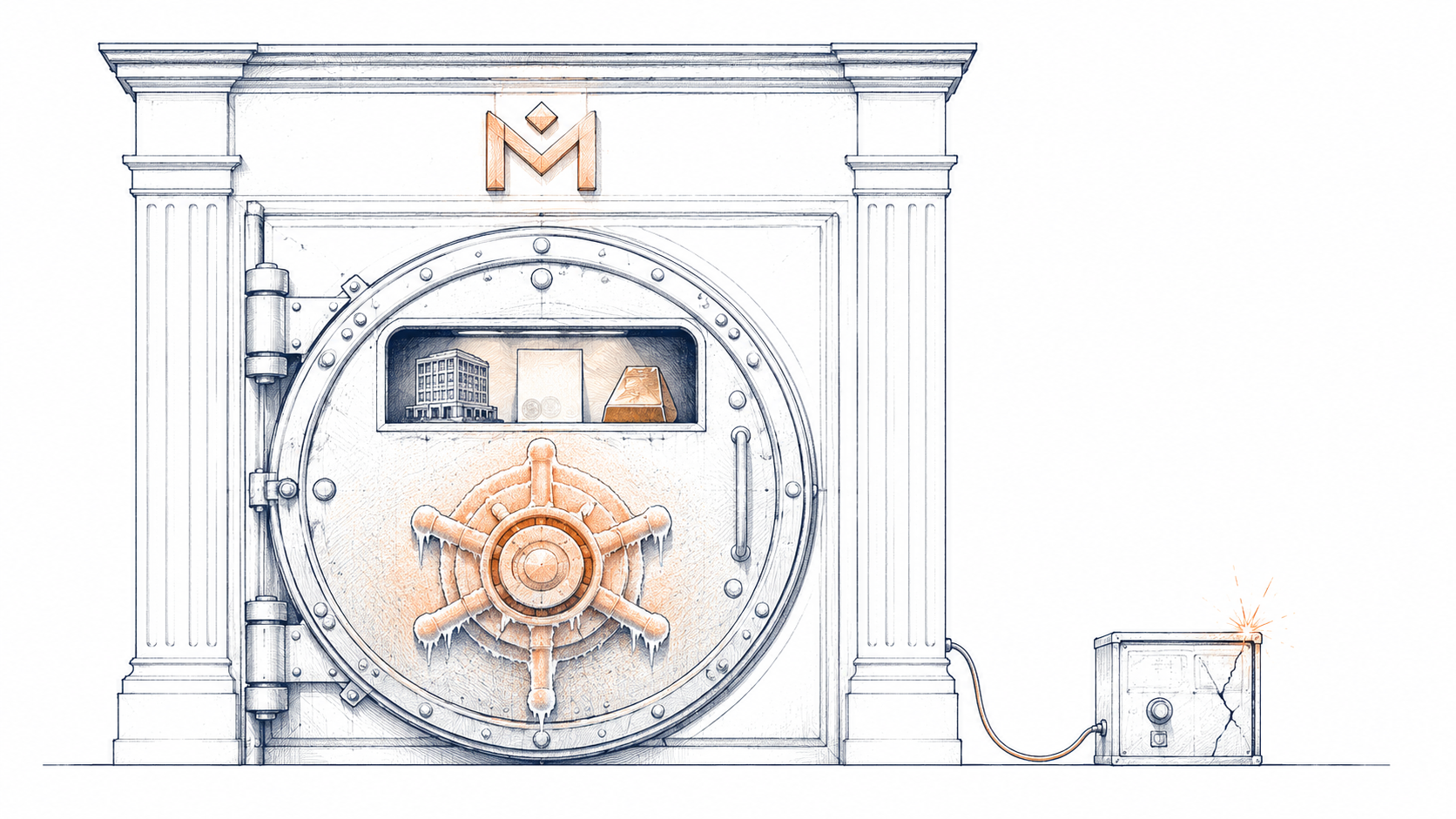

Tokenization is usually framed as an infrastructure upgrade.
A bond, fund or other traditional asset can keep its underlying economic and legal characteristics while gaining something new: programmability, faster settlement and the ability to move across blockchain-based markets.
That proposition has helped turn real-world assets into one of crypto’s largest institutional opportunities.
MANTRA was built specifically around it. Its Layer 1 network was designed to support the tokenization and on-chain distribution of traditional financial assets.
This week, the network stopped.
MANTRA halted block production after detecting an attacker exploiting a vulnerability in an upstream software dependency. Transactions were frozen, deposits and withdrawals were suspended on affected venues, and validators remained offline while developers prepared and tested a patch. The team later said the incident was isolated to its Cosmos EVM module and affected two wallet addresses before containment, with no user funds exploited.
MANTRA’s token also fell as much as 18.5% to an all-time low near $0.0041 shortly before the chain stopped producing blocks, although the project has not established that the exploit caused the price decline.
For a network focused on real-world assets, the incident illustrates a problem that will become increasingly important as tokenization grows.
Moving an asset on-chain does not simply give it blockchain properties.
It makes the asset’s digital representation dependent on blockchain infrastructure.
A Treasury Can Be Fine While Its Token Is Not
Consider what happens when a government bond is tokenized.
The government can continue making payments. The underlying security can remain safely custodied. The investor’s legal claim on the asset can remain intact.
None of that guarantees that its tokenized representation will always be available.
If the blockchain stops producing blocks, the underlying bond does not cease to exist. But the token representing it may temporarily become impossible to transfer, settle or use in an on-chain transaction.
That separates two categories of risk that are easy to conflate.
There is the risk of the asset itself: whether the issuer can meet its obligations, whether custody is sound and whether ownership is legally enforceable.
Then there is the risk of the infrastructure used to represent and move it.
MANTRA’s incident is particularly useful because the vulnerability was found in an upstream dependency — software on which the network relied rather than simply an isolated problem with a tokenized asset. The network was halted to prevent transactions while the issue was contained and remediation prepared.
The financial asset and the technology carrying it can therefore have very different failure modes.
Tokenization connects the two.
Financial Infrastructure Has a Higher Bar Than Crypto Experimentation
That distinction becomes more consequential as the assets moving on-chain become more institutional.
One of tokenization’s strongest propositions is continuous markets. A blockchain does not need to wait for a stock exchange to open before processing a transfer. Settlement can theoretically happen at any time.
But 24/7 settlement requires 24/7 availability.
When MANTRA stopped, the halt prevented assets from moving on the network. Deposits and withdrawals were paused on affected venues, and bringing the chain back required remediation, testing and coordination with validators.
For a crypto-native application, downtime is already costly.
For infrastructure intended to carry regulated funds, bonds, credit and other financial instruments, it raises a different standard.
Institutional users need predictable answers about what happens when the technology underneath an asset becomes unavailable: how ownership records remain authoritative, how pending transactions are reconciled and how the system returns to a trusted state.
Those requirements shift the competitive landscape for RWA blockchains.
Transaction speed and fees still matter. But the more financial value a network carries, the more traditional infrastructure qualities — uptime, redundancy, recovery procedures and operational predictability — become part of the product itself.
The blockchain stops being merely the venue.
It becomes part of the risk model.
Tokenization Adds Infrastructure Rather Than Making It Disappear
This is where the promise of tokenization can sometimes obscure what is actually happening.
Putting a financial asset on-chain can remove friction from how it is transferred and settled. Smart contracts can automate processes that previously required several intermediaries. Markets can become more interoperable.
But the original financial architecture does not simply vanish.
The issuer still matters. Custody still matters. The legal framework still matters.
Now the blockchain matters too.
And a blockchain is itself a stack of dependencies: validators, software modules, bridges and code maintained across different projects and teams. MANTRA’s reliance on upstream software is not unusual in modern software development. What the outage demonstrates is that those dependencies become economically significant when financial assets depend on them.
That does not undermine the case for tokenization.
It changes what success requires.
As tokenized assets grow from experiments into financial infrastructure, blockchains will increasingly have to compete on something less exciting than programmability or transaction throughput: their ability to keep functioning when something underneath them fails.
MANTRA’s underlying RWA proposition did not disappear when its chain stopped. But the infrastructure needed to exercise the properties promised by tokenization temporarily did.
That distinction will matter more as larger pools of traditional assets move on-chain.
Tokenization gives an asset the capabilities of blockchain infrastructure. It also makes the asset’s digital life dependent on that infrastructure continuing to work.