
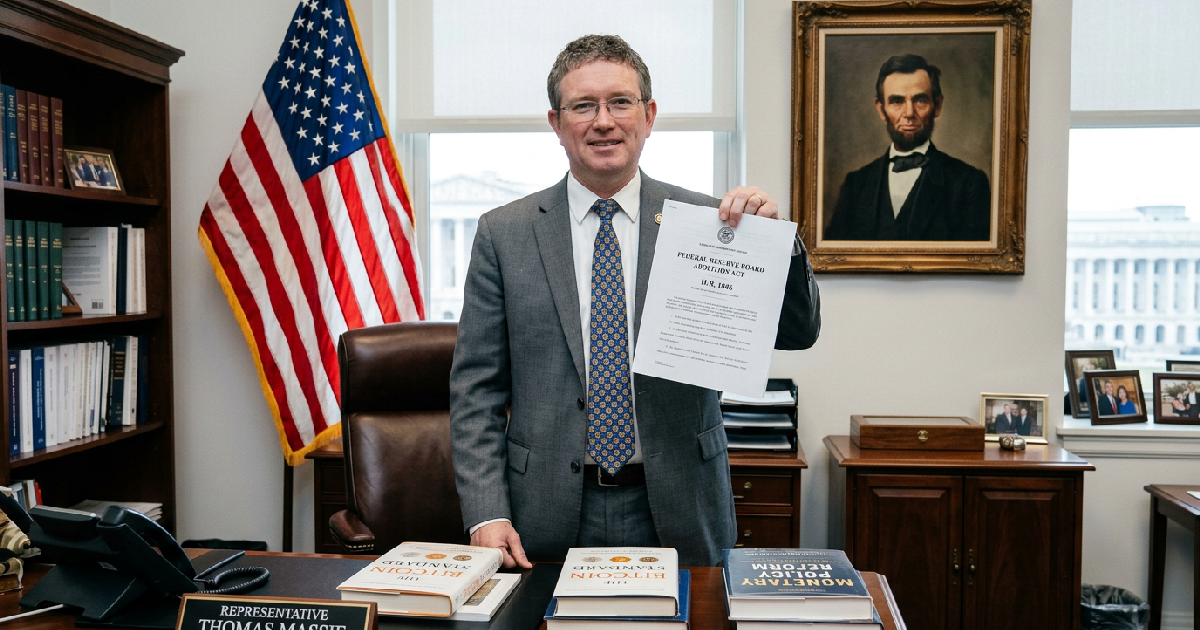

U.S. Representative Thomas Massie (R-Kentucky) has reintroduced the Federal Reserve Board Abolition Act (H.R. 1846), a move that has sparked renewed interest across the Bitcoin community.
The legislation, filed on March 5, 2025, seeks to dissolve the Board of Governors of the Federal Reserve and the Federal Reserve banks while repealing the Federal Reserve Act of 1913. Under the terms of the bill, all assets and liabilities currently held by the central bank would transfer to the U.S.
Treasury, a process that would become effective one year after the act is enacted.
Representative Thomas Massie’s push is part of a coordinated two-chamber effort. Senator Mike Lee (R-Utah) has filed a companion bill, S. 869, in the Senate to support the abolition.
The Kentucky congressman blames the Federal Reserve’s policies for devaluing the dollar, specifically citing the creation of “trillions of dollars out of thin air” during the COVID-19 pandemic to fund government deficit spending. He argues these actions have resulted in the high inflation currently impacting American retirees and savers.
The legislative effort draws inspiration from “The Bitcoin Standard,” a book by Saifedean Ammous published in 2018. During a June 13, 2024, appearance on a podcast hosted by Tom Woods, Representative Thomas Massie revealed that listening to the audiobook helped him understand the flaws of the current monetary system.
He noted that the majority of the text focuses on the history and definition of money itself, rather than just the technical aspects of the Bitcoin protocol.
Growing legislative support for Federal Reserve abolition
Support for the abolition of the central bank appears to be at a decade-high. Representative Thomas Massie stated that his 2025 bill has attracted approximately two dozen Republican co-sponsors in the House. This indicates a tenfold increase in backing compared to similar efforts he championed ten years ago.
This rising interest coincides with a shifting market structure in Bitcoin, as more individuals look toward assets with fixed supplies.
The legislative package introduced by Representative Thomas Massie extends beyond just the abolition of the bank. In January 2025, he reintroduced the Federal Reserve Transparency Act (H.R. 24). This specific bill calls for a full audit of the Federal Reserve to provide oversight of its operations.
The congressman’s stance has found significant resonance with the public; a May 2024 poll he conducted on X saw over 115,000 votes, with 86.6% supporting the central bank’s dissolution.
External advocacy groups have also joined the fray. Dennis Porter, the CEO and Co-Founder of the Satoshi Act Fund, recently led an effort through the Orange Pill organization to distribute copies of “The Bitcoin Standard” to various congressional offices.
This grassroots push aims to educate lawmakers on the 21-million-coin supply cap of Bitcoin, contrasting it with the “free money policies” Representative Thomas Massie has criticized in his official statements.
Political operations and the role of digital assets
Representative Thomas Massie has increasingly aligned his political activities with the digital asset sector. In March 2025, he announced that his campaign would begin accepting Bitcoin donations. His campaign has already secured more than $261,000 in individual donations. This shift comes as a rejection of central bank digital currencies becomes a more prominent topic in Washington’s fiscal policy discussions.
The Congressman’s critique focuses heavily on the “monetization of debt.” He argues that the Federal Reserve enables unprecedented deficit spending by the Treasury Department. By purchasing government debt, the central bank essentially devalues the savings of the American public.
“Americans are suffering under crippling inflation, and the Federal Reserve is to blame,” Representative Thomas Massie stated when discussing the necessity of the “Federal Reserve Board Abolition Act.”
The path forward for H.R. 1846 remains challenging despite the increase in co-sponsors. Abolishing the central bank would represent a total overhaul of the American financial system. However, the presence of a companion bill in the Senate by Senator Mike Lee ensures the proposal will be debated across both chambers of Congress.
While similar legislation was first introduced by former Representative Ron Paul in 1999, the current version has found a new audience within the growing pro-Bitcoin caucus.
The transition proposed in the legislation is firm regarding the timeline for asset liquidation. Should the act pass, the transfer of properties and obligations to the Treasury would be synchronized to conclude within 12 months. This bold timeline reflects the urgency Representative Thomas Massie feels regarding the state of the dollar. As com/bitcoin-70-000-support-bitcoin-targets-70-000-support-faces-1-26-billi/”>market participants monitor Bitcoin support levels and ETF flows, the debate over the future of central banking continues to gain traction in the nation’s capital.