
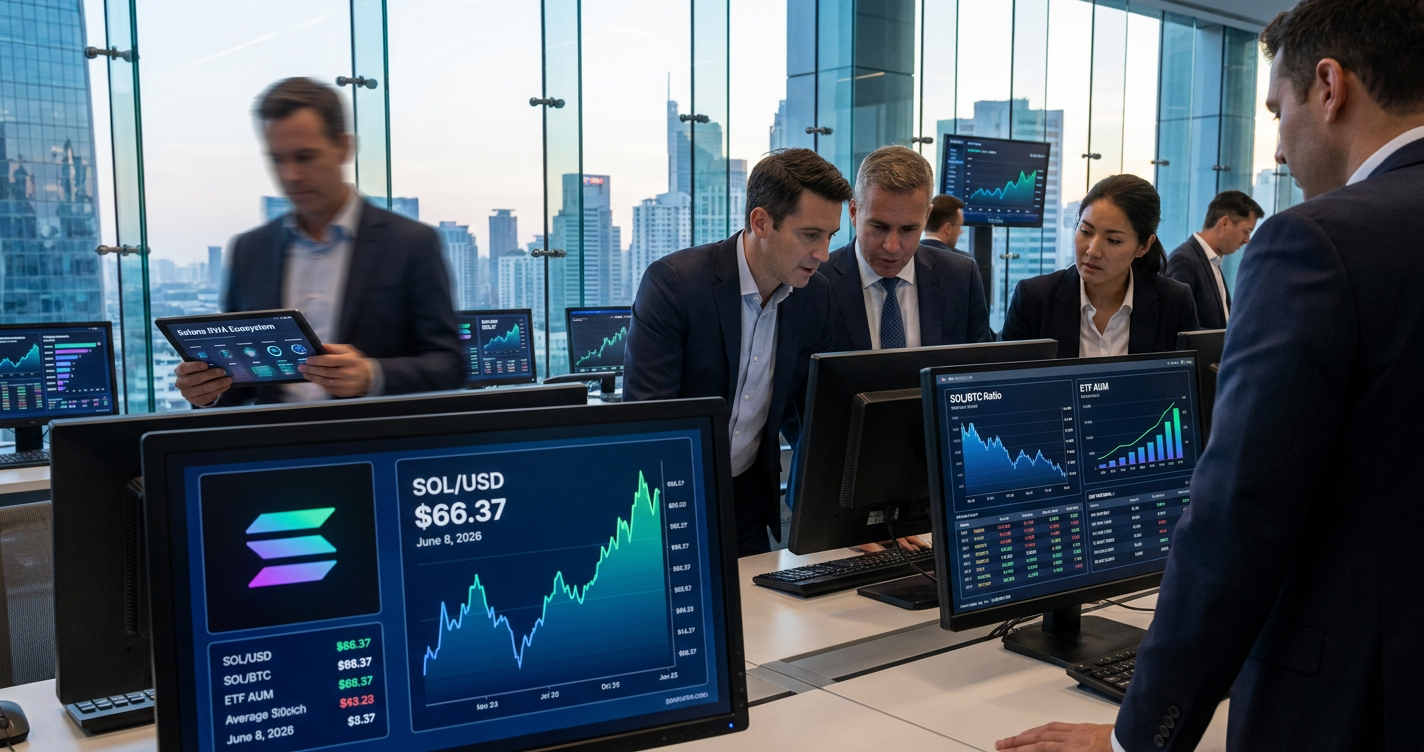

Solana is positioning itself as a primary “risk-on” leader in the cryptocurrency market as the third quarter of 2026 approaches, underpinned by substantial institutional adoption and a maturing ecosystem. While the asset has faced price volatility over the last year, its network fundamentals and decentralized exchange (DEX) market share suggest it is increasingly challenging the dominance of established players.
As of June 8, 2026, the Solana (SOL) price was trading at $66.37, maintaining an intraday range between $61.53 and $67.04. This price level comes after a period of significant growth in 2024 and 2025, during which the token reached an all-time high of $294.16 in January 2025.
Institutional interest has remained a core pillar of this trajectory, with nearly 15% of institutional investors allocating funds to Solana in 2024, a notable rise from previous years.
The network’s utility is expanding through the integration of major financial services and regional partnerships. The Solana Foundation recently signed a memorandum of cooperation with Alatau City, Kazakhstan, to collaborate on blockchain infrastructure.
This follows a trend of traditional finance adoption, such as Stripe choosing the network for USDC stablecoin settlements and PayPal making its PayPal USD (PYUSD) available on the blockchain. As of April 5, 2026, 58.3% of the PYUSD market cap, totaling $827.83 million, was hosted on Solana.
Institutional appetite grows through spot ETFs and private funds
The institutional landscape for Solana has shifted dramatically with the introduction of regulated investment vehicles. In October 2025, the first spot SOL ETFs went live in the United States, attracting initial inflows of approximately $900 million. By May 22, 2026, eight spot Solana ETFs were trading in the U.S. market, managing nearly $1.
1 billion in total assets under management (AUM). This influx of capital occurs as Bitcoin signals market structure analysis remains a central focus for macro investors.
Beyond exchange-traded products, the blockchain has become a hub for tokenized treasury markets and private credit. In late July 2024, Hamilton Lane launched the first private credit fund on the Solana blockchain. During Q3 2024, the tokenized treasury market on the network doubled in value to $123 million within just 30 days.
This growth was largely driven by a $50 million influx of USDC from Ethereum on September 23, 2024, highlighting the shifting liquidity preferences among digital asset managers.
Scalability and low fees drive decentralized exchange dominance
Solana’s technical advantages, particularly its low-cost environment, have allowed it to capture a significant portion of the trading market. The average transaction fee on the network was recorded at $0.02, significantly lower than the $3.58 average seen on Ethereum during the same reporting windows.
This cost efficiency helped Solana capture 22% of the DEX trading market in late 2024, with its DEX trading volume reaching $626 billion for the year.
The high volume of activity is also reflected in the sector for Real World Assets (RWAs). Major asset managers like Franklin Templeton have voiced plans to launch money market funds on the network, while BlackRock’s BUIDL fund previously partnered with Securitize to explore tokenized liquidity. As com/best-altcoin-to-buy-now-debate-alphapepe-bitcoin-risk-appetite-2026/”>investors evaluate the best altcoin to buy now, these fundamental integrations provide a level of utility that separates the network from purely speculative assets.
Market sentiment and network activity trends into late 2026
Despite the robust institutional data, the broader market sentiment has remained cautious. During Q3 2024, the CMC Crypto Fear and Greed Index sat at a neutral 53, with sentiment frequently dipping into bearish territory. Furthermore, the network saw a 9.
25% decline in daily transactions during that same period as the initial frenzy surrounding meme coins began to cool. However, daily active users still showed resilience, rising 82% during that quarter.
The network projects collectively attracted $173 million in private funding during Q3 2024, the highest level of investment since early 2022. This consistent capital injection into the ecosystem’s infrastructure suggests that developers are preparing for a long-term shift in how digital finance operates.
As the market moves deeper into 2026, Solana’s ability to maintain its $5.6 billion Total Value Locked (TVL) base will be critical to its “risk-on” leadership status.
Future outlook for Solana as Q3 infrastructure matures
The transition into the third quarter of 2026 serves as a litmus test for Solana’s ability to sustain its market share. With nine other firms awaiting decisions on spot SOL ETF applications, the potential for further institutional inflows remains high. These decisions, expected by October 2025, already set a precedent for the current AUM levels.
The asset’s performance continues to be a focal point for those monitoring the impact of geopolitical shifts on crypto market confidence.
While Solana’s price has seen a 49.76% decrease over the 12 months leading up to June 2026, its role in the stablecoin and RWA sectors continues to expand. The combination of high-speed settlement for PYUSD and the launch of new futures ETFs by firms like Volatility indicates that the infrastructure layer is still growing.
Whether SOL can reclaim its previous high of $294.16 will depend on continued network stability and the successful onboarding of state-level partners like those in Kazakhstan.