
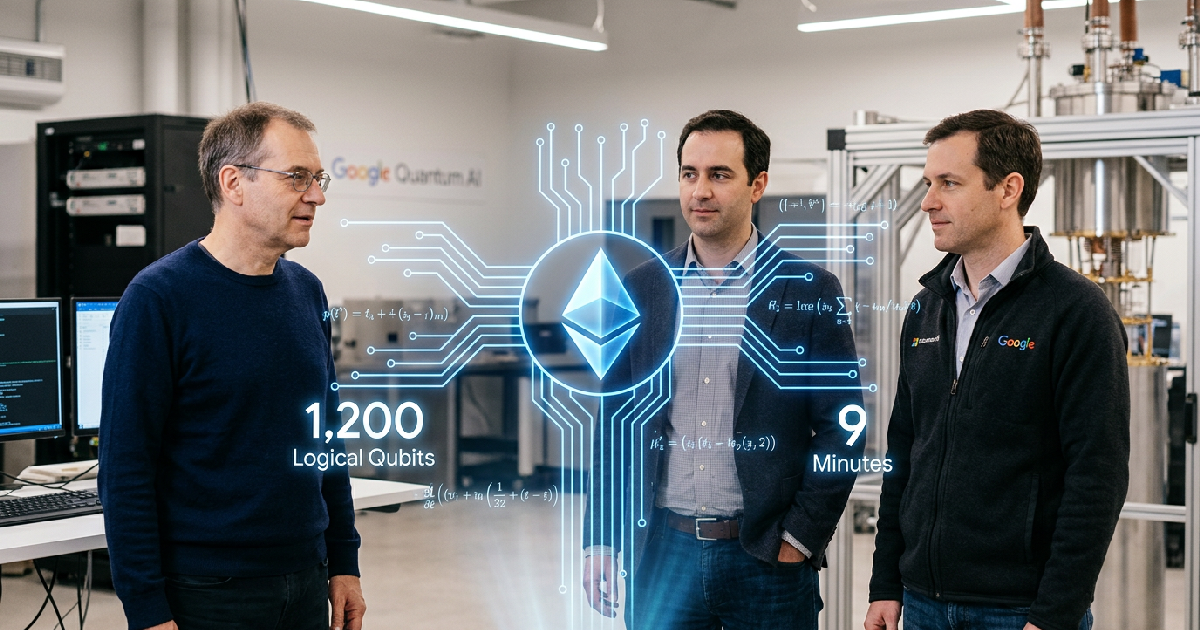

Google Quantum AI researchers Ryan Babbush, Hartmut Neven, and Craig Gidney published research on March 31, 2026, revealing a dramatic 20-fold reduction in the quantum computing resources required to break the elliptic curve cryptography (ECC) used by Ethereum.
The paper demonstrates that a quantum computer with approximately 1,200 logical qubits—or fewer than 500,000 physical qubits—could crack the 256-bit elliptic curve discrete logarithm problem (ECDLP-256) in as little as nine minutes. This discovery significantly accelerates the timeline for potential quantum-led exploits against major blockchain networks and digital assets.
The findings have sent ripples through the digital asset industry, as the revised hardware requirements are far lower than previous industry estimates that called for tens of millions of physical qubits. According to the research, a superconducting quantum computer of this scale could execute Shor’s algorithm to derive private keys from public addresses.
Stanford cryptographer Dan Boneh and Ethereum Foundation researcher Justin Drake contributed to the analysis, which warns that the current cryptographic foundations of most cryptocurrencies are becoming more vulnerable as hardware evolves.
Currently, the risk is concentrated in accounts that have already exposed their public keys through prior transactions. Research indicates that approximately 0.1% of dormant Ethereum funds are currently in these technically vulnerable accounts. For the 1,000 wealthiest exposed addresses, which collectively hold roughly 20.
5 million ETH, a machine meeting Google’s new efficiency standards could theoretically crack every account in fewer than nine days. These risks extend beyond Ethereum, potentially affecting more than $600 billion in Bitcoin, stablecoins, and other digital assets.
How Google researchers optimized the quantum attack
The breakthrough relies on specifically designed quantum circuits that optimize the execution of Shor’s algorithm. By refining how the 256-bit elliptic curve discrete logarithm problem is handled, researchers identified two primary paths for an attack. One variant requires roughly 1,200 logical qubits and fewer than 90 million Toffoli gate operations.
An alternative configuration uses slightly more hardware, at 1,450 logical qubits, but reduces the operational complexity to 70 million Toffoli gates. These efficiencies suggest that Bitcoin signals market structure analysis might soon include quantum readiness as a fundamental metric for long-term holders.
Google chose to implement a unique disclosure method for this research to prevent the misuse of the actual attack code. Instead of publishing the full quantum circuits, the team released a zero-knowledge proof (ZKP). This cryptographic tool allows external researchers and the U.S.
government to verify the validity of the claims without gaining access to the specific details of the exploit itself. This coordinated approach ensures that developers have the necessary data to build defenses without providing a blueprint for malicious actors.
The speed of a potential attack is particularly concerning for the “on-spend” window. This refers to the time between a user broadcasting a transaction and that transaction being confirmed on the blockchain. Google’s data suggests that a sufficiently powerful quantum computer could resolve the private key in roughly 9 to 12 minutes.
Because Bitcoin’s average block time is approximately 10 minutes, a quantum attacker could potentially intercept a transaction in transit, replace the recipient address, and broadcast a competing version before the original is finalized.
Ethereum Foundation strategy for post-quantum cryptography
The Ethereum community has not been idle in the face of these emerging threats. In January 2026, the Ethereum Foundation officially formed a dedicated Post-Quantum (PQ) security team led by Thomas Coratger.
This group is focused on transitioning the network to post-quantum cryptography (PQC) before the 2029 window identified by Google as a tipping point for quantum viability. Developers are exploring account abstraction and “quantum-proof” signature schemes to safeguard user funds. This urgency mirrors how com/xrp-to-tor-david-schwartz-details-xrp-ledger-s-doomsday-protocol-on-ma/”>David Schwartz details XRP Ledger’s protocol changes to handle extreme security risks.
Implementing these protections may be more affordable than many users expect. Nico, the lead of the Ethereum Foundation’s Kohaku privacy project, recently stated that post-quantum account protection can be implemented today for as little as $0.07. This suggests that the barrier to entry for security is technical and logistical rather than financial.
The challenge lies in migrating millions of active and dormant accounts to new cryptographic standards without compromising the decentralized nature of the network.
While the threat feels imminent, current hardware remains well below the necessary thresholds. Google’s most advanced quantum chip, Willow, currently features 105 qubits—a far cry from the 500,000 physical qubits required for the documented attack.
However, the 20-fold reduction in required qubits means the “quantum winter” for cryptography may end much sooner than the industry previously anticipated. But with the Ethereum Foundation and Google both targeting 2029 for major PQC migrations, the race between the builders and the crackers is now officially underway.
Global migration timelines and the 2029 deadline
The push for post-quantum security is part of a broader global effort that transcends the world of digital finance. Google began migrating its internal systems to PQC as early as 2016 and has set a firm internal deadline of 2029 for full migration. This timeline aligns with the expected growth of quantum hardware capabilities.
In contrast, the U.S. government has set a slightly more conservative target of 2035 for its full transition to quantum-resistant standards.
For the average cryptocurrency holder, the immediate risk remains low, but the window for complacency is closing. As institutional players continue to consolidate holdings—exemplified by reports that Bitcoin supply on exchanges has hit multi-year lows—the pressure to ensure those long-term “cold” storage funds are protected from future technology is mounting.
Developers suggest that the next few years will see a flurry of “hard forks” and network upgrades specifically designed to swap out vulnerable ECC algorithms for quantum-resistant alternatives.
As we move toward the late 2020s, the focus of blockchain development is likely to shift from scaling and speed to fundamental survival. The research by Ryan Babbush and his colleagues serves as a definitive wake-up call. It proves that the “quantum threat” is no longer a distant theoretical problem, but a measurable engineering challenge with a clear, and shrinking, countdown.