
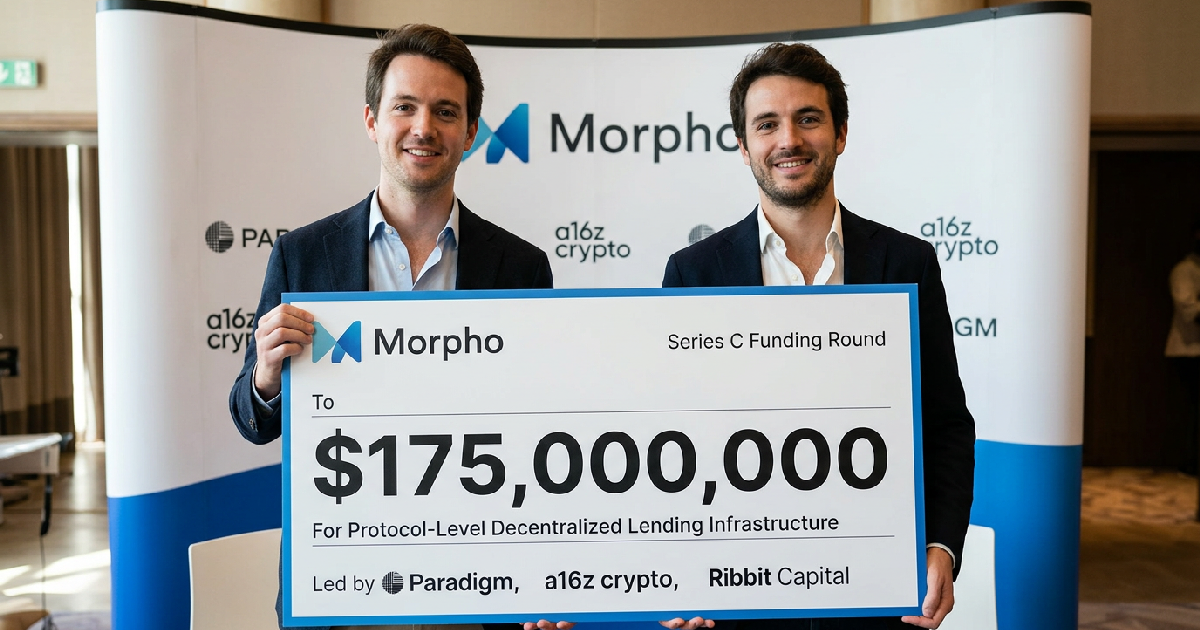

Paris-based decentralized finance developer Morpho has officially secured a $175 million funding round co-led by Paradigm, a16z crypto, and Ribbit Capital. The investment, announced on June 9, 2026, values the protocol at $2 billion and marks one of the largest capital raises in the history of the DeFi sector.
The company plans to use the funds to scale its decentralized lending infrastructure and build a global “open credit network.”
The round drew participation from a heavy-hitting roster of institutional and strategic investors, including Apollo Funds, Circle Ventures, VanEck, and Bpifrance. Paul Frambot, Merlin Egalite, Julien Thomas, and Mathis Gontier Delaunay founded Morpho in 2021. They now lead an organization that boasts over $11 billion in lifetime deposits and approximately $6.6 billion in total value locked (TVL), according to current protocol data.
This latest fundraise represents Morpho’s fourth institutional round since its inception. The protocol remains a primary challenger to established giants like Aave, which currently holds roughly $12.5 billion in locked assets. Morpho’s strategy focuses on dismantling “dated” financial systems by providing a secure, programmable layer for credit products that can be utilized by traditional financial institutions.
Strategic expansion into institutional lending markets
Morpho founders believe that fragmented systems and extractive intermediaries have historically limited the efficiency of global finance. To address this, the firm intends to deepen its technical and commercial integrations. The goal is to connect capital providers with seekers globally through an infrastructure that accommodates every bank and pension fund seeking onchain exposure.
The presence of Apollo Funds in the round is particularly significant. As a firm managing over $700 billion in assets, its involvement suggests a bridge is maturing between legacy finance and decentralized protocols. As market analysts monitor moving averages to gauge broader crypto sentiment, Morpho is focusing on the utility of credit as the “largest profit pool in financial services.”
The investment was structured as a purchase of Morpho’s cryptocurrency, with pricing based on the token’s average monthly value. Currently, the MORPHO governance token trades at $1.86. The project carries a market capitalization of $1.20 billion and a fully diluted valuation of $1.85 billion, reflecting the scale of the governance network behind the protocol.
Building a new credit stack for global finance
Morpho’s technology is already in use by major industry players such as Anchorage Digital, Galaxy, and Bitwise. These firms value the simplicity and security and the protocol as they push borrowing and lending services to their own clients. The new capital will help Morpho expand to additional blockchain networks and strengthen its infrastructure for businesses building their own tailored credit products.
Guy Wuollet, General Partner at a16z crypto, described the round as a continuation of a long-standing thesis regarding the evolution of borrowing. Just as investors identify mispriced assets in emerging trading platforms, Morpho’s backers see a massive opportunity in rebuilding the global credit stack from first principles. By removing intermediaries, they aim to lower costs for borrowers while maintaining competitive yields for lenders.
Additional participants in the round included Wintermute Ventures, HashKey Capital, and SBI Group. This diversity of backing — from traditional French state investment banks to crypto-native market makers — underscores the protocol’s broad appeal. Morpho’s founders maintain that the true value of finance has been held back by legacy infrastructure that this new network is designed to replace.
The company will now focus on onboarding more institutional participants. Its current client base already includes high-profile exchanges and custody providers such as Binance, Kraken, and Fireblocks. As the protocol grows toward its $2 billion valuation, the focus remains on technical resilience and global accessibility for the next generation of credit markets.