
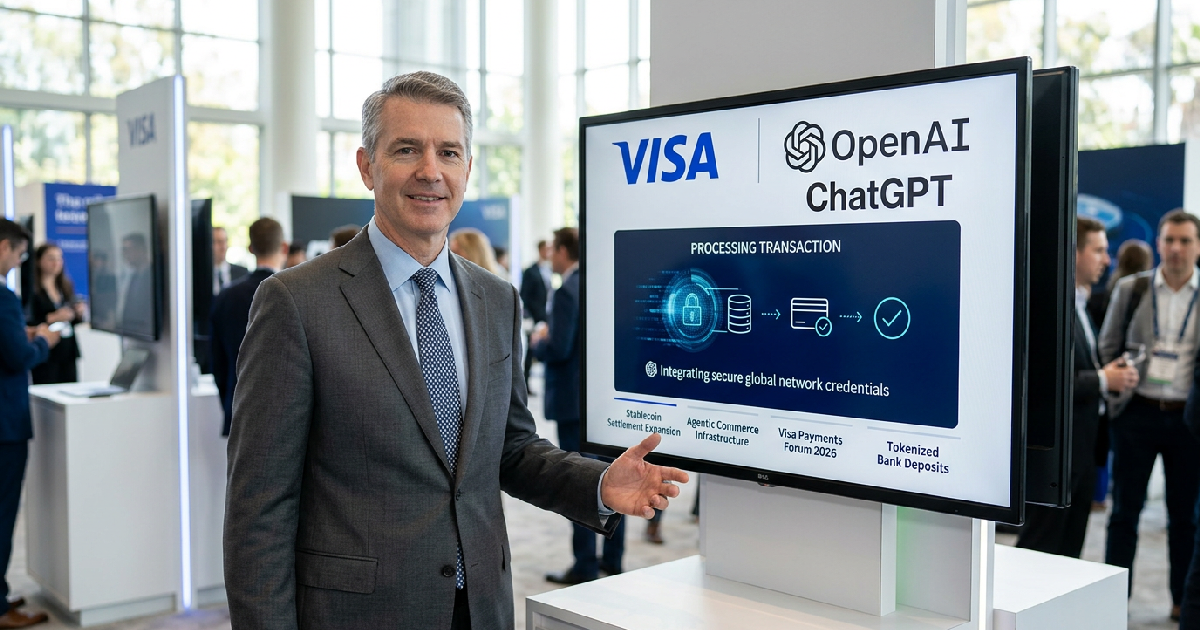

Visa Inc. and OpenAI have entered a strategic collaboration to integrate secure global network credentials and security infrastructure directly into the ChatGPT ecosystem and the Atlas browser.
Announced on June 10, 2026, during the Visa Payments Forum in San Francisco, the deal aims to facilitate “agentic commerce,” where artificial intelligence acts autonomously on behalf of users.
Chief Product and Strategy Officer Jack Forestell framed the move as a dual evolution of the payments industry, where AI handles the consumer-facing front end while blockchain-based settlement manages the back-end architecture.
The partnership represents a significant shift toward programmable commerce. Under the new agreement, Visa will provide the underlying network infrastructure for transactions initiated within OpenAI environments. This includes the implementation of tokenized credentials, which the companies recently demonstrated through a proof-of-concept.
In this trial, AI agents successfully paid for digital services via command-line environments without manual human intervention. It signals a move away from traditional “click-to-buy” models toward a future where software agents represent the buyer.
To support this autonomous future, Visa also unveiled a suite of identity and verification tools. The new Agentic Directory acts as a verification registry for both merchants and AI agents to ensure legitimacy on both sides of a trade.
Meanwhile, a service called Agent Score, developed alongside the AI firm New Generation, will help merchants determine if their digital storefronts are technically optimized for AI-led interactions. This push for infrastructure comes as payment networks compete to standardise how machines talk to each other across the global economy.
Expanding stablecoin settlement through VisaNet
Parallel to its AI ambitions, Visa is aggressively scaling its blockchain-based settlement capabilities. The company revealed that stablecoin settlement volume through VisaNet reached an annualized run rate of approximately $7 billion as of March 2026. This growth is driven by the expansion of seven-day settlement cycles across a wider array of banks and acquirers.
Currently, more than 160 stablecoin-linked card programs are either live or in development globally, highlighting the integration of stablecoin risks and rewards into mainstream finance.
The company is not just relying on existing third-party stablecoins like USDC. Visa announced plans to support tokenized bank deposits, a technology that allows traditional financial institutions to convert standard deposits into programmable digital money.
By keeping these assets on the bank’s own balance sheet while enabling 24/7 movement, Visa aims to bridge the gap between legacy banking and decentralized ledger technology. Partners such as Worldpay and Nuvei are already participating in pilots to test these settlement efficiencies.
Building the trusted agent protocol for secure checkouts
To ensure these automated transactions remain secure, Visa has reinforced its “Trusted Agent Protocol,” an open framework first introduced in late 2025. This protocol, integrated with technology from Akamai, is designed to prevent fraud in agent-driven checkouts. As more users delegate financial tasks to AI, the risk of “rogue” agents performing unauthorized purchases increases.
Visa’s framework seeks to establish a standard handshake between the AI agent and the payment network to verify the user’s intent.
The company is also deploying a Large Transaction Model, an AI fraud detection system trained on billions of historical payment data points. This model is expected to reduce false declines, which often occur when automated systems attempt large or unusual purchases that don’t fit traditional consumer profiles. As the com/bitcoin-signals-market-structure-analysis-2026/”>market structure shifts toward more transparent digital assets, these AI-driven security layers will become mandatory for institutional adoption.
Future outlook for agentic commerce and tokenization
The integration of OpenAI into Visa’s network marks a clear line in the sand for the payments industry. While rival Mastercard has also explored agentic commerce, Visa’s explicit focus on combining AI with stablecoin settlement suggests a more holistic approach to the digital economy.
By March 2026, the data showed that annualized stablecoin volume was no longer a niche metric but a primary pillar of Visa’s transaction growth. This trend mirrors how rejections of central bank digital currencies by some officials have cleared a path for private stablecoin initiatives.
Looking ahead, the success of “intelligent commerce” will depend on whether consumers trust AI to manage their wallets. Visa’s Head of Crypto, Cuy Sheffield, has indicated that the goal is to make these high-tech settlements invisible. Instead of navigating complex blockchain wallets, the user—or their AI assistant—will simply see a faster, more reliable payment experience.
The coming months will see if the OpenAI partnership can move beyond the proof-of-concept stage into a daily reality for millions of ChatGPT users.