
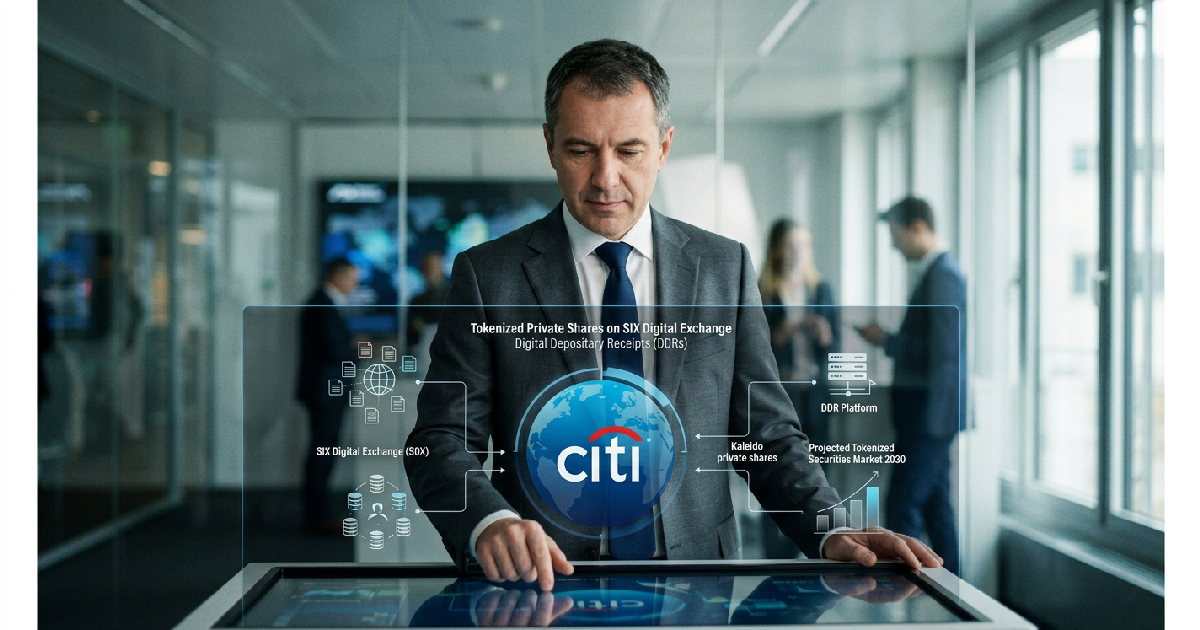

Citigroup launched a first-of-its-kind digital offering on June 11, 2026, enabling its wealthy and institutional clients to trade tokenized shares of private companies. The bank is issuing these interests as Digital Depositary Receipts (DDRs) on private shares, effectively creating a “digitally native” version of traditional equity.
By acting as both the issuer and custodian, the bank aims to streamline access to historically illiquid private markets for its global client base.
The service operates on blockchain infrastructure provided by SIX Digital Exchange (SDX), the Swiss-regulated digital-asset subsidiary of SIX Group. This setup allows eligible clients to hold their tokenized private-company interests alongside traditional securities in a single, unified account. Citigroup has already finalized its inaugural transaction on the platform, involving shares of the digital asset firm Kaleido, which is part of the Citi Ventures portfolio.
Artem Korenyuk, Citigroup’s global lead for digital assets enterprise alignment and services enablement, explained that the new model simplifies the investor experience. “This lets clients put private-company shares essentially right next to their Apple stock,” he said, noting how the DDR structure offers transparency that traditional special-purpose investment vehicles (SPVs) lack.
This move comes as Apple stock and other public equities continue to dominate portfolios, highlighting the bank’s push to equalize the visibility of private assets.
Improving private market transparency through digital depositary receipts
The rollout specifically targets the complexities of private market infrastructure, which Artem Korenyuk described as opaque. He argued that under current SPV models, many “investors don’t know what they’re actually buying,” whereas the DDR provides a “very clear alternative.” This direct model is designed to be more cost-effective and efficient, reducing the administrative hurdles and hidden fees that often characterize private equity investments.
Steve Cerveny, Founder and CEO of Kaleido, noted that private firms are currently “scaling faster than the structures around us,” making this digital shift necessary. While Citigroup is currently restricting the service to non-U.S. investors, it signals a broader institutional shift.
Large financial players are increasingly looking at blockchain to solve structural inefficiencies, a trend noticed as Bitcoin signals market structure analysis suggests growing professional interest in digital ownership frameworks.
The bank’s choice of the SIX Digital Exchange (SDX) platform builds on a strategic partnership first announced in May 2025. By leveraging a regulated Swiss environment, Citigroup can offer a compliant path for global issuers to attract capital.
This adds a third tier to the bank’s growing digital architecture, which already includes Citi Token Services for instant payments and a massive interbank consortium for tokenized deposits.
Predicting a multi-trillion dollar tokenized securities market
Accompanying the launch, a new Citigroup research report released in June 2026 provides an aggressive forecast for the sector. The bank now expects the global tokenized securities market to reach a base case of $5.5 trillion by 2030. In its most optimistic “bull case” scenario, that figure could climb to $8.2 trillion, representing a massive shift from the current $17 billion market valuation.
This updated outlook is significantly higher than Citigroup’s 2023 prediction, which capped the 2030 market at roughly $4 trillion. The bank’s analysts cite the increasing maturity of digital custodians and tokenization agents as primary drivers. Ryan Marsh, Head of Innovation and Strategic Partnerships at Citi’s Investor Services, previously noted that the bank will support clients with end-to-end servicing as tokenization scales globally.
As the market evolves, the bank is reportedly in talks with other private firms to bring more shares onto the platform. Though U.S. investors are currently excluded, Citigroup may expand access depending on future regulatory clarity.
For now, the successful integration of Kaleido’s shares provides a blueprint for how large banks might manage private equity in an era where U.S. Treasury CBDC rejection remains a topic of debate, keeping the focus on private ledgers instead of state-backed digital currencies.