
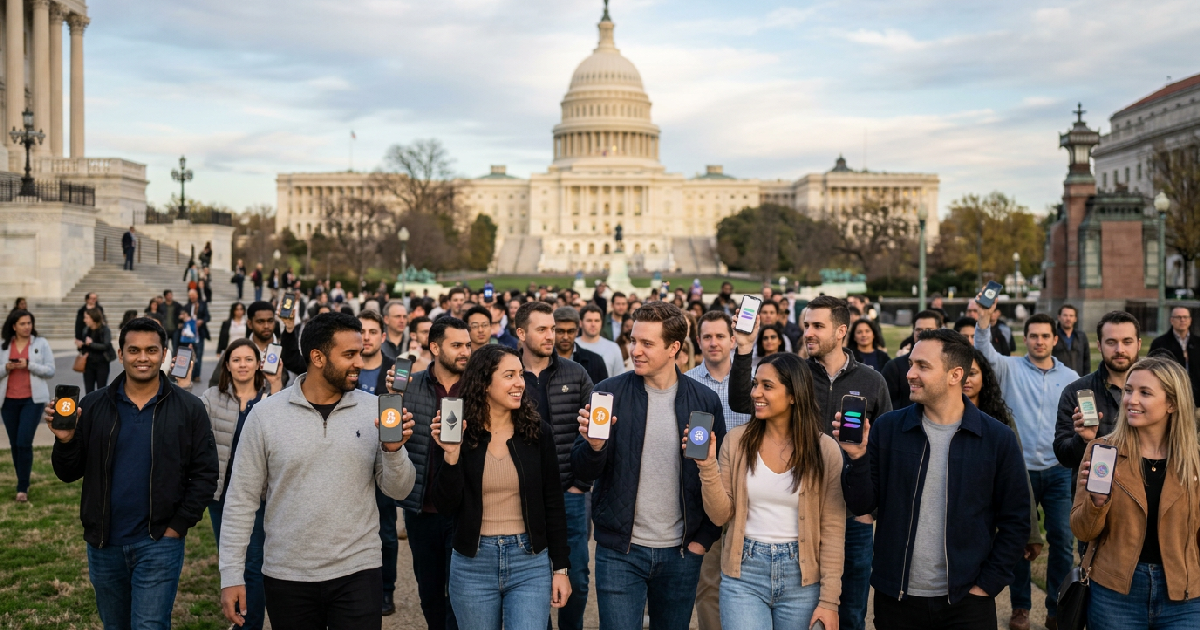

A new survey conducted by The Harris Poll for Digital Currency Group (DCG) reveals that cryptocurrency has become a hot-button election issue, with voter support for the asset class more than doubling since 2024.
The study, which surveyed 1,874 registered voters between May 8 and May 18, 2026, highlights a growing demand for Congress to establish clear regulatory frameworks rather than continuing the current “regulation by enforcement” approach. This shift in sentiment is already reshaping political campaigns as the industry directs unprecedented funding toward the 2026 midterm elections.
The data suggests that digital assets are no longer a fringe interest but a primary lens through which a rapidly expanding bloc of voters evaluates candidates. Political strategists are taking note, as the crypto industry has already funnelled over $129 million into federal elections across the last three cycles.
Remarkably, nearly 92% of that total was spent during the 2024 cycle alone, underscoring the aggressive move by firms like Coinbase and Ripple to secure a seat at the legislative table.
And it’s not just about the money. Voters are increasingly prioritising digital privacy and data ownership, viewing these as essential rights in an era of central bank digital currencies and heightened surveillance. As Scott Bessent rejects central bank digital currency initiatives, many candidates are finding that a pro-innovation, anti-surveillance stance provides a distinct edge in competitive districts.
Massive spending by Fairshake and corporate backers
The financial scale of this political movement is record-breaking. Fairshake, a pro-crypto super PAC, raised more than $200 million in its initial election cycle, bolstered by $114 million directly from corporate backers.
Coinbase contributed $50 million to Fairshake and its affiliates, while also making four separate $500,000 donations to partisan PACs across both the House and Senate. This bipartisan approach aims to ensure that crypto remains a priority regardless of which party holds the gavel.
The industry’s success rate in the 2024 elections was formidable, with Fairshake backing the winner in 36 of the first 42 congressional races it entered. By the end of the general election, more than 90% of the candidates supported by the PAC had secured victory.
This track record makes Fairshake the most heavily funded super PAC heading into the 2026 midterms, currently holding over $193 million in cash to influence future races.
Individual candidates have seen massive influxes of “crypto cash” to bolster their platforms. For example, Democratic Representative Elissa Slotkin of Michigan and Ruben Gallego of Arizona received $9.5 million and $9.2 million respectively. On the Republican side, GOP Representative Young Kim of California was aided by roughly $2 million in spending from the industry, illustrating the broad, non-partisan nature of the sector’s current lobbying efforts.
Regulatory clarity as a primary voter demand
The Harris Poll indicates that voters are tired of the ambiguity surrounding digital asset laws. Investors are looking for a shift away from the U.S. Securities and Exchange Commission’s (SEC) aggressive litigation strategy.
Many believe that without a formal legal framework passed by Congress, the United States risks losing its technological edge to more friendly jurisdictions. This sentiment is driving a surge in voter engagement that analysts predict will peak in late-2026.
Market participants are watching these political developments closely as they impact price stability and adoption. While Bitcoin signals indicate shifting market structure in response to these regulatory hopes, the underlying volatility remains a concern for less-seasoned investors.
The push for clarity isn’t just about protecting big exchanges; it’s about providing a safe environment for retail participants who now make up a significant portion of the electorate.
But the industry has also shown it can be a punishing adversary. In 2024, crypto lobbyists spent $40 million to successfully defeat Democratic Senator Sherrod Brown in Ohio. This move served as a warning to other lawmakers that opposing the industry’s growth could result in well-funded opposition campaigns.
The defeat of such a senior incumbent has forced many in Washington to reconsider their “crypto-skeptic” positions ahead of the next cycle.
Future implications for the 2026 midterm elections
As we head deeper into the 2026 cycle, the Blockchain Association’s PAC has already begun deploying capital, spending $38,500 in early efforts to shape the field. The focus remains on candidates who demonstrate a sophisticated understanding of blockchain technology and a willingness to curb what the industry calls “regulatory overreach.”
This has created a new category of “single-issue voters” who prioritise the health of their digital portfolios above traditional partisan loyalty.
Political analysts suggest that the influence of crypto will be most felt in battleground states where small margins decide the outcome. In these areas, even a minor swing of pro-crypto voters can flip a seat. As candidates like Patrick Witt tease breakthroughs on national digital infrastructure, the competition to be titled the “most crypto-friendly candidate” is intensifying across the country.
So, the 2026 midterms are likely to be the most expensive and tech-focused in history. With nearly $200 million in the bank, Fairshake and its affiliates are positioned to be the ultimate kingmakers.
Whether this leads to the long-awaited regulatory clarity the industry demands remains to be seen, but one thing is certain: crypto is no longer just a financial asset, it is a potent political weapon.