
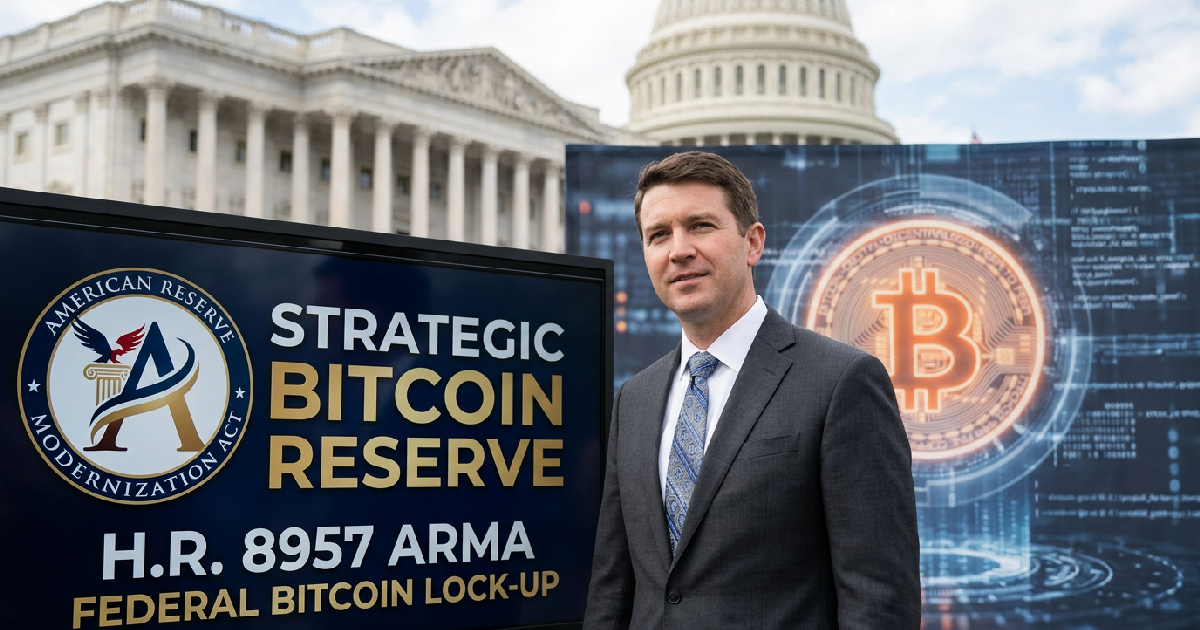

Representative Nick Begich of Alaska introduced H.R. 8957, the American Reserve Modernization Act of 2026, which proposes a strict 20-year lock-up period for all federally held Bitcoin deposited into a new National Strategic Bitcoin Reserve.
The bill, co-led by Representative Jared Golden of Maine and backed by 16 original co-sponsors, aims to prevent future administrations from liquidating the nation’s digital assets for at least two decades.
Under the terms of the legislation referred to the House Committee on Financial Services, the Treasury would be barred from selling, swapping, or encumbering the Bitcoin holdings unless the proceeds are used specifically to reduce the $39 trillion national debt.
The Arctic congressman’s proposal arrives as political momentum for a sovereign digital asset reserve reaches a fever pitch in Washington. By mandating a 20-year holding period, the American Reserve Modernization Act (ARMA) seeks to treat Bitcoin as a long-term strategic asset similar to the Gold Reserve.
This legislative “handcuff” is a direct response to concerns that a change in executive leadership could lead to the premature auctioning of seized or purchased tokens.
The timing of the bill is particularly relevant as the Bitcoin price stabilizes amidst growing interest from institutional and state-level actors. Proponents argue that a multi-decade commitment is necessary to capture the asset’s potential appreciation while providing a hedge against the continued devaluation of the US dollar.
The bill marks one of the most prescriptive attempts yet to codify how the federal government interacts with the world’s largest cryptocurrency.
Strategic Bitcoin Reserve mandates strict twenty year lock up
At the heart of H.R. 8957 is a “no-exit” clause that fundamentally changes how the US Treasury manages digital currency. The bill explicitly states that for 20 years, no Bitcoin in the reserve may be “sold, swapped, auctioned, or otherwise disposed of for any purpose.”
This hard lock is designed to outlast five presidential terms, ensuring that Bitcoin remains a permanent fixture on the national balance sheet.
The only escape hatch provided in the legislation is for the sole purpose of debt retirement. With the national debt having recently surpassed the $39 trillion mark, Representative Nick Begich and Representative Jared Golden have framed the reserve as a potential emergency fund.
This provision allows for the liquidation of assets only if the capital is applied directly to the Treasury’s outstanding liabilities, preventing the funds from being diverted into general government spending.
To ensure the government actually holds the assets it claims, ARMA introduces rigorous transparency requirements. The Treasury would be required to maintain a persistent public proof-of-reserve on an official website. This commitment to transparency reflects a shift in market structure, as seen when Bitcoin signals indicate shifting sentiment among veteran investors who demand higher levels of custodial verification.
Transparency and reporting requirements under the ARMA framework
The American Reserve Modernization Act (ARMA) establishes a detailed protocol for federal digital asset oversight. Beyond the primary Bitcoin reserve, the bill also creates a separate Digital Asset Stockpile. This secondary entity would house all other federally held non-Bitcoin digital assets, such as those seized in criminal investigations involving other tokens or stablecoins.
The following items are officially named and mandated under the H.R. 8957 framework:
- Bill Name: American Reserve Modernization Act (ARMA) (H.R. 8957)
- Introduced by: Alaska Congressman Nicholas Begich
- Co-lead Support: Representative Jared Golden (D-ME)
- Primary Venue: House Committee on Financial Services
- Asset Management: Managed by the US Treasury via the Strategic Bitcoin Reserve
- Economic Mandate: Treasury and Commerce Departments must jointly explore budget-neutral methods to increase Bitcoin holdings
- Audit Protocol: Quarterly public proof-of-reserve reports verified by independent third-party auditors
Each quarterly report must contain the total number of holdings, a full list of transactions, and a public cryptographic attestation. This attestation serves as mathematical proof that the government retains control over the private keys. These controls are intended to prevent the kind of mismanagement seen in private-sector crypto collapses, ensuring the “keys” to the nation’s digital gold remain secure.
Exploration of budget neutral Bitcoin acquisition strategies
Representative Nick Begich’s bill does not just focus on holding what the government already has; it also looks at ways to grow the stack. The legislation mandates that the Treasury and Commerce Departments collaborate to find “budget-neutral” ways to increase the nation’s Bitcoin holdings. This could involve reinvesting existing seized assets or reallocating departmental funds without increasing the deficit.
This push for state-level accumulation mirrored sentiments from other high-profile figures in the financial sector. For instance, former hedge fund manager Scott Bessent recently expressed skepticism toward central bank digital currencies while emphasizing the need for hard-asset reserves. The ARMA bill aligns with this “anti-CBDC” philosophy by focusing on decentralized Bitcoin rather than a government-issued token.
The bill’s progression now depends on the House Committee on Financial Services. If passed, it would represent a historic shift in US monetary policy, officially recognizing Bitcoin as a strategic reserve asset.
Critics, however, argue that locking up billions of dollars in a volatile asset for 20 years carries significant risk if the market enters a prolonged downturn. But for the sponsors of H.R. 8957, the risk of having no Bitcoin at all is far greater than the risk of price volatility.