
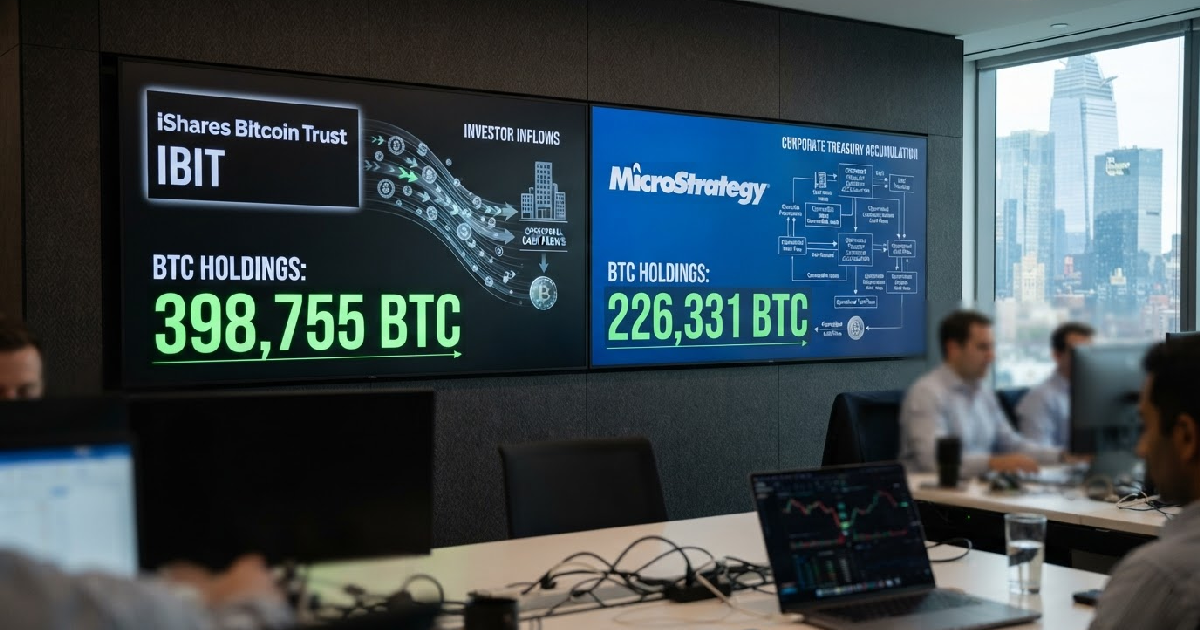

BlackRock’s iShares Bitcoin Trust (IBIT) and MicroStrategy, which rebranded to Strategy in February 2025, stand as two of the largest institutional holders of Bitcoin. Yet, their methods for accumulating the digital asset diverge significantly, reflecting distinct philosophies and financial structures that are profoundly shaping Bitcoin’s market dynamics.
While BlackRock IBIT passively acquires Bitcoin through surging investor demand for its spot Exchange-Traded Fund, Strategy actively raises capital through various financing tools to bolster its corporate treasury holdings. As of July 22, 2026, IBIT reported holdings of 741,671.6 BTC, valued at $48.25 billion, representing 3.532% of the total Bitcoin supply. Just a day later, on July 23, 2026, Strategy held approximately 843,775 BTC.
Passive flows versus active treasury management
The core distinction between IBIT and Strategy lies in their operational models for acquiring Bitcoin. IBIT functions as a demand pipe, channeling traditional investor appetite directly into Bitcoin purchases, whereas Strategy operates as an active corporate treasury engine, making deliberate financial decisions to increase its Bitcoin reserves.
This difference means IBIT’s Bitcoin accumulation is driven by the ebb and flow of investor capital seeking regulated exposure, while Strategy’s growth depends on its ability to secure financing and the strategic choices of its leadership. Both routes lead to substantial Bitcoin holdings, but they signal varied forms of capital entering the cryptocurrency ecosystem.
BlackRock IBIT’s market integration approach
BlackRock IBIT’s appeal stems from its simplicity and accessibility within traditional financial markets. Investors wanting exposure to Bitcoin’s price movements, without the complexities of direct ownership or self-custody, can simply purchase shares of the ETF through their existing brokerage accounts.
This mechanism means that when institutional and retail investors buy IBIT shares, the fund responds by purchasing equivalent amounts of spot Bitcoin on the open market. This makes IBIT a clear indicator of growing appetite for Bitcoin among traditional finance participants, often seen as a measure of institutional adoption.
Since its approval by the U.S. Securities and Exchange Commission (SEC) on January 11, 2024, and its subsequent launch on Nasdaq, IBIT has seen remarkable growth.
It quickly surpassed $1 billion in Assets Under Management (AUM) within its first trading week and reached $55 billion in AUM within two years, making it one of the most successful ETF launches in history. In November 2024, it further solidified its market presence by becoming the first spot Bitcoin ETF to offer exchange-listed options.
The ability for traditional market participants to gain Bitcoin exposure through a familiar and regulated wrapper represents a significant structural shift for the asset. Even though some buyers might be tactical or rebalance their positions, the sheer volume of capital entering through ETFs has fundamentally broadened Bitcoin’s ownership base.
MicroStrategy’s leveraged corporate bet
In stark contrast to IBIT’s passive approach, Strategy employs an aggressive and deliberate strategy to accumulate Bitcoin. The company, which held zero Bitcoin in January 2020, began converting its corporate treasury into Bitcoin in August 2020 under the leadership of Michael Saylor, based on the thesis that Bitcoin would better preserve purchasing power than cash.
Strategy actively raises capital through a mix of equity issuance, convertible debt, preferred stock, and high-yield debt offerings to fund its Bitcoin purchases. This intricate financial engineering provides shareholders with leveraged exposure to Bitcoin, amplifying returns during bull markets but also intensifying drawdowns during corrections.
This model introduces a distinct set of corporate finance considerations, including funding costs, potential share dilution, and debt obligations. For instance, Strategy borrows at rates as low as 0.875% through convertible notes to finance its Bitcoin acquisitions. Servicing its debt and preferred stock currently costs the company approximately $1.8 billion annually in interest and dividends, a substantial ongoing expense.
As of July 23, 2026, while Strategy’s total Bitcoin holdings are valued at around $58 billion, roughly $22 billion of this amount is owed to lenders and preferred investors. This leaves approximately $36 billion in net Bitcoin for common shareholders, highlighting the leveraged nature of their exposure and the complexity of the company’s balance sheet.
Divergent impacts on Bitcoin market cycles
The differing accumulation methods of IBIT and Strategy naturally lead to varied impacts on Bitcoin’s market cycles. IBIT’s inflows are largely a reflection of broader investor sentiment and allocation trends within traditional finance, meaning its accumulation can surge during periods of high demand for regulated Bitcoin products.
Conversely, Strategy’s purchases are tethered to specific financing windows, prevailing market conditions, board decisions, and its internal capital structure choices. The company can strategically time its capital raises and Bitcoin acquisitions, acting as a more independent market force than a purely reactive ETF.
What different accumulation means for price discovery
Understanding these distinct approaches is crucial for gauging capital flows into Bitcoin. IBIT’s steady, demand-driven accumulation suggests a growing, more integrated market where Bitcoin is viewed as a legitimate portfolio allocation. These ETF flows can be fast and sometimes reversible, but they also bring immense distribution to a new investor base.
Strategy’s active, directional buying, on the other hand, reflects a conviction-based, long-term corporate treasury strategy. While tied to corporate finance risks, MicroStrategy’s holdings are considered sticky, often acquired through long-term debt or equity, making them less prone to quick reversals than certain ETF flows. This represents a more fundamental, balance-sheet driven adoption.
Expanding Bitcoin’s ownership and institutionalization
The broader takeaway from BlackRock IBIT and Strategy’s prominence is the significant diversification of Bitcoin accumulation channels. Beyond these two giants, long-term holders, miners, sovereign entities, private funds, and individual retail investors all contribute to the asset’s supply absorption. This multi-faceted accumulation is vital for Bitcoin’s maturity and long-term stability.
In earlier cycles, Bitcoin’s market was heavily reliant on crypto-native exchanges and retail trading. Today, some of the most visible and impactful buyers are entities deeply embedded within traditional finance or public-company capital markets. This shift signifies a profound transformation in who owns Bitcoin and how it’s being held.
The enduring comparison and forward outlook
Market participants will undoubtedly continue to compare IBIT and Strategy, often tracking their respective holdings through daily ETF flow dashboards and SEC filings. This provides a running scoreboard of institutional Bitcoin accumulation, offering valuable insights into market trends.
However, the more nuanced understanding isn’t just about who holds more Bitcoin. It’s about the nature of the capital entering the market, its potential stickiness, and the inherent risks associated with each accumulation route. IBIT offers broad distribution and traditional access, while Strategy presents a leveraged, corporate-centric Bitcoin play.
Neither model is without its complexities, but both are instrumental in the ongoing institutionalization of Bitcoin. They illustrate that the asset is no longer exclusively the domain of crypto-native traders, but is increasingly being integrated into traditional capital structures, reshaping its ownership landscape for the future.