
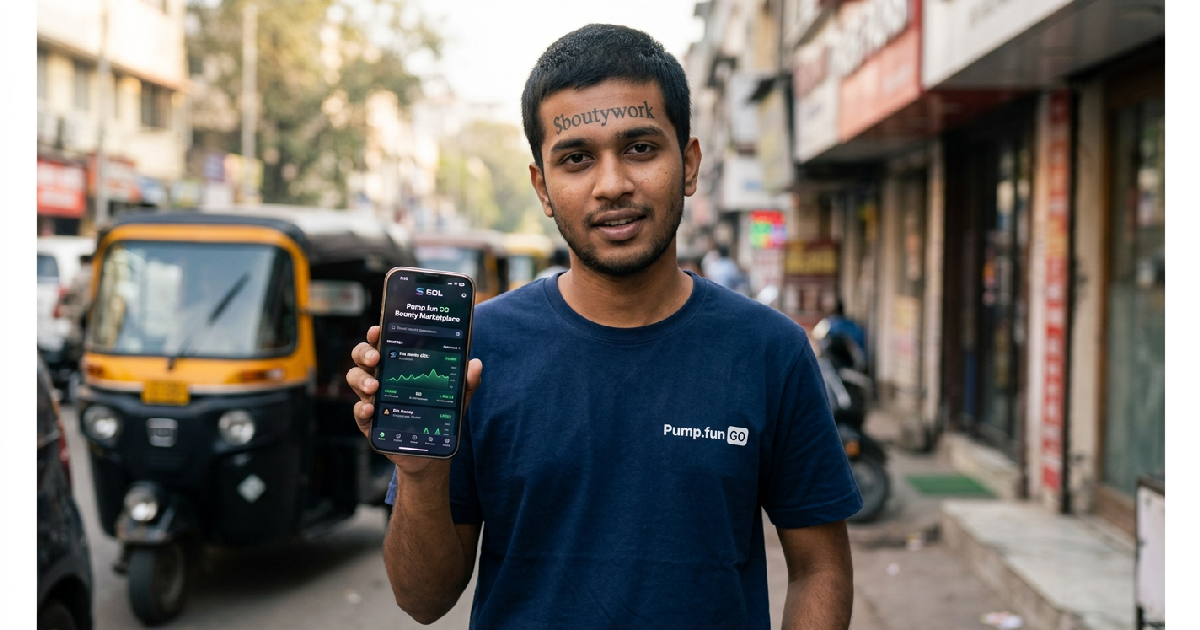

The Solana-based memecoin launchpad Pump.fun is facing intense scrutiny following the launch of its “GO” bounty marketplace on June 4, 2026. This platform allows users to post cryptocurrency rewards for viral stunts, leading to a surge of individuals tattooing token tickers on their foreheads and bodies.
The most prominent case involves an Indian user named Arivu (@Arivulife), who sought a 40 SOL bounty (approximately $2,570) by tattooing a misspelled ticker on his face after the bounty creator made a typo in the original instructions.
The controversy began when the creator, using the handle @ayushquantt, posted a bounty for the ticker “$Bountywork.” However, the creator reportedly forgot the letter “n” in the description, writing “$boutywork” instead. Arivu followed the written instructions exactly and filmed himself getting the incorrect “$boutywork” inked on his forehead.
Despite meeting the filming requirements, the payout was initially denied because the tattoo did not match the actual coin ticker, “$Bountywork.”
The incident has highlighted the volatile and often “dystopian” nature of the memecoin attention economy. Watching the dispute unfold on social media, traders launched a new token specifically named $BOUTYWORK to capitalize on the error.
While Arivu missed out on the original reward, he reportedly earned $15,000 in transaction fees from this new project and eventually received nearly $42,000 in total community-driven rewards. This shift suggests that risk appetite in the memecoin market remains driven by absurdist narratives and viral misfortune.
Pump.fun GO marketplace hosts over 230 active bounties
The GO marketplace functions by holding reward funds in escrow while users attempt various tasks to promote specific tokens. Since its debut last week, the platform has registered over 230 active bounties and upwards of 494 submissions. While some tasks are as simple as quitting a job live on camera for roughly $3,000, others involve significant physical risk or public property damage.
Confirmed listings on the platform include a $3,572 bounty to spray-paint a car with a memecoin ticker and set it on fire while wearing a mascot costume. Another controversial post offered roughly $24,584 to interview the family of a murderer in the Henry Nowak case.
Critics argue these incentives push individuals toward dangerous behavior for short-term liquidity, particularly as market structure shifts and investors look for higher engagement levels.
The platform’s co-founder, Dylan Kerler, has previously been linked to controversial token launches, adding to the skepticism surrounding Pump.fun’s latest venture. The market reaction to the GO marketplace has been mixed; the PUMP token price fell 14% to $0.00142 on June 5, 2026. This drop broke a critical support level of $0.
0017, which analysts suggest may be tied to the ethical concerns and potential regulatory pushback regarding the new bounty system.
Extreme promotional stunts and the quest for viral status
Arivu’s forehead tattoo is part of a broader trend of extreme body modification for crypto-promotion. Australian streamer Zachary Gollan, known as Donnie Darko, is currently attempting to break a Guinness World Record by tattooing the “Pump.fun” name 700 times on his body.
As of mid-2025, Gollan had already reached 415 tattoos in a bid to monetize his identity as a memecoin ambassador and launch his own $PUMPINK token.
The GO marketplace appears to be a direct attempt to rival Dare Market, another platform dedicated to the promotion of chaotic content. To participate, users must connect their X accounts and crypto wallets, ensuring that every stunt is tied to a digital identity and a financial payout.
This integration creates a feedback loop where physical actions are immediately converted into social media clout and token value, regardless of the personal cost to the participant.
Data from the marketplace shows that while many attempt these stunts for thousands of dollars, the actual payouts have been relatively small. The largest single payout recorded as of June 8, 2026, was only $487.11.
This suggests that while hundreds of thousands of dollars are touted in bounty descriptions, the “escrow” process and strict review of “proof” by Pump.fun often result in users receiving far less than they anticipated.
Historical controversies and the ethics of bounty marketplaces
This is not the first time Pump.fun has faced a backlash for the behavior of its users. The platform’s livestreaming feature was previously suspended in late 2024 following incidents of animal cruelty and self-harm.
Although the feature returned with new moderation protocols in early 2025, the GO marketplace seems to have reignited the debate over whether platform owners are responsible for the real-world harm caused by their incentivized systems.
Other notable bounties currently live or recently completed include:
- Approximately $57,000 for skydiving into a 2026 World Cup match in a mascot costume.
- Roughly $15,204 to sponsor a verified attempt to break a running world record.
- A reward of $13,728 to organize a “NEET parade” through the streets of New York City.
The ethical implications of these tasks are significant, especially as the platform continues to attract users from various global regions. As the platform maintains between $100,000 and $118,000 in unclaimed rewards in escrow, the pressure for more extreme content is unlikely to subside.
For participants like Arivu, the outcome was life-changingly profitable, but for the broader industry, it marks a controversial intersection of finance and performative indignity.