
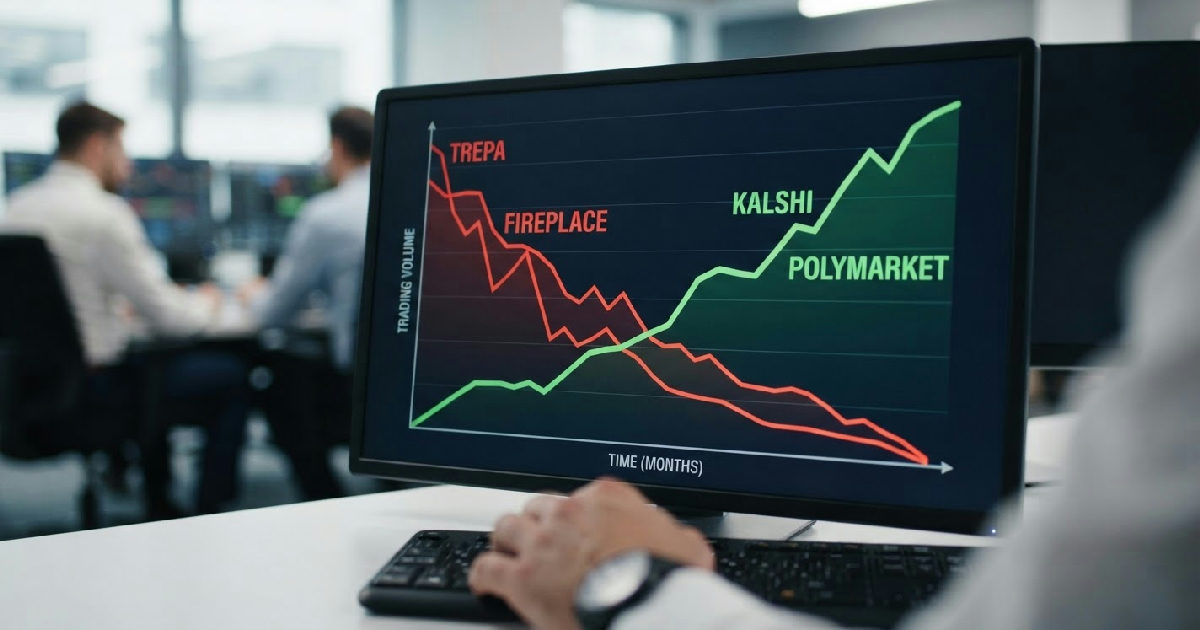

Two distinct crypto prediction markets, Trepa and Fireplace, announced their immediate cessation of operations on Monday, August 10, 2026. The winding down occurred within 90 minutes of each other, leaving users until September 30, 2026, to withdraw their remaining funds.
These closures starkly underscore a rapid consolidation within the burgeoning prediction market sector, where dominant players Kalshi and Polymarket now command an overwhelming share of trading volume.
Consolidation reshapes the prediction market landscape
The dual shutdowns highlight the increasing challenges faced by smaller ventures attempting to compete with heavily funded and well-established platforms. Data from DefiLlama reveals that Kalshi and Polymarket collectively accounted for an astonishing 93.3% of the past 30 days’ trading volume across 40 tracked prediction market venues. This dominance translates to $13.87 billion of a total $14.87 billion, effectively squeezing out most smaller competitors.
The market’s rapid shift towards a duopoly is clear. Kalshi alone captured 75.7% of the total trading volume over the last month, solidifying its position as the clear market leader. The third-largest venue, BNB Chain-based OPINION, managed only a modest 2.8% in comparison. This intense concentration of activity points to a winner-take-most dynamic, where capital and user liquidity funnel towards the largest platforms.
Financial backing plays a critical role in this competitive environment. Kalshi has amassed $2.685 billion in funding and was last valued at a staggering $22 billion. Polymarket, meanwhile, has received $1.6 billion across two tranches from Intercontinental Exchange. In stark contrast, Trepa raised a mere $420,000, and Fireplace secured $1.5 million, illustrating the vast chasm in resources available to these competing entities.
Trepa cites user retention and market size challenges
Trepa, which built its own unique mechanism on Solana, paid users based on the accuracy of their numerical guesses. Its founders, known as Jong and Leon, provided an extensive post-mortem analysis of the company’s struggles. They launched on the Solana mainnet on December 8, 2025, after securing pre-seed funding in August 2025 from investors like Colosseum and Balaji Srinivasan.
A key operational hurdle for Trepa was its reliance on a “concurrency trap,” as described by its founders. The platform operated for only one hour daily, from 1 p.m. to 2 p.m. UTC, facilitating 60-second rounds on Bitcoin’s price. This model required a significant number of users to be active simultaneously, leading to degraded retention over time.
The founders noted that expanding to more assets or longer time windows would have diluted the liquidity pools essential to their pari-mutuel payout system. They also acknowledged significant failures in their distribution strategies. “Referrals did not work and paid KOLs returned almost nothing,” they wrote, underscoring the difficulty of organic growth in the crowded crypto space.
Perhaps most pointedly, Trepa’s founders challenged the commonly reported figures for active crypto users. They concluded that the “genuinely active audience for a product like this is in the hundreds of thousands at the moment, not the millions.” This assessment, if accurate, has profound implications for a crypto industry that often touts widespread adoption, further compounded by geographic restrictions and onramping challenges.
Fireplace withdraws from the market
Fireplace offered a different approach, functioning as a professional trading terminal built atop Polymarket. It routed orders and charged a fee for doing so. Unlike Trepa, Fireplace did not offer a detailed explanation for its closure, simply stating, “It was a hell of a run.”
Fireplace raised $1.5 million. Kalshi’s subsequent release of Kalshi Pro, a desktop terminal offering a professional interface across markets, likely impacted Fireplace. Kalshi, already controlling three-quarters of the market, now offered a direct alternative in the same category.
The front-end aggregation layer for Polymarket was already crowded. This intense competition for front-end services meant Fireplace faced an uphill battle even before Kalshi’s direct entry into its niche.
Navigating a complex regulatory and competitive environment
The dominant prediction market players operate under varying regulatory frameworks, adding another layer of complexity. Kalshi, for instance, is a CFTC-regulated financial exchange operating as a Designated Contract Market (DCM). Despite this regulatory status, it has faced numerous legal challenges.
On July 7, 2026, a court denied Kalshi’s injunction request against New York regulators, followed by an enforcement lawsuit from the New York Attorney General on July 31, 2026, accusing it of operating an unlicensed gambling platform.
Other jurisdictions have also taken action. In May 2026, Wisconsin filed lawsuits against Kalshi and similar platforms over alleged sports betting law violations. On May 26, 2026, Spain’s Ministry of Consumer Affairs banned Kalshi for a period of three to four months, citing a lack of gambling licenses.
New Zealand also prohibited prediction markets like Kalshi in February 2026. These ongoing legal battles highlight the uncertain regulatory landscape, even for a well-funded, regulated entity.
Despite these challenges, Kalshi’s trading volumes have seen substantial growth. Combined monthly global trading volume on Kalshi and Polymarket soared from under $5 billion in September 2025 to roughly $24 billion by April 2026. In July 2026, Kalshi alone posted $37.7 billion in trading volume, a 14% increase from the previous month.
Its market on the Spain-Argentina World Cup final contributed nearly $1.9 billion to this figure.
Outlook for a consolidating crypto market
The sudden shutdown of both Trepa and Fireplace within hours of each other serves as a stark reminder of the cutthroat competition in the crypto prediction market. It reinforces the notion that even with innovative approaches, a lack of significant capital and user acquisition capabilities can be fatal when facing established, well-funded behemoths.
The founders of Trepa, Jong and Leon, maintained their belief in the core concept of prediction markets but conceded, “We were not the team that found the way to build a business around it.”
This market consolidation also brings into question the overall size and activity of the crypto user base, particularly for niche applications. Trepa’s founders’ assertion that the active audience is in the “hundreds of thousands, not millions” challenges a widely held industry narrative. This suggests a potentially difficult environment for retail participants and a limited pool of sustainable traders.
The capital continues to flow into the broader prediction market sector, but with a distinct focus. This suggests that future success may increasingly lie with platforms that can navigate complex regulatory frameworks and attract institutional-grade investment, leaving less room for smaller, less capitalized projects in the crypto-native space.