
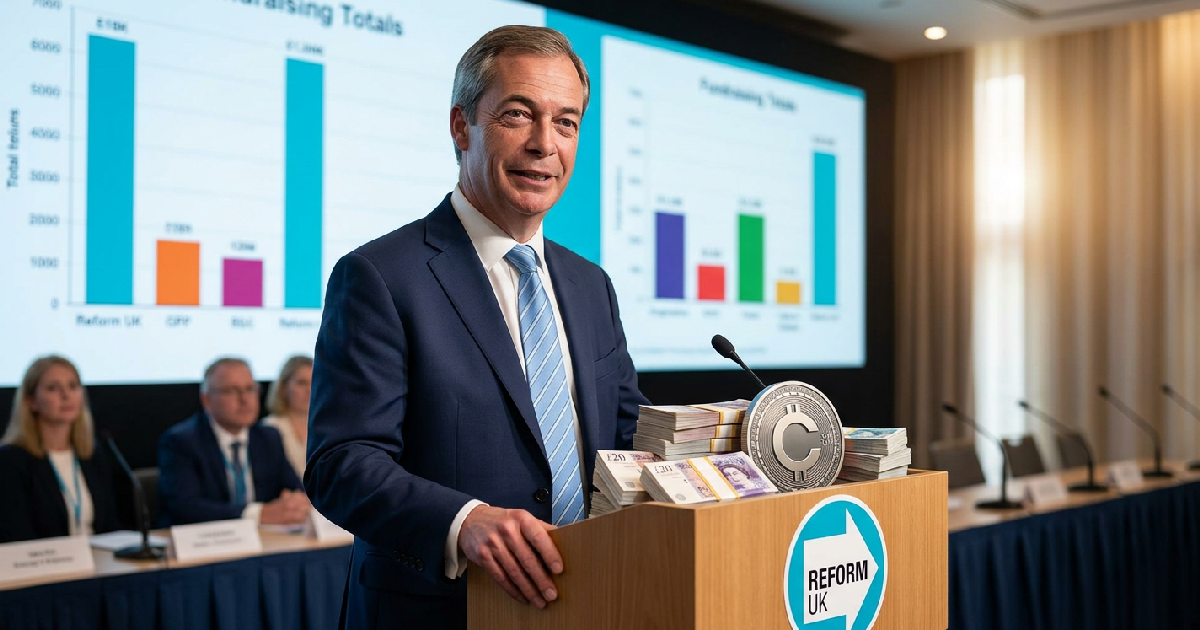

Reform UK, led by Nigel Farage, raised £9 million in private donations during the first quarter of 2026, outstripping the combined totals of the Labour and Conservative parties. According to Electoral Commission data released on Thursday, June 4, the surge was driven largely by two cryptocurrency billionaires who contributed more than £7 million between them.
The party has now topped British political fundraising charts for three consecutive quarters.
The Conservatives reported £6 million in private donations for the period between January and March, while the Labour Party brought in £4 million. These figures come as Reform UK aggressively expands its donor base through the inclusion of digital asset wealth. Total political donations across all registered UK parties reached £24.7 million in the quarter, a 214% jump over the same period in 2025.
The massive influx of capital highlights a growing intersection between unconventional financial sectors and Westminster politics. While established parties rely on traditional business networks, Farage’s party has leaned into the crypto sector, even adopting the third-party platform Radom to accept Bitcoin and other digital assets. This financial momentum is surfacing at a time when market sentiment shifts toward clearer regulatory frameworks for digital finance globally.
Crypto billionaires drive Reform UK fundraising lead
Two men were responsible for the vast majority of Reform UK’s quarterly income. Ben Delo, co-founder of the BitMEX trading platform, donated £4 million across two separate payments in January and March. Delo, who is currently relocating from Hong Kong to the UK, stated in the Daily Telegraph that he intended to help prevent a national decline that he believes is otherwise irreversible.
Christopher Harborne, a British-Thai investor and an early backer of Tether, contributed £3 million in a single January payment. Harborne has become a primary financier for the party, having donated £12 million in 2025 alone. His cumulative contributions to Reform UK over the last 12 months now exceed £15 million, cementing his role as one of the most prolific donors in modern British history.
Other notable contributors included David Grainger, a biotechnology executive and venture capitalist, who gave £1.1 million. Navroz D Udwadia, the co-founder of asset manager Alpha Wave, contributed £250,000 as a first-time donor. Meanwhile, Bassim Haidar, a former donor to the Conservative Party, shifted his support to Reform UK with a £150,000 contribution during the three-month period.
Labour and Conservatives struggle with traditional donor fatigue
The Conservative Party’s total of £6 million represents a significant gap behind Reform UK’s private fundraising. Its largest single gift was a £1.1 million contribution from Mary V Doran, followed by £250,000 from property developer Kamal Pankhania. These traditional funding streams are appearing increasingly strained as Reform UK captures more of the high-net-worth individual market.
The Labour Party’s £4 million haul was anchored by Lord David Sainsbury and Gary Lubner, who each gave £550,000. Another £250,000 came from Danny Luhde-Thompson, co-founder of Quadrature Capital. This cooling in donation volume follows a period where macro warning signs and rising Treasury yields have forced many UK philanthropists and investors to reassess their discretionary political spending.
The disparity in fundraising sources is becoming a point of political conflict. The Labour government recently announced plans for a moratorium on cryptocurrency donations to political parties. At the time of the announcement in March, Reform UK was the only major British party utilizing such systems. The government also proposed capping overseas donor contributions at £100,000 to improve transparency.
Nigel Farage faces investigation over personal gifts
While Reform UK celebrates its financial advantage, Nigel Farage is currently facing a probe by the Parliamentary Commissioner for Standards. The investigation centers on a £5 million personal cash gift Farage received from Christopher Harborne two months before the 2024 general election. Farage has provided varying descriptions of the money, at one point calling it a “reward” for his Brexit campaigning.
Parliamentary rules mandate that members declare relevant donations from up to a year before taking office. Farage initially claimed the funding was for his lifetime personal security. Reform UK maintains that the payment was a personal gift and does not require formal declaration. However, the Parliamentary Commissioner is assessing whether the failure to disclose the sum violated ethics codes.
The outcome of this investigation could have severe consequences for the Reform UK leader. Prime Minister Keir Starmer has publicly questioned why Farage kept the donation secret. If the standards investigation results in a suspension of ten sitting days or more, it could trigger a recall petition in his Clacton seat.
This would force a by-election that could jeopardize Farage’s position in the House of Commons.
Future of UK political finance remains uncertain
The Electoral Commission’s Jackie Killeen noted that while the UK’s system has high levels of transparency, certain areas require strengthening through the Representation of the People Bill. This legislative push is partly a response to the rapid rise of crypto-linked funding. For now, the legal landscape allows parties like Reform UK to bypass traditional donor limits through large private gifts from individuals.
Despite the looming regulatory crackdown, Reform UK’s war chest is already substantial. The party’s ability to attract billionaire investors from the digital asset space suggests a lasting shift in how insurgent political movements are funded. As the government moves to restrict these channels, the current crop of data shows that Reform UK has successfully capitalized on a unique window of financial opportunity.