
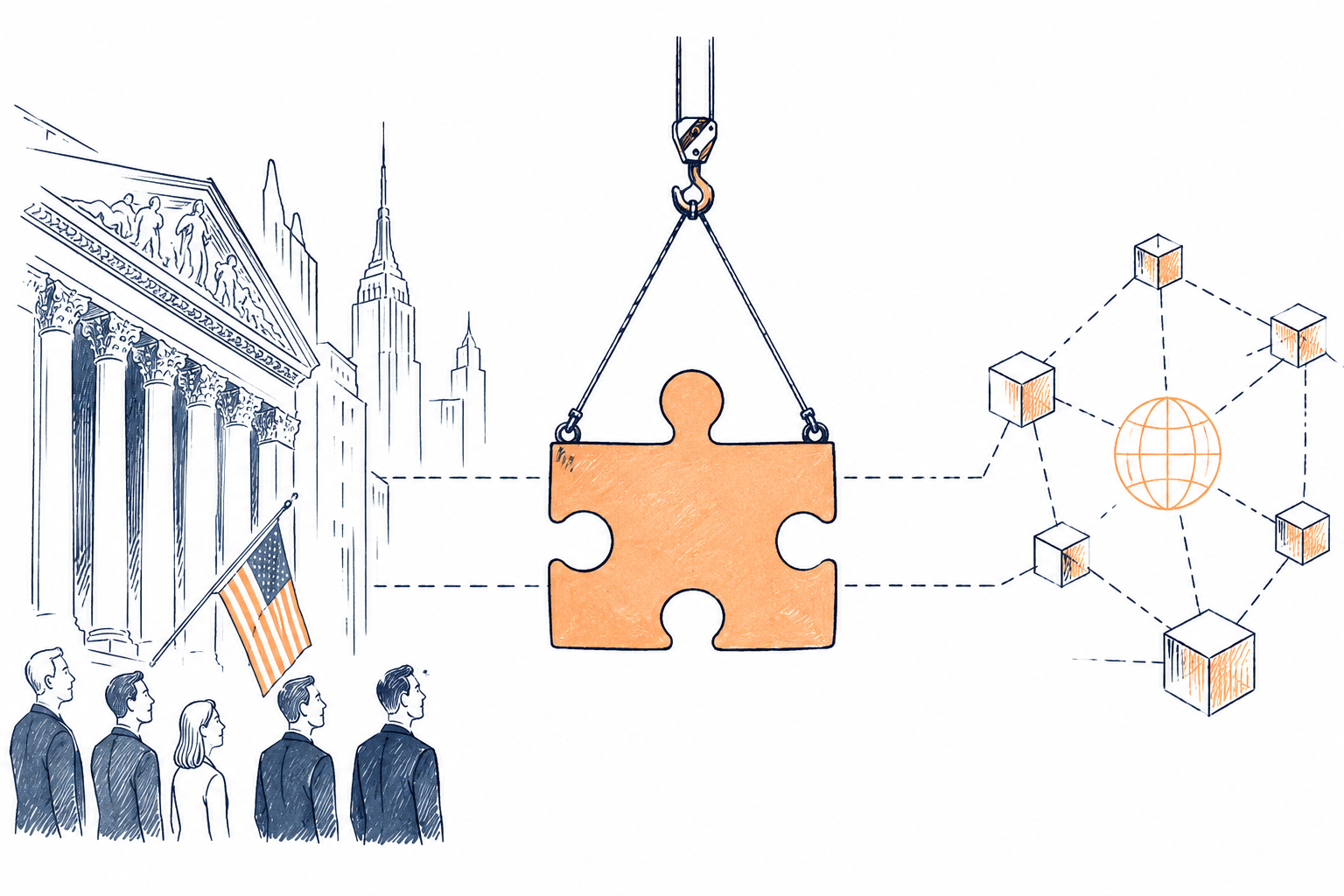

Tokenization was supposed to reshape financial markets. Banks launched pilot projects, asset managers explored blockchain-based funds and financial institutions experimented with digital representations of traditional assets.
Yet despite growing interest, tokenization has remained largely confined to isolated initiatives rather than becoming part of mainstream market infrastructure.
The missing piece was never the ability to create digital assets.
It was the infrastructure needed to clear, settle and record those assets within the financial system.
That is why the recent role of the Depository Trust & Clearing Corporation (DTCC) deserves attention. As the organization responsible for processing and settling securities transactions across U.S. markets, DTCC is increasingly involved in building infrastructure that could support tokenized financial assets alongside existing market systems.
The shift suggests that tokenization is evolving from a technology experiment into an infrastructure project backed by some of Wall Street’s most important institutions.
The Bottleneck Was Never Blockchain
Much of the discussion around tokenization has focused on the assets themselves.
Governments explored tokenized bonds, asset managers experimented with digital funds and financial institutions examined how equities and other securities could move onto blockchain networks.
Creating digital versions of financial assets, however, solved only part of the equation.
Most transactions still relied on traditional post-trade infrastructure for ownership records, clearing and settlement. As long as those systems remained separate from blockchain-based assets, many of the efficiency gains promised by tokenization could not be fully realized.
DTCC’s growing involvement addresses that challenge from the opposite direction. Instead of asking how more assets can be tokenized, the focus shifts toward building the infrastructure required for those assets to operate within institutional financial markets.
Infrastructure Has Become Wall Street’s New Priority
DTCC’s role also helps connect a broader trend unfolding across the financial industry.
Large asset managers such as BlackRock continue expanding tokenized investment products. Banks are developing their own blockchain platforms, while stablecoin issuers are becoming increasingly integrated into global payment systems.
What these initiatives have in common is a growing need for infrastructure capable of supporting digital assets at institutional scale.
That marks an important shift in how Wall Street approaches tokenization. The conversation is gradually moving away from which assets can be tokenized toward how the financial system itself should evolve to support tokenized markets.
The distinction matters. Individual tokenization projects can exist for years without fundamentally changing financial markets. Market infrastructure, by contrast, has the potential to reshape how every participant operates.
If that transition continues, tokenization’s next phase may be defined less by the creation of new blockchain-based assets and more by the modernization of the systems that allow those assets to function across global capital markets.